The Graz homosexual scandal of 1926 has largely faded from memory today. However, it can be traced fairly well through about 20 newspaper articles available online. My thanks go to the Austrian National Library for digitizing its newspaper holdings and to Graz-based homosexual activist Hans-Peter Weingand for important tips about publications by him and other historians on this scandal.
The Background Beginning in March 1926
The first newspaper apparently to report on the homosexual scandal was the Neue Wiener Journal (March 18, 1926). It stated that initially around 70 people were said to be involved, with four already arrested. It mentioned “secret gatherings to which unemployed or otherwise impoverished young men were invited,” which here should be read as a discreet hint at male prostitution. A few days later, more information followed: the investigations began when on March 8 the unemployed Rudolf M. was arrested on suspicion of having committed “immorality with men” (i.e., acts contrary to nature). During interrogation he heavily implicated three “boys.” In many articles it is noted that the accused had two lists with the names of men who were (likely) homosexual (“Neues Grazer Tagblatt,” March 22, 1926). Two former non-commissioned officers (often named as Captain) Alexander Winternitz and Alfred Mitkrois reportedly confessed and, based on these two ominous lists, named 100, sometimes “prominent persons,” who were said to be homosexual (“Neue Freie Presse,” March 26, 1926).
The Petition or Protest in April 1926
The meaning of the two lists of allegedly homosexual men for the later trial and conviction remains largely unclear in the newspaper reports. What is known today is that the two ex-soldiers Alexander Winternitz and Alfred Mitkrois, who shared a love affair, also used these two lists to mount a petition demanding immunity for homosexual acts. This was done out of emancipatory reasons and out of their own interest as defendants in a criminal case.
According to Hannes Sulzenbacher (“’One gets the impression that Ulrich wasn’t quite normal.’ Eight Petitions against the Austrian Unzucht-law,” in Capri, No. 17, September 1994, PDF pp. 753 ff, here pp. 755-756), Winternitz and Mitkrois, in their “interrogation,” named about a hundred respectable Graz citizens as persons who would need to be punished alongside them. Their obvious wish to pressure the police and thereby perhaps gain impunity did not come to pass. On the contrary: the Graz police widened the proceedings. The two men then filed a petition for the legalization of homosexuality and pointed out several arguments “that speak for repealing § 129 I b and also for pardoning all those convicted thereafter and for stopping all ongoing proceedings.” A copy of this petition was sent to the Austrian Chancellor, to the Graz Regional Court, and to the Wissenschaftlich-humanitäre Komitee (WhK—the first advocacy organization for homosexuals based in Berlin). The petition was—as Sulzenbacher notes—written in a “notably aggressive tone.” The text claims that the paragraph serves “the lust and satisfaction of lecherous sexual drives” of the police, the public prosecutor’s office, and the judiciary, who are empowered by the law to “snoop on sexual secrets.” The tone of the petition thus threatens to undermine its serious aim, but it must be seen in light of the desperate situation and the existential threat faced by the two men.
Also, Hans-Peter Weingand (“’Facing an unfriendly majority.’ The homosexual movement in Styria,” in Leben und Begehren zwischen Geschlecht und Identität, 2010, pp. 66-83, here pp. 69, 72-73) discusses this petition, of which a copy dated April 9, 1926 is today in the Austrian State Archives. Weingand shows how German homosexual activists expressed solidarity but also distanced themselves from the approach of the Graz “fellow travelers.”
When Weingand later writes in Queere Geschichte(n) (2021, p. 12) that Mitkrois belonged among the first homosexuals in Austria to confidently address the federal government and to demand the repeal of the criminal-law paragraph, his respect for the petition becomes evident. The petition remained unsuccessful. Winternitz and Mitkrois were later convicted not only of sexual acts but also of defamation.
The Verdicts in August 1926
The trial before the Graz Magistrate Court was secret, but the verdict after nine days of proceedings on August 21, 1926, was public. After an indictment against 43 men, 25 of them were convicted. Several newspapers named some of the convicted by name. Among those convicted were the 23-year-old unskilled worker Alfred Gerstl, the 19-year-old driver Mayer-Brucker, the 18-year-old barber Viktor Tiber, the 20-year-old Johann Andreas Dialer, the retired Captain Alexander Winternitz, and the retired Captain Alfred Mitkrois, each receiving several months of arrest or imprisonment (as reported, among others, by Neue Freie Presse, August 21, 1926). The reference to the ages of the first-mentioned convicts likely served to indicate that they were regarded as “the seduced,” while Winternitz and Mitkrois were regarded as “seducers.” Regarding the “barber’s assistant” Viktor Tiber, a barber’s newspaper later noted that the crimes were committed in a so-called “gentlemen’s salon” (“Neue Wiener Friseur-Zeitung,” September 1, 1926).
Newspaper Coverage of the Scandal and the Verdict
Most of the roughly 20 newspaper articles are factual and informative; only a few commented on the scandal. A clear (and rare) statement in favor of homosexuals appeared in the nationalist-liberal Salzburger Volksblatt (March 24, 1926): “Also in Austria one should decide to adopt a different view and assessment of that ‘crime’ whose roots lie in an unfortunate natural inclination and not in criminal tendencies.”
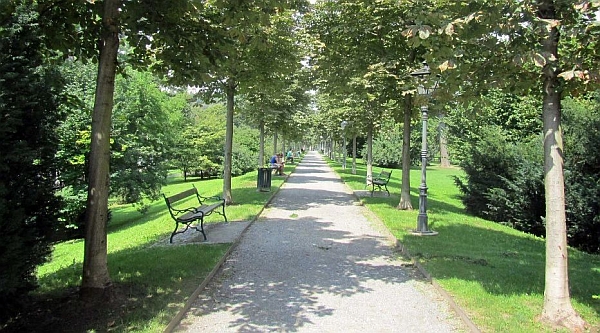
The social-democratic Arbeiterwille provides initially telling hints about Graz’s homosexual meeting places, indicating a scene: the homosexuals “held their gatherings in a café or along the Dammallee. They used the Schlossberg as a salon.” Afterwards the newspaper evaluated the case as follows: “The trial yielded the usual picture of pederastic networks—disgusting, but pitiable and sad. (…) Unnatural is not only the pederast, but also the law that brands these unfortunate people as criminals.” It is only reprehensible when they “abuse” youths, not when they live out their miserable sexual life among similarly aged adults. The newspaper deliberately did not name the convicted, because it regarded these people as unfortunate rather than criminals and did not want to “condemn them for their illness” (“Arbeiterwille,” August 22, 1926). In politically left circles it was typical for that era to see homosexuals not as criminals but as sick people.
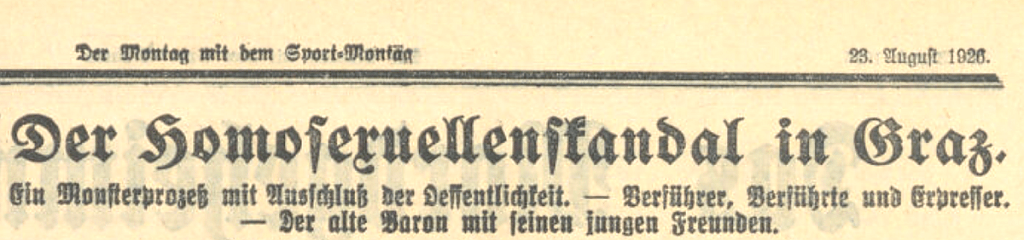
Under the headline “The Graz Homosexual Scandal. A Monster Trial with Exclusion of the Public,” the bourgeois-conservative newspaper “Der Montag” reported the case: “For in Graz homosexuality, which is widespread in all large cities and especially in Germany, has produced the most unpleasant accompanying phenomena.” In big cities such cases could be handled discreetly, but in Graz everyone knows everyone, so homosexuals here could be more exposed to extortion. It concerns many “city-known personalities,” and there are homosexuals in Graz both by inclination and those by coercion. The paper pointed to prostitution and later extortion from both sides. Thus “seducers and the seduced” are “bound to each other.” Young lads are made victims and are approached by “older gentlemen” in establishments or on the street. Included is the Vienna- and Graz-known “Baron S.” with his “friendships” with young men. The newspaper considered it right to combat the “excesses,” even if “one can reasonably take the position that homosexuality is a private matter” (“Der Montag,” August 23, 1926).
The Reactions of the German Gay Movement
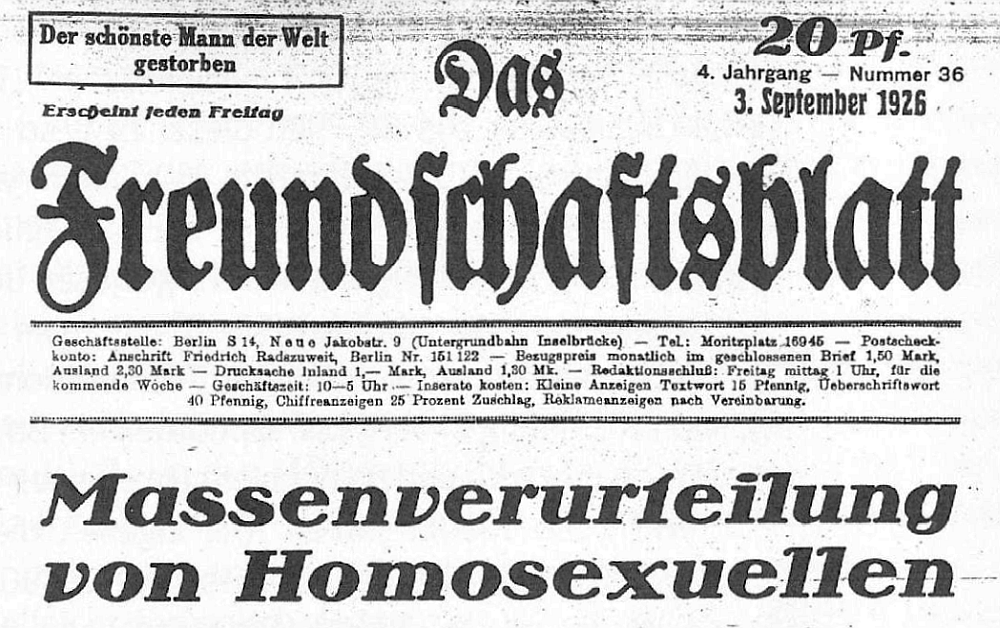
In Germany’s gay movement of 1926, the scandal does not seem to have made major waves. The only publication that took a strong interest was Das Freundschaftsblatt (September 3, 1926, pp. 1-2), which was highly engaged and drew parallels to Germany based on similar criminal provisions: “This mass trial is a blot on the German-Austrian Republic. What have the defendants done? The Graz public prosecutor’s office has orchestrated a witch-hunt against people who followed their innate natural drive. They committed acts that harmed no one and violated no third party rights. When will the designated men of the two free republics realize that it is not power but law that should prevail?”
The Wissenschaftlich-humanitäre Komitee and Its Protagonist Magnus Hirschfeld
The Wissenschaftlich-humanitäre Komitee (Scientific-Humanitarian Committee) and its leading figure Magnus Hirschfeld apparently never commented on this scandal. The reasons for this remain a matter of speculation. The aggressively worded petition by the main accused, Winternitz and Mitkrois (see above), was probably seen not only as harmful to the movement but also as harmful to the WhK’s petition. Perhaps they believed that a scandal connected with prostitution could not easily be woven into an emancipatory defense strategy.
The Further Fate of Some Convicts
Viktor Tiber, the barber’s assistant, appeared in court again ten years later, accused of abducting 15-year-old Adolf Hudetz. He was acquitted of the kidnapping but was re-sentenced for “immorality with Hudetz” to 15 months in a severe jail term (“Salzburger Volksblatt,” December 15, 1936).
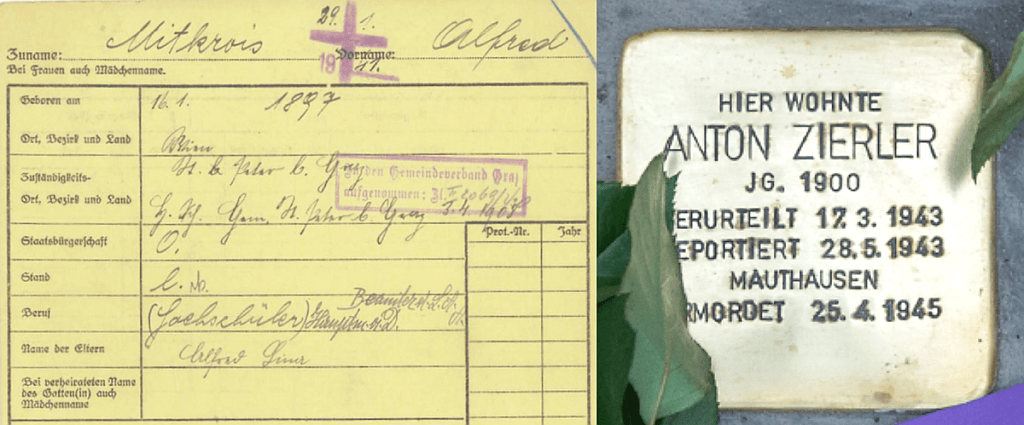
According to Hans-Peter Weingand (“Queere Geschichte(n),” 2021, p. 12), Alfred Mitkrois (born January 16, 1897) died after Austria’s Anschluss to the National Socialist German Reich at Dachau. His prisoner card is reproduced. In the same publication (p. 15), Weingand notes Anton Zierler (born November 17, 1900), who died in Mauthausen in 1945. “In 1926 Zierler came before court for ‘immorality with nature’ and was sentenced under § 129 Ib to three months’ severe imprisonment.” His prisoner card is also reproduced. A link between Zierler’s 1926 conviction and the large simultaneous homosexual trial is not verifiable, but is quite plausible. In Graz today a Stolperstein memorializes Anton Zierler.
Conclusion
The newspaper reports are, in multiple respects, typical of attitudes toward homosexuality in that era. They split people into “seducers” and “the seduced,” they passed moral judgment, and they also expressed sympathy for homosexuals—while there remained an ever-present fear of exploitation and the “seduction” of minors by older men.
From today’s perspective, many questions remain open. What happened to most of the many convicted individuals later is known only for a few, and one can only hope that they did not, like Alfred Mitkrois and Anton Zierler, end up in a concentration camp. The question of what the situation for Graz’s homosexual community was like before, and how sharply this scandal affected them, cannot be answered.
The queer community needs a strong journalistic voice — especially now! Do your part to support TheColu.mn’s work.
In Winternitz’s and Mitkrois’s lists, many prominent homosexuals from Graz are said to have appeared, though the newspapers did not name them. The enigmatic “Baron S.” may refer to “Erich Salm-Reifferscheidt” (1868-1945), who in 1926 in Graz was accused of being a “päderast” (“Der Tag,” October 9, 1926). But for what purpose the two lists of so-called homosexuals were created remains unclear. A newspaper report claimed the people on these lists were “reconnoitered” by Winternitz and/or Mitkrois, hinting at the preparation of blackmail (“Illustriertes Wiener Extrablatt,” March 23, 1926). Another paper wrote that the lists contained “field marshals, artists, and statesmen” (“Arbeiterwille,” March 26, 1926).
Overall, it seems more plausible that these lists served political arguments for demands of immunity from criminal penalties and simultaneously provided homosexuals with positive points of identification. It is also possible that Winternitz and Mitkrois hoped for support from these individuals, whether as signatories or as financial backers of a planned campaign. In that sense, despite a not-exactly-well-phrased petition, Winternitz and Mitkrois were early homosexual activists who courageously fought against injustice not only for themselves but for others as well.