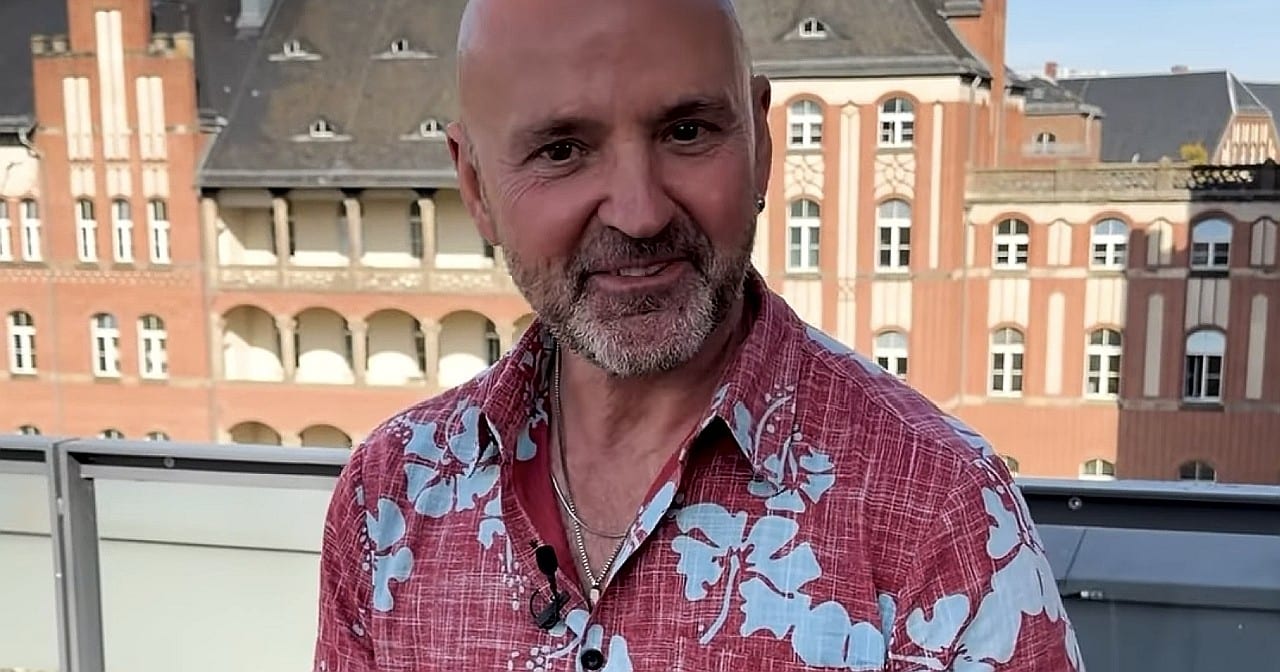
He is one of 13 people worldwide who have been cured of HIV, and the second in Berlin. He’s doing “very well,” says Thomas Kahlert, 62, who has gone down in medical history as the “Second Berlin Patient.”
In 2009, HIV was discovered in Kahlert during a routine checkup, and in 2015 he faced acute myeloid leukemia, a form of blood cancer. “That was a terrible moment.” It quickly became clear that he would need a transplant. After the first blood test following the transplant, no viruses were detectable. When Kahlert tells this story, he becomes visibly moved, pausing several times, fighting back tears. That is how it often goes for him when he recounts the tale, he says.
Because of the leukemia, chemotherapy and a stem-cell transplant were necessary. On October 14, 2015 — exactly eleven years ago — he received stem cells from a healthy donor, including the donor’s immune system. Since then, neither HIV viruses nor cancer cells have been detectable — he is considered cured.
Family and friends kept it quiet for a long time
The case was made public in 2024 (TheColu.mn reported). The patient’s name remained confidential then — in part because he had worked at Charité for 38 years. For a long time, no one in his family or circle of friends knew about the diagnosis, Kahlert says; he himself had pushed it from his mind. Yet unlike many others affected, he could live without antiretroviral therapy; he did not have to take daily medications that reminded him of the diagnosis. For a long time, it wasn’t clear why. Research later showed that he himself is heterozygous, just like his donor.
The HIV virus targets immune cells at specific docking sites called CCR5 receptors. About one percent of people of European descent have a mutation in these receptors, the so-called Delta-32 mutation. This mutation prevents the virus from entering cells, and those who carry it are naturally resistant to HIV.
With the first “Berlin Patient,” researchers succeeded in finding a stem-cell donor whose tissue matched the recipient and who carried the immune-protective mutation. In Kahlert’s case, the approach was somewhat different: a fully HIV-immune donor was not found. The donor in Kahlert’s transplant carried, on their cells, both the normal version of the CCR5 receptor and the mutated Delta-32 version. This occurs when a person inherits the Delta-32 mutation from only one parent.
After the stem-cell transplant, Kahlert also received antiretroviral therapy to suppress the virus. This treatment prevents further viral production but does not affect already existing virus reservoirs formed after infection.
View this post on Instagram
Instagram
|
Discontinued antiretroviral therapy on doctor’s orders
Kahlert stopped antiretroviral therapy three years after the transplant, acting on his own decision and against the advice of his physician at the time — since then there have been no signs of renewed viral replication. The researchers were surprised at the time; he is convinced: “I just felt it.” He also wanted to know whether all the effort had paid off. He remains in regular contact with the donor. His greatest wish is that the insights from his cure make their way into research and become accessible in countries where not everyone has access to modern medicine.
On the eleventh anniversary of his transplant, Charité is inaugurating a new HIV cure research center, BeCURE, which will also house the Brown-Kahlert Study Center. There, strategies to cure or permanently control HIV and other viral diseases will be developed, Charité announced. Basic research, clinical research, qualitative and social-behavioral studies, community involvement, and data analysis will be integrated at the BeCURE center, said BeCURE director Christian Gaebler, who also played a leading role in Kahlert’s cure. Many findings from HIV research are transferable to other chronic viral diseases, such as Hepatitis B.
Charité’s history with HIV runs deep: in 2008, the first person worldwide to be cured of HIV—the first “Berlin Patient”—was treated there. The stem-cell transplant procedure can work when there is also a cancer diagnosis, Gaebler noted. It is not scalable to a large population because these therapies carry extremely high risks and would not be justifiable for someone living with HIV who can be treated, he said. The 13 people worldwide who have been cured of HIV all underwent stem-cell transplantation.
The aim is to find routes without stem-cell transplantation
“The goal must be to discover paths that can be scaled without this stem-cell transplantation,” Gaebler said. Specifically, the focus is on researching and developing antibody- and immunotherapies, as well as novel gene- and cell-based therapies. There are now global study results that offer hope of pursuing this route, and the center aims to pursue it further. The center seeks to ensure research aligns with real-world needs and asks: What actually helps patients?
Worldwide, roughly 41 million people live with HIV. In Germany, one in five people with HIV live in Berlin. According to the Robert Koch Institute, there are nearly 18,000 people in Berlin living with HIV, about 1,000 of whom are undiagnosed. Modern therapies can treat the infection, but they must be taken for life; without treatment, viral rebound typically occurs within weeks.