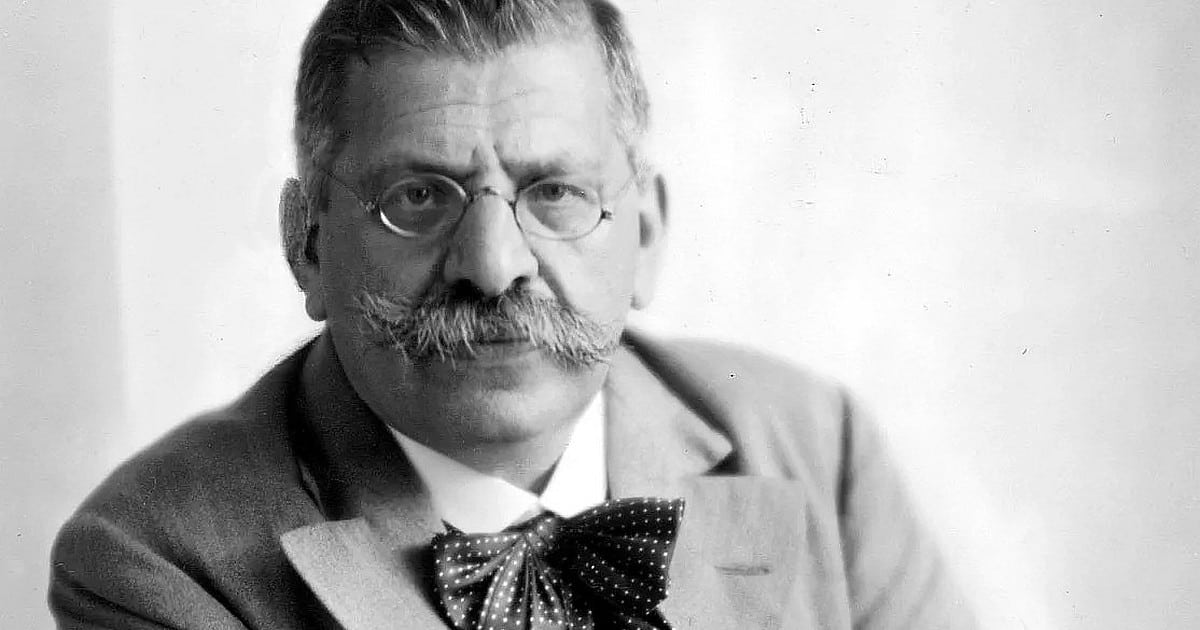
Magnus Hirschfeld, along with other activists, founded in 1897 the Wissenschaftlich-humanitäre Komitee (WhK), the world’s first organized gay rights advocacy group. Through the WhK, he filed several petitions with the Reichstag aimed at abolishing § 175 of the German Strafgesetzbuch (StGB) — though these efforts ultimately did not prevail — and he also published scientific and emancipatory writings on gender diversity with a special focus on homosexuality.
Only Magnus Hirschfeld Reached into the Heterosexual Majority
Beyond Hirschfeld, Adolf Brand and Friedrich Radszuweit were two other significant gay rights activists up to 1933. Brand and Radszuweit, from the perspective of the LGBTQ movement, wielded influence, yet they did not command a broad base in the heterosexual mainstream. Hirschfeld did, in part because, as a physician, he was a popular sexologist and reformer. As head of the WhK, he knew how to mobilize the liberal-bourgeois society around his sexual-political aims. The masculinist Brand, who led the small, elitist, art-leaning “Community of the Elect,” was not located within the majority; similarly, the commercially oriented populist Radszuweit, heading the sizeable Federation for Human Rights, failed to win broad traction. Hirschfeld and the WhK could present themselves to the public as the established, “serious” representative for sexual minorities — especially gay men — because they drew on modern scientific findings.
Magnus Hirschfeld and the “Vorwärts”
When evaluating articles about Magnus Hirschfeld, the WhK, and the Institute for Sexual Science in the “Vorwärts,” it’s important to consider that the roughly 480 accessible pieces likely reflect the fact that the Social Democrat Hirschfeld was viewed as a “comrade,” which shaped both the quantity and the content of their coverage. Thus, Hirschfeld was initially a comrade to the “Vorwärts,” then a prominent and always-present sexologist, and finally a gay rights activist. To assess the newspaper’s stance, one must look at the topics chosen for coverage, not merely the way stories were reported. Editorial comments are helpful for interpretation but are relatively rare. Unless otherwise noted, more than 80 links in this article point to the “Vorwärts.” I am grateful to Rainer Herrn of the Magnus Hirschfeld Society for his feedback on my text.
Hirschfeld and the Gay Movement
The WhK and the Yearbook for Sexual Intermediates
Readers of the “Vorwärts” likely learned for the first time in December 1902 that the WhK was a gay rights advocacy group. The paper had earlier triggered a broad gay scandal with its November 15, 1902 piece “Krupp on Capri” concerning Friedrich Alfred Krupp (see Wiki). About two weeks later, the “Vorwärts” published a WhK statement clarifying that admitting to being homosexual did not constitute an insult or an offense to honor, and that homosexuals could be as honorable as anyone else. Hirschfeld would view the republication of this clarification in many newspapers as a success (December 2, 1902). A few weeks later, he could repay the editors of the “Vorwärts” by countering an accusation that they had published the article of November 15 for “low motives” ( maligning a capitalist). Hirschfeld credited the editorial staff with acting “under noble motives” (namely the desire to abolish § 175) — or perhaps a mixture of both motives (January 13, 1903).
Under Hirschfeld’s leadership, the WhK began publishing the “Yearbook for Sexual Intermediates with Particular Reference to Homosexuality” in 1899 — the world’s first scholarly journal dedicated to sexology. The “Vorwärts” mentioned the Yearbook roughly ten times between May 3, 1900, and October 24, 1906. It was not reviewed in the sense of a scholarly critique, but it at least became known to a broad audience. The span of these mentions roughly coincides with the peak period of the Yearbook, whose scope would contract in later years. The linked article from May 3, 1900 marks the beginning of “Vorwärts” coverage of Magnus Hirschfeld and the Committee.
The Petition
Among the “Vorwärts” articles that addressed § 175 not only in general terms but specifically in relation to the WhK’s petition to the legislative bodies of the German Empire, two deserve special mention. First, at a public debate concerning a man charged with homosexual acts, Hirschfeld gave a speech to 600 people, and at its conclusion the assembly resolved to “join the petition to the Reichstag.” The published resolution in the “Vorwärts” gives the impression that the editors aligned themselves with the petition’s content (January 18, 1905). This demonstrates Hirschfeld’s ability to persuade a large audience. Wilhelm Kauffmann praised Hirschfeld’s work in his article “Morality and Homosexuality” (May 7, 1929), noting the support of several prominent figures for the petition. The editors’ circumscribed distance from particular points of Kauffmann’s argument stands out. (That same year, Kauffmann himself was dismissed from public service for a homosexual relationship and later joined Hirschfeld’s Institute for Sexual Science as secretary of the 1928 World League for Sexual Reform founded by Hirschfeld.)
From 1899, under Hirschfeld’s leadership, the WhK published the Yearbook for Sexual Intermediates with a special focus on homosexuality, the world’s first scholarly sexology journal. In the “Vorwärts,” the Yearbook is referenced multiple times, underscoring its significance in public discourse. The Yearbook’s prominence waned somewhat in the following years, but its historical role as a pioneering research publication remains central to Hirschfeld’s legacy.
Hirschfeld’s Lectures on Sexuality
May 7, 1904, marked a notable judicial moment in Hirschfeld’s career when he was convicted for insulting remarks made during a statistical survey into sexual orientation among metal workers and students at the Technical University of Berlin. Some respondents felt the questions about whether their sexual attraction was directed toward men, women, or both were defaming. The court ruled in favor of the students. The “Vorwärts” defended Hirschfeld in two articles, reaffirming his approach and pointing to the WhK, the petition, its signatories, and numerous Hirschfeld publications like the Yearbook for Sexual Intermediates and the study “The Results of the Statistical Investigations into the Percentage of Homosexuals” (May 7, 1904; also April 28, 1904). The editors’ wry judgment of the ruling was: “By this reasoning, one might understand the inquisitorial process Galileo faced centuries ago” (May 8, 1904).
Hirschfeld’s Lectures on Homosexuality
In a time when mass media such as television or the internet did not exist, and print was not affordable for everyone, public lectures were central to shaping public opinion. Hirschfeld developed a vivid, accessible lecture style that enabled him to connect with large audiences. He is credited with delivering more than 1,000 lectures in his lifetime across several countries on a wide range of topics. The “Vorwärts” contains references and reports from 1902–1930 about roughly 120 of his lectures — a fraction of his total output. His primary interests included all aspects of sexuality, as well as themes linked to the Lebensreform movement — the free body culture (FKK), education, dance, attire, and alcohol — and, not least, politics. His first well-attested talk to a medical audience was scheduled for November 26, 1902 at what is now Berlin’s Humboldt University, but it was banned by the rector who complained about a talk “with special reference to the third gender (contrary sexual feeling).” The “Vorwärts” stood clearly with Hirschfeld in this conflict (November 26, 1902). The actual content of his talks, such as “The Third Sex” (January 14, 1903; February 8, 1903; July 4, 1903), is accessible through his publications.
During World War I, Hirschfeld’s emancipatory efforts slowed; he delivered only two talks on “War Psychology” (October 26, 1915) and “The Nature of Human Personality” (June 7, 1917). Although a member of the Social Democratic Party, Hirschfeld generally kept his talks non-political. That changed in 1919 as Germany shaped its Weimar Republic, the only year in which he spoke publicly on party politics — including his “Introduction to Socialism” (April 4, 1919).
After a talk in Munich, Hirschfeld was assaulted in the street (October 5, 1920), and the “Vorwärts” carried the later-corrected report of his death (October 11, 1920). Many other talks could not be carried out as planned. A talk in Hamburg on sexual questions was interrupted by stink bombs (February 24, 1920). In Cologne, Hirschfeld was refused the Gürzenich Hall and the Hall of the Cologne Reading Society for a talk titled “The Right to Love” (October 27, 1927). The “Vorwärts” took a strong stance on the event (“Cologne’s Muckertum”) on October 21 and again on October 31, 1927. This incident has since become part of Cologne LGBTQ history tours by the Centrum Schwule Geschichte.
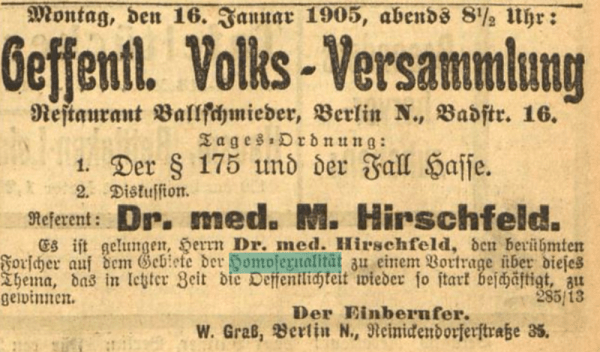
Hirschfeld frequently drew on current court cases or scandals connected to sexual questions in his talks — but not always. The August Hasse case (January 18, 1905) and his talk on “The Sexual Distress of the Youth,” which covered the Steglitz school tragedy (November 11, 1924; March 26, 1928) are examples. Apparently Hirschfeld’s voice was powerful: when the sensationalist orator Theodoor Hendrik van de Velde struggled to fill a room with his talk, Hirschfeld would step in and read van de Velde’s manuscript aloud (February 23, 1928).
Hirschfeld as Expert Witness
Long before World War I, Hirschfeld had already built a name as a sharp-witted sexologist and was frequently asked to prepare expert reports in cases involving sexual delinquency. The “Vorwärts” documents around 40 such cases from 1906–1930, and probably far more. Rainer Herrn notes in his book “Love and Sorrow” (2022, pp. 161) that the Institute for Sexual Science, founded in 1919, became a highly sought-after and capable institution for assessing sexual delinquents; in its first year, Hirschfeld and staff handled nearly 100 expert cases. In most cases, the matters involved were not about homosexuality.
The following sections discuss eleven criminal-law cases in queer contexts — including murders, slander, violations of § 175 RStGB, men in women’s clothing, so-called transvestites, and “indecent” literature. The influence of expert witnesses like Hirschfeld on court decisions was significant, not only in the Harden-Eulenburg affair and the Eichbaum case, but also in a brief note on the verdict for a kleptocrat: Hirschfeld stood by the man in court, and he was acquitted (December 28, 1929). I examine both: (a) how the “Vorwärts” reported on these scandals and (b) the nature of Hirschfeld’s own medical-legal opinions. In many cases the key issue was § 51 of the StGB, which concerned whether the offender could be considered “unaccountable” and thus not responsible for the act, potentially excusing criminal liability.
The cases connected to these expert assessments — particularly the Haarmann affair — had a profound impact on public attitudes toward homosexuals. I currently suppose that the following expert cases — Haase (1912), Hiese (1924), and Staverock (1924) — may not have been well known in queer historical research.
Expert Witness in the Kuno von Moltke Case (1907)
As the “Vorwärts” reported in its coverage of the Harden-Eulenburg affair, one defamation suit against journalist Maximilian Harden was brought by Kuno von Moltke. Hirschfeld served as an expert witness. In the trial of October 23–29, 1907, Hirschfeld testified that Moltke possessed “an inclination which one might describe as homosexual” that even Moltke himself did not fully recognize (October 26, 1907). This testimony strengthened Harden’s case and Harden appeared to be acquitted, likely thanks to Hirschfeld’s expert opinion based on Lili von Elbe, Moltke’s divorced wife, who had reported deficiencies in their marital intercourse. Moltke appealed the verdict. In the appeal (December 18–25, 1907), Lili von Elbe recanted her testimony, and Hirschfeld had to withdraw his opinion. The “Vorwärts” published both Hirschfeld’s altered testimony (December 31, 1907, p. 6) and Hirschfeld’s attempt to justify that he had arrived at different conclusions given a changed factual basis (December 31, 1907, p. 7). The newspaper did not shy from noting Hirschfeld’s initial position and subsequent reversal, while the public prosecutor pointed to Hirschfeld’s change of mind. In the second trial Harden was convicted, likely also because of the revised testimony. According to Rainer Herrn (Love and Sorrow, 2022, pp. 166–167), this was a defining defeat for Hirschfeld and damaged his reputation as an expert witness.
Expert Witness in Eichbaum, Haase, and Ritter Cases (1910–1913)
A 19-year-old Berlin clerk, Julius Eichbaum of Lichterfelde, was first noticed when he was found in women’s clothes and arrested as a “false lady.” Hirschfeld attested his “unaccountability” under § 51 StGB and even escorted him home, and there was apparently no subsequent trial (October 4, 1910). Six months later this “false lady” (listed here under the middle name “Franz Eichbaum”) faced charges of fraud. Hirschfeld testified that for the fraud § 51 should not apply, even if Eichbaum was “hereditarily heavily burdened,” and Eichbaum was sentenced to one month in prison (April 1, 1911). See the noted article “The False Lady in Court” in the Medical History Journal (2014, pp. 199–236) by Rainer Herrn for more on this case.
A year later, the 22-year-old male-labeled mail clerk Max Haase was charged with embezzlement. The “Vorwärts” notes that he moved in “circles of homosexuals” (May 24, 1912). Hirschfeld’s report asserted that Haase was sexually dependent on another man but nonetheless § 51 did not apply, and Haase received a two-year sentence (September 3, 1912).
In the Ritter case, it was alleged that he had sexually abused a 13-year-old pupil, Otto Klähn, murdered him, and dismembered the body; contemporary public perception categorized Ritter’s sexual acts as homosexual. Four “Vorwärts” articles cover this sensational murder case, with “The Blood Act of the Homosexual” (September 14, 1913) noted for its sensational headline and description of the crime. Hirschfeld’s testimony stated that Ritter’s homosexuality did not bear on his culpability and that, although not a case of sadism or lust murder, Ritter remained a “public dangers-mental patient.” He further argued that the application of § 51 StGB could not be assured beyond the Reichsgericht’s safety standard. At the end of the second trial day Ritter received a five-year sentence (September 24, 1913).
Expert Witness in Klein and Nebbe (1923)
The Klein/Nebbe case concerned Ella Klein, accused of poisoning her husband Willi Klein in 1922. Her partner Margarete Nebbe was charged with being an accomplice. The Berlin trial received extensive media coverage. On March 16, 1923, the principal offender Ella Klein was sentenced to four years in prison, Nebbe to one and a half years in penal servitude. The “Vorwärts” covered this crime at least ten times, thoughtfully addressing the lesbian relationship between the two women. In the article “The Expert Opinions on the Poisoners” (March 16, 1923), four different psychiatric or psychosexual expert opinions, including Hirschfeld’s, were cited. The consensus among experts was that both women suffered a mental defect and had a homosexual disposition, with Nebbe described as the more active male component. The divergence among the opinions concerned the assessment of “responsibility” under § 51 StGB, with some deeming it “greatly diminished.” Hirschfeld’s analysis focused on the sexual aspect, arguing that the homosexual nature contributed to their revulsion toward their husbands. The historical case inspired Alfred Döblin’s novella “The Two Girlfriends and Their Poisonous Murder” (1924), later adapted into a film in 1978. The media portrayal of this case shows parallels to the “Lesbian Murder Trial” of 1974 involving Marion Ihns and Judy Andersen, in terms of how reportage reflected sensationalist framing.
Expert Witness in Hiese and Staverock (1924)
Dora Hiese, a dentist and nurse, was accused of embezzlement and theft in 1924, with funds allegedly used for “female friendships.” She received a three-month prison sentence. The article carried the headline “Half Man, Half Woman,” highlighting the claim of intersexuality in Hiese’s expert assessment, which noted that Hirschfeld’s report had allowed her to wear men’s clothing and thus obtain a police-issued “Transvestite Permit” (January 4, 1924).
Mathilde Staverock, together with Theodor Just, faced trial for the murder of Berta Raekling (Räkling) and the dismemberment of her body. Staverock was described by the court as lesbian and sadistic, while Just was described as heterosexual and masochistic. Raekling had been married but had never found satisfaction with men. The following article discusses Hirschfeld’s assessment: he noted the bisexuality of the defendants, emphasized how frequently lesbian women destroy marriage, and argued for a reduced culpability due to diminished responsibility. It remains unclear how his blunt assessment affected the sentence. Staverock received seven years in penal servitude for incitement to murder.
No Expert Witness for Haarmann (1924)
As the “Vorwärts” reported regarding the gay serial killer Fritz Haarmann, Hirschfeld appears to have been deemed suitable by the court but declined the role (or was declined) and instead participated as an observer. In his book “Love and Sorrow” (2022, pp. 249–254), Rainer Herrn details how Hirschfeld used his public writings to influence public perception, aiming less at advancing a forensic position than at limiting the damage by linking homosexual persecution with criminal stigma in media coverage.
Expert Witness in Vogel (1926)
In several cases Hirschfeld prepared opinions about whether a publication constituted “indecent writing” under § 184 StGB. For the homosexual author Bruno Vogel’s anti-war treatise “Es lebe der Krieg” (1926/1927), the “Vorwärts” referenced Hirschfeld’s, Helene Stöcker’s, and Thomas Mann’s exculpatory opinions (June 1, 1926, and January 14, 1927). Two years later Vogel was acquitted of charges related to this war-critique; the work, however, appeared only in a censored form (May 28, 1929). The censorship arc and the implicated passages are discussed in my TheColu.mn article on censorship.
Expert Witness in Hagedorn (1927)
The 18-year-old Käthe Hagedorn faced charges of sexual abuse and murder of her six-year-old sister Käthe and nine-year-old Friedel, her brother. Hirschfeld’s report argued that hormonal factors induced a “sexual frenzy,” explaining that she did not know what she was doing (June 13, 1927). The “Vorwärts” also noted that Hagedorn’s relationship with actress Paula C. appeared to be of a lesbian nature (June 15, 1927). She was ultimately sentenced to eight years in prison.
Expert Witness in the Steglitz Schoolboy Tragedy (1928)
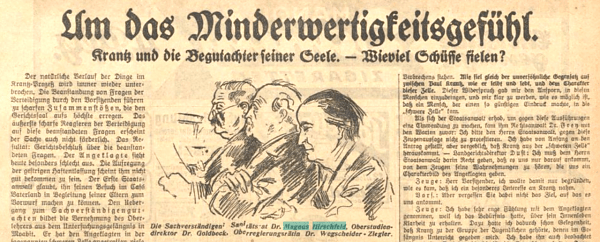
The notorious “Steglitz Schoolboy Tragedy” (1928) involved Paul Krantz (18) and Günther Scheller (19), who had a suicide pact: Scheller would shoot his friend Hans Stephan (18) and Krantz would then shoot Scheller, his sister, and himself. Scheller carried out his portion; Krantz did not, and he stood trial. The “Vorwärts” touched on the homosexual relationship between Hans Stephan and Günther Scheller (February 9, 1928). Hirschfeld was one of several expert witnesses. The newspaper even published a drawing of Hirschfeld at the trial (February 15, 1928). Following the proceedings, Hirschfeld characterized Krantz’s development as arrested at the level of a 15-year-old and “hereditarily severely burdened” (February 19, 1928). Krantz was acquitted. A few weeks later, Hirschfeld discussed the case in a talk, blaming insufficient sexual education for the tragedy (March 26, 1928). The case has been the subject of several films, including Daniel Brühl’s portrayal of Paul Krantz in “Was nützt die Liebe in Gedanken” (2004).
Hirschfeld’s Institute for Sexual Science
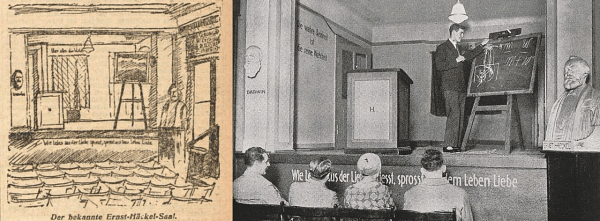
In 1919, Magnus Hirschfeld founded the Institute for Sexual Science — a move both to institutionalize sexology academically and to conduct research that could support changes to sexual law. Rainer Herrn’s comprehensive history, “The Institute for Sexual Science 1919–1933,” is a meticulous and exemplary account (2022). After Hirschfeld secured a building for the proposed foundation on April 22, 1919, the “Vorwärts” began reporting regularly on the institute — more than 130 times. It covered the opening day in July 1919 (June 5, 1919) and the start of regular teaching in September 1919 (September 4, 1919). Within a year, Hirschfeld reported visits by about 1,100 physicians, around 1,200 participants in courses, and about 18,000 medical consultations (October 24, 1920). The Ernst Haeckel Hall was later converted into a lecture hall, with the first lectures planned from January 1922 (December 21, 1921). In early 1924, the institute was transferred from Hirschfeld’s private property to the Magnus-Hirschfeld Foundation, which he had founded (February 3, 1924).
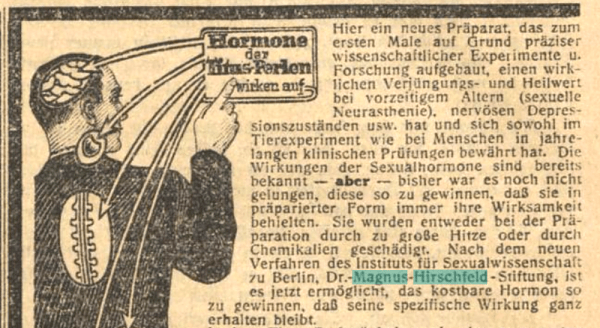
The “Vorwärts” ran at least seven advertisements for “Titus-Perlen” for impotence, highlighting the Institute for Sexual Science and the Magnus-Hirschfeld Foundation. According to Rainer Herrn (Love and Sorrow, 2022, pp. 366–376), the institute developed remedies for impotence with Hirschfeld and his colleague Bernhard Schapiro, marketed through pharmaceutical firms such as the nearly identical “Testifortan” and the “Titus-Perlen.” In both products the developers shared in profits.
The Institute and the Gay Movement
The most prominent “Vorwärts” feature about the Institute appeared in February 1925 under the headline “The Unknown Science.” It highlighted Hirschfeld’s and the institute’s contributions to research, counseling, treatment, and sexual-reform activism, and it printed two illustrations from the institute and the Ernst-Haeckel Hall that had not appeared in queer scholarship before. The editorial staff treated the institute as accessible to people with “a life beyond the norm” — i.e., homosexuality. The WhK’s role as the gay rights representative and the institute’s work converge repeatedly in coverage (February 22, 1925, pp. 5–6). Berlin, the piece concludes, can be proud of the institute. The first congress on “Sexual Reform Based on Sexology” in 1921, held at the institute, was also covered by the “Vorwärts” (September 16–17, 1921).
Only a few events at the institute are publicly known in the queer context, including institute archivist Karl Giese’s talk on “The Sexual Intermediates” (February 19, 1924). The “Vorwärts” gave extensive coverage to a lecture series organized at the institute around the impending reform of sexual law, with Hirschfeld’s talks on “Punishment of Sexual Deviations” and Police Inspector a. D. Hans von Tresckow’s (ex-head of Berlin’s moral police) talk on “Coercion in sexual matters” as culminating discussions (August 13, 1925). On February 25, 1926, Hirschfeld gave a talk on “Sexuality and Dress with Particular Attention to Transvestites’ Customs,” and a year later Hanns Heinz Ewers, invited by the WhK, read sexual psychology from his works such as “The Death of Jesus Maria” on “psychological hermaphroditism” (February 11, 1927).
That the institute played a significant role in the history of the gay movement is only partially reflected by the “Vorwärts” announcements of events. An example are the public Q&A evenings conducted from 1926 to 1932, which certainly included topics like homosexuality. About twenty such notices appear in the “Vorwärts,” with the last Q&A evening held on September 5, 1932 (September 4, 1932). With that notice, coverage of the institute ends, even though Hirschfeld had left Germany two years earlier on a world tour beginning in autumn 1930, ultimately returning to Europe in 1932 but never stepping foot on German soil again for safety reasons.
Hirschfeld as a Film Consultant
Hirschfeld contributed as a scientific adviser to perhaps eight to ten films. The “Vorwärts” links him to six films, with the first four directed by Richard Oswald, a pioneer of Weimar-era educational cinema.
Four Films with Director Richard Oswald
The two films Sündige Mütter (Mother Sins) (1918) on abortion and Die Prostitution (Prostitution) (1919) were promoted with Hirschfeld’s name, signaling his prominence at the time. Hirschfeld saw cinema as a powerful medium for education, especially given the era’s stigma around sexuality; he believed scientific experts could legitimize this new form of mass entertainment as an instrument of enlightenment. (This principle would echo half a century later when sexual scientist Hans Giese legitimized the Oswalt Kolle educational films.)
Two other Oswald films connected to homosexuality are Anders als die Andern (Different from the Others) (1919), also known as “The Third Gender.” The world premiere was announced for Morgen (cinema release on May 30, 1919) with opening remarks by Hirschfeld. The film was promoted through September 1919, and a parliamentary inquiry by a Prussian legislator later questioned how such films could be suppressed (September 24, 1919). After its release, this film contributed to renewed film censorship as it was denounced as homosexual propaganda and banned from general audiences, shown only to professional audiences. One screening for teachers and physicians sparked a controversy that led to the film’s exclusion from general release (October 11, 1919). Eight years later, the film was shown to invited guests at the Institute for Sexual Science in December 1927 (December 13, 1927). The film title is sometimes misrendered as “The Homosexuality” in some listings. For the historical arc of this influential film, see James Steakley, Anders als die Andern (2007, p. 9), which places the premiere at May 31, 1919. The film is presently available in partial form; the Munich Film Museum has reconstructed portions and released it on DVD.
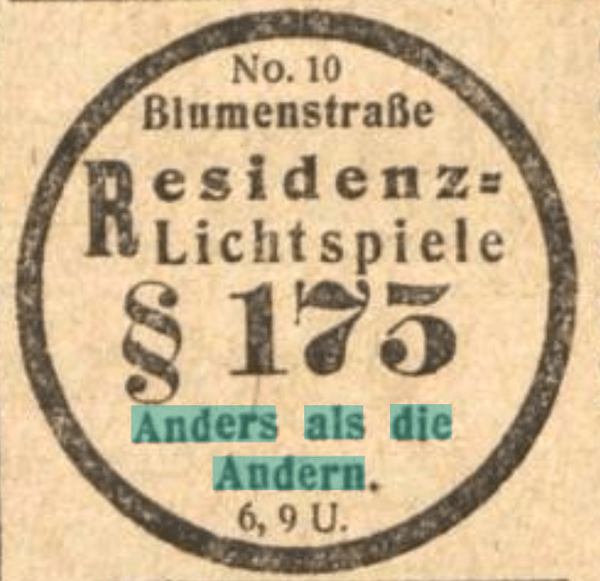
From the 1927 film Gesetze der Liebe. Aus der Mappe eines Sexualforschers — featuring scenes from Anders als die Andern — some cinemas advertised with accompanying doctor’s talks (February 24, 1928). Since only fragments survive, a journalistic piece in the “Vorwärts” drew attention to the censorship of scenes portraying homosexuality (December 4, 1927). It’s striking that the film was announced again months later without a reference to Hirschfeld, but with the promise of “a lecture by a physician” (July 12, 1929; February 24, 1928). Hirschfeld’s name seems to have become a selling point that the censors sought to obscure by marketing without naming him.
Two Films Without Oswald
In the early 1930s, two films appeared without Oswald’s direct direction in which the “Vorwärts” hinted at name-misuse. In Das Recht auf Liebe (1930), about World War I soldiers, Hirschfeld was named as co-author of the screenplay; the paper warned that widespread opposition to the “abuse of his name” for this film existed (January 18, 1930). In Liebe ein Naturgesetz (Love as a Natural Law) (officially 1933, but released in 1932), the film about love between a man and a woman was promoted in cinemas in early 1932 with many advertisements (see 17 advertisements). The film had no youth-allowance rating and required an introductory medical talk, usually led by Dr. Edwards (February 16, 1932). An ad stated the film would proceed with “a medical talk following Dr. Magnus Hirschfeld” (August 12, 1932), which suggested Hirschfeld’s involvement, though by that time he was no longer in Germany for safety reasons.
The queer community needs a strong journalistic voice — now more than ever. Make your contribution to support TheColu.mn’s work.
Hirschfeld’s Final Years
The decades-long close collaboration between Hirschfeld and the “Vorwärts” editoriaI team persisted through 1930, with contributions about Hirschfeld often approaching “court coverage” in tone. Hirschfeld, in turn, helped the paper by providing statements and running at least eleven advertisements for his practice in the “Vorwärts” between August 10, 1910, and August 10, 1924. He described himself as a longtime “subscriber to the ‘Vorwärts’ from its first issue and still today” (From Then to Now, 1986, p. 154). This 1922/23 remark can be viewed as a nod to his enduring partnership with the paper. In 1928 the “Vorwärts” celebrated his 60th birthday and highlighted his achievements as a sexologist, including his “special” writings on homosexuality and his role as a tireless pioneer for progressive ideas (e.g., the legalization of homosexuality). At the end of 1930, Hirschfeld also spoke at two rallies against § 218 (the anti-abortion law) (September 30, 1930; November 12, 1930), a controversial topic given the economic crisis. He began advocating for abortion rights on social grounds, alongside eugenic arguments. On November 15, 1930, Hirschfeld embarked on a research trip to the United States and never returned to Germany. Fearing for his safety, he never stepped on German soil again.
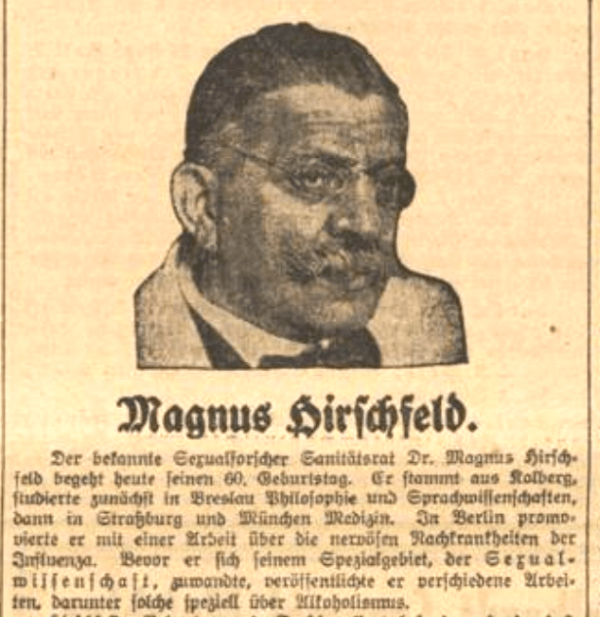
From the “Vorwärts” Silenced
The “Vorwärts” or “Neuer Vorwärts” continued to appear for another decade, ten long years in which Magnus Hirschfeld was largely silenced. Readers were never informed why he did not return to Berlin, nor that the Institute for Sexual Science was looted on May 6, 1933, and there was no obituary when Hirschfeld died in exile in 1935. Unlike other newspapers, the “Vorwärts” never published scurrilous attacks on Hirschfeld.
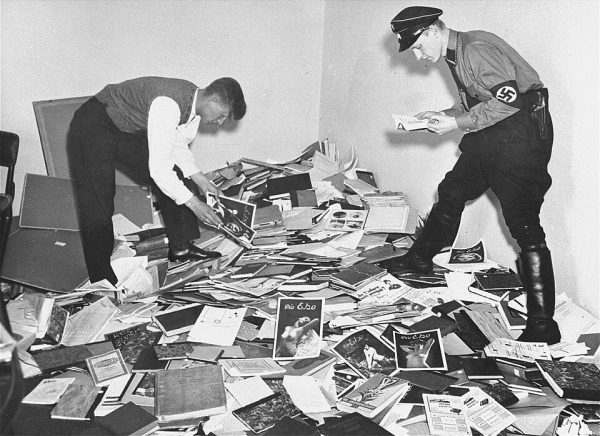
That the editorial team of the “Vorwärts” also had to flee into exile in early 1933 is notable for two reasons. First, they could have shown greater sympathy and attention to their former SPD comrade Hirschfeld, who likewise had become a victim of fascism. Second, in exile they could continue the fight against the Nazis through the “Neue Vorwärts” until 1940, just as they did in other areas. Yet the political climate had shifted. The Nazis now treated the gay population as state enemies, and the Social Democrats often stood by with little more than a shrug.