At first, one looks on in rather disbelief when reading the quote that accompanies the introduction from Jennifer V. Evans’s “Eine queere Art der Geschichte” (Amazon-affiliate link): about a “stream of my ancestors” as well as “biological parents” and “queer ancestors.”
To be upfront: Evans isn’t aiming with her new book (fortunately!) to fuse queer history with genealogical research. How would that even look? After all, for decades it has become a cliché that the beauty of queerness lies precisely in the ability to choose one’s own family: long live the chosen family!
Kinship Concepts and Queer Relationship Forms
And that is precisely what Evans focuses on in her book. In it, the Canadian historian and professor explores queer life in postfascist Germany after 1945. Her central question: How can we speak today about the social arrangements that unfolded beyond the cisgender and heterosexual everyday life? Self- and other-ascriptions such as gay, lesbian, trans, bi, pan & Co. have, after 1945, become established in everyday language only gradually.
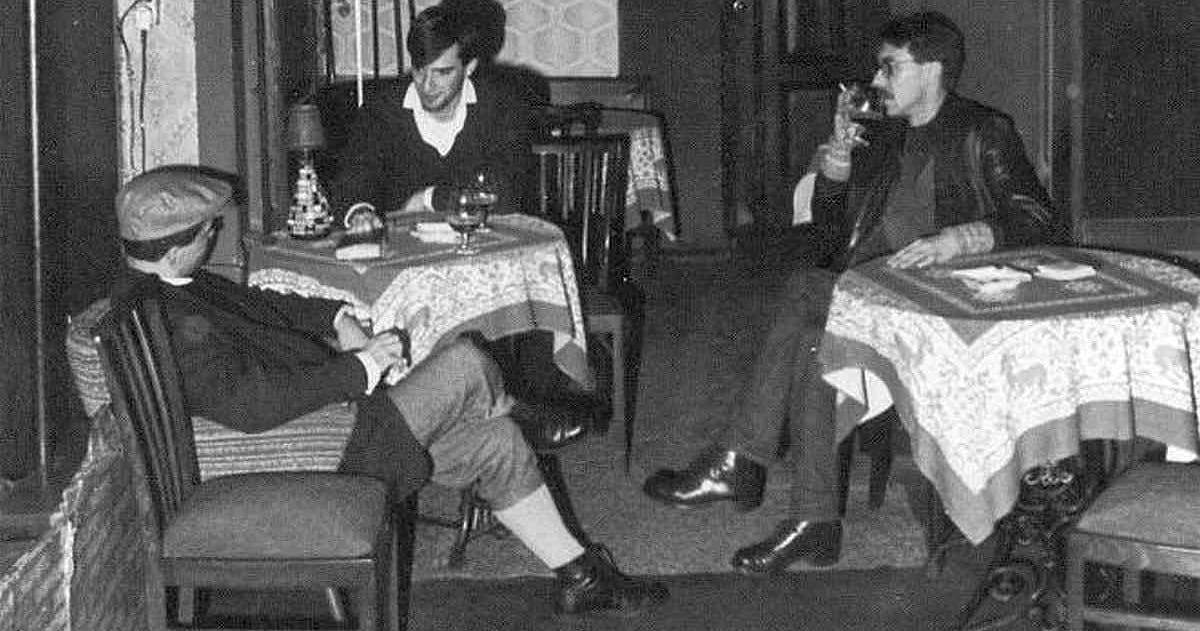
Evans’s idea: an application of the kinship concept to queer relationship forms, which she in the book summarizes as “queer kinships.” A term she emphasizes she does not intend to carry normative or even progressive connotations: for instance, she recounts the bar owner Elisabeth Hartung, who, with her “Ellis Bierbar,” created something of a safe harbor for those queer people who had been ostracized by the majority society.
Hartung gained broader notoriety in 1971 when Rosa von Praunheim portrayed her in his film “Nicht der Homosexuelle ist pervers, sondern die Situation, in der er lebt.” At the same time—and this is what makes this case notable—Hartung, a butch lesbian, had been a member of the NSDAP since 1939 and maintained close friendships with high-ranking Nazi officers. It is precisely this inconsistency and moral ambiguity that Evans finds especially compelling.
The queer community needs a strong journalistic voice — especially now! Please contribute to support TheColu.mn’s work.
Concealing Power Dynamics

That is also underscored by another example she returns to repeatedly throughout the book: sexual relationships between men and (often) underage boys, which are widely recognized as an entry point for power abuse.
Even these forms of sexual expression fall under Evans’s broad term of “queer kinships” — not as a normative relativization, but as historical labeling and reinterpretation. That Evans’s anti-normative focus pushes the potential power dynamics of such relationships into the background is one of the book’s weaknesses.
Keine leichte Kost
With “A Queer Kind of History,” Evans continues her long-running research into the queer everyday life in postwar Germany. Once again she achieves an impressive balancing act between the faithful narration of individual biographical fates and the simultaneous condensation of history that helps readers gain distance from the subject and thereby gain a view of the bigger picture.
At the same time, given its scholarly ambitions, the book is far from light reading. Yet for those who bring an interest in theoretical work and the queer everyday life in postwar Germany, the reading can be recommended without hesitation.
Jennifer V. Evans: A Queer Kind of History. Queer Life in Germany after Fascism. Translated from English by Elisa Barth. 500 pages. Suhrkamp Verlag. Berlin 2026. Paperback: €28 (ISBN 978-3-518-30092-3). E-Book: €27.99