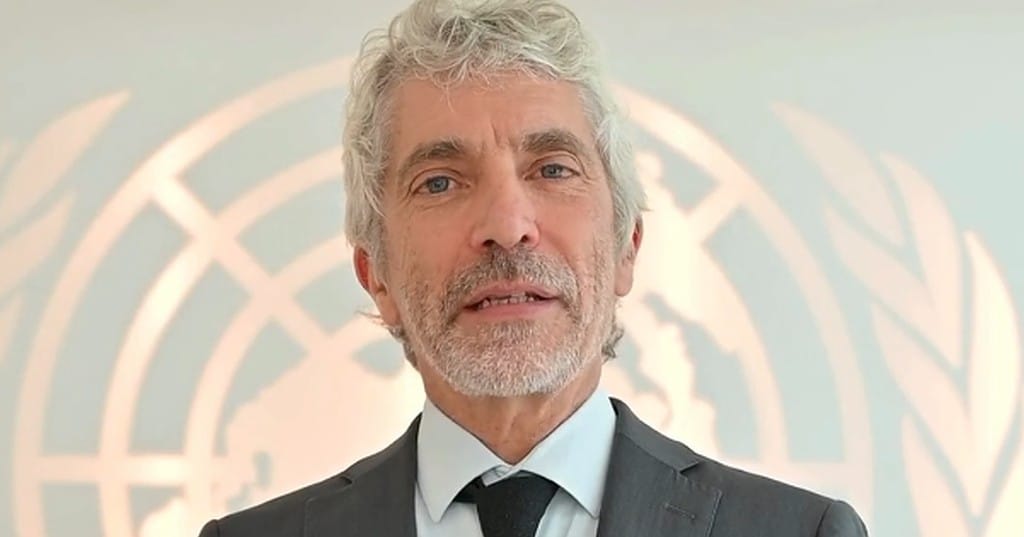
Across the globe, the rise of authoritarian populism and the rollback of democratic standards are increasingly putting queer people in peril. This warning comes from Graeme Reid, a South African-born advocate who has served since 2023 as the United Nations’ independent expert on protection from discrimination and violence based on sexual orientation and gender identity, in an interview with Geneva Solutions, a Swiss news platform.
The South African Reid, who previously led Human Rights Watch’s queer rights program, sees behind the current wave of anti-LGBTQ laws and rhetoric a clear political calculus: “It’s a staple in the playbook of authoritarian populists to target vulnerable minorities—whether migrants or LGBTQ people—to win populist support,” the 61-year-old said.
Moreover, the hate speech adjusts to domestic political realities. In the United States, there is a distinctly targeted focus on transgender individuals: “In the U.S., you see a very targeted attack on trans people — it’s not a broad assault on lesbians or gay men. And that’s precisely because it serves political advantage.” Of course, Donald Trump’s crusade against trans people also touches other queer individuals: Washington recently did not only roll back discrimination protections based on gender identity in schools and universities, but also protections based on sexual orientation (as reported by TheColu.mn).
Reid framed this in terms of an expansion of “illiberal democracies,” a concept popularized particularly by former Hungarian Prime Minister Viktor Orbán. Orbán asserted in 2014 that a state does not need to build on liberal Western values, but should center national interests. hallmarks of “illiberal democracies” include the curtailment of minority rights, restrictions on press freedom, and the weakening or elimination of checks and balances. The term is criticized for sounding belittling, which is why some prefer the plain label “undemocratic.”
Queer People as “Scapegoats” for Everything
The threat to the queer community grows in tandem with the global erosion of democratic institutions, Reid continued. Sexual and gender minorities are being deliberately used as scapegoats to blame for economic crises or to conjure an imagined, idealized past. A prime example, he noted, is Russia with its “gay propaganda” laws.
What’s particularly alarming is the geopolitical dimension of these attacks: “What worries me is that the rights of LGBT people have become almost a symbolic hallmark of this worldwide geopolitical conflict. LGBT people are portrayed as threats to the family, to children, and to the nation itself, which puts them in an extremely vulnerable position.”
Furthermore, the nature of discriminatory laws is shifting: in many regions it’s no longer simply about banning consensual acts, but about sweeping censorship and “propaganda” rules that criminalize any visibility of identity. “That also has direct consequences for advocacy groups, which are increasingly unable to do their work—whether due to funding restrictions or laws limiting their activities,” Reid argues.
Dire Situation Behind Bars
The interview coincided with the release of an 80-page report by the Geneva-based Association for the Prevention of Torture, which Reid helped contribute to. The document highlights the extensive discrimination and violence that queer people face in the penal system.
Reid stressed that social stigma dramatically increases the likelihood of imprisonment — for instance, through school dropouts stemming from bullying and the pushing of people into informal labor markets: “There is a direct link between discrimination, stigma, and the risk of being arrested and detained.”
Inside prison, this vulnerability is amplified, because “the discrimination and stigma they experience outside are mirrored—and even intensified—behind bars, whether from fellow inmates who may commit violence against an incarcerated person, or from the prison staff themselves. […] This is a very common experience for trans women, who are especially vulnerable.”
Although there are some country-specific improvements — including in parts of Latin America with staff training or differentiated risk assessments for housing trans women — the protections available globally remain far from adequate. Reid announced that he will present to the UN Human Rights Council in March 2027 a comprehensive study on the status of imprisoned queer people in prisons, deportation centers, and psychiatric facilities.
Boycotts at the UN Human Rights Council
On the international stage, the UN special rapporteur faces growing obstacles from conservative states. When he presented his first report to the UN General Assembly, delegates demonstratively left the chamber: “This shows that it isn’t about objections to details or the specific topic I’m addressing. Rather, for many, questions of sexual orientation and gender identity simply do not belong within the human rights system. […] This is a fundamental objection to the universality and indivisibility of human rights.”
Despite attempts to push queer rights out of the universal human rights catalog, Reid continues to rely on informal conversations behind the scenes: away from the heated public setting, many have shown at times a willingness to engage in a more rational and compassionate exchange. (dk)