That today it is possible to live openly as gay or lesbian and to place oneself within the political right is no longer news in Western Europe. In Germany, Jens Spahn and Alice Weidel stand as almost exemplary examples of this, and for both it seems to work within their respective milieus — at least at first glance.
The case of the French writer and political activist Renaud Camus, however, pushes the apparent or actual dichotomy to the extreme — after all, he is a man who has from the outset of his career openly foregrounded his own gay desire and yet became a spokesperson and intellectual face of European right-wing extremism.
Inventor of the Ideology of the “Great Replacement”
The internationally circulated formula of the “Great Replacement” originates from Camus’ pen. The notion that the native European population would increasingly be replaced by immigrants was elaborated by him in his 2011 book Le Grand Remplacement (The Great Replacement) published in France. Camus found in that idea a new label for a notion that already circulated among German far-right circles under the term Umvolkung. What initially drew only limited attention, over the following years developed into a remarkable political impact.
Five years later the work appeared in German under the title Revolt Against the Great Replacement — accompanied by a foreword by Austrian identitarian Martin Sellner. He recognized in Camus’ formula exactly the slogan the Identitarian Movement had so far lacked: a concise umbrella term that fused several of its flashpoints into a single threat scenario. Among these were mass immigration, an increasing presence of Islam — and declining birth rates in Europe.
Author of Gay Sex Stories
Yet in Camus’ earlier life, little seemed to point toward this radical shift toward right-wing conspiracy thinking. He had been known primarily as a gay bohemian: the author of autobiographical tales of sexual encounters from the 1970s, now regarded as classics of gay literature. Under the title Tricks they were published in 1999 by Bruno Gmünder Verlag in German. No less a figure than Roland Barthes praised the work with a foreword.
Thus the philosopher and cultural theorist admired the straightforward way Camus recorded his sexual encounters with men. “The Tricks of Renaud Camus are simple; they speak of homosexuality without ever speaking about it,” Barthes noted. Homosexuality appeared in Camus not as a problem to be explained or justified, but as a matter-of-fact description of knowing someone, the sexual attraction, and the act, told with a casualness that in the late 1970s was by no means self-evident.
Barthes was especially impressed by the attitude toward changing sexual partners. He spoke of an ethics of dialogue shaped by benevolence: from a merely desired “type,” an encounter could become an individual person.
The Literary Success Largely Eluded Him
In these dialogues one also learns a great deal about Camus himself. In one of the 1978 Trick protocols, he discusses his then-life as a writer. When a sexual partner asked whether he could live off his books, Camus replied, “Yes, but poorly.” His income was roughly at the minimum wage level. “I only need a little of the bohemian life,” said the thirty-one-year-old at the time. And when his counterpart asked if he could write something that would earn money, Camus answered, “Maybe. I don’t know. I never tried.”
In this casualness there already lurked a frustration that would later play a fatal role in his path. The literary success he hoped for largely did not materialize. Camus wrote relentlessly, publishing dozens of books over the course of his life, but most reached only a small audience. The broad attention that eluded him as a writer would decades later befall him precisely on a political wrong turn: with the “Great Replacement” he became an internationally recognized — though highly controversial — figure.
His homosexuality did not sit on the sidelines either — on the contrary: he used his gay self-confidence and bent it to fit his right-wing worldview. The freedom to live openly as a homosexual served as proof to him of the cultural superiority of the West over what he perceived as a fundamentally homophobic Islamic culture.
Convicted for Racist Incitement
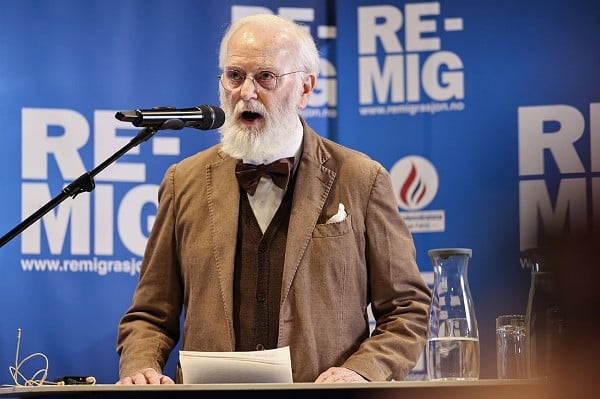
Camus founded his own political party, stood for elections, and radicalized his rhetoric ever further. His remarks about Muslims led to a conviction in 2014 for incitement to hatred and violence; in 2022 he was convicted again for racist hate speech.
A new biography now traces this astonishing path in detail for the first time. Under the title L’Homme par qui la peste arriva, Le Monde journalists Gaspard Dhellemmes and Olivier Faye published in early 2026 a portrait of the now eighty-year-old Camus. The book has not yet appeared in German. Thorough discussions of it, however, were provided by Kai Nonnenmacher, a professor of Romance studies at the University of Bamberg, on his blog Rentrée littéraire, which is dedicated to contemporary French literature.
Immigrants as Objects of His Sexual Desire
Nonnenmacher points to a tension within Camus’ biography: men from North Africa and other Muslim countries — whose religion Camus increasingly described as a threat to Europe — repeatedly appear as objects of his sexual desire, and at the same time as projection surfaces for his fears. Even if that does not present a contradiction for Nonnenmacher, the psychological paradox cannot be denied. Camus desires in these men precisely that machismo that also fascinates his political thinking: the heroic and combative. What Camus is attracted to in the individual man, he rejects as a trait of an entire culture.
Yet the deeper contradiction lies deeper still. It lies in the demographic core of Camus’ theory itself. For the “Great Replacement” describes not only an alleged threat from immigration. A central piece of the mosaic is the fact that the European population no longer reproduces sufficiently.
The queer community needs a strong journalistic voice — now more than ever! Contribute to support TheColu.mn’s work.
Homosexuals as “Gender Traitors”
In this way Camus touches on a question that remains strikingly unsaid: what does this mean ultimately for homosexuals themselves? Because as soon as the survival of the “own” people is made dependent on its ability to biologically reproduce, family, descent, and generational succession become politically charged. Not only immigration, but also a low birth rate appears as a danger — without yet deriving from that the question of where queer life realities fit within this order should be placed.
European right-wing extremists have so far kept their distance on this question. How far the internal logic of an ideology that declares reproduction a matter of societal survival can be pushed has already been explored by literature. In Margaret Atwood’s dystopian novel The Handmaid’s Tale (1985), drastically reduced birth rates lead to the establishment of the fundamentalist state of Gilead. Fertile women are forced to bear children while homosexuals are persecuted as “Gender Traitors” — traitors to their own gender.
The contemporary European right is still far from such a consequence, but the comparison remains instructive: Atwood imagines in fiction what happens when the biological reproduction of a group is placed above individual freedom and elevated to a political existential question. Camus, of course, did not foresee such a step in his theory. He would probably shrug off the idea that one day his own homosexuality could be viewed by political fellow travelers as a “Gender Traitor.”
Alice Weidel and the “Continuity of Our People”
But precisely this apparently confident stance reveals a blind spot that should no longer be overlooked. As long as homosexuality can be mobilized as Western freedom against a homophobic Islamism, the gay man or lesbian right-wing extremist does not appear to be a contradiction. But what happens when the gaze turns inward — when the reproduction of the “own people” is no longer merely a concern about foreigners but also about the lack of reproduction within one’s own group?
That question is not simply a speculative thought experiment; it has touched, in summer 2026, the career of Alice Weidel herself. In Saxony-Anhalt, the AfD’s electoral program called for the family — comprising father, mother, and children — to be presented not only as the societal ideal but explicitly linked to the “continuity of our people.” The text argued that declining birth rates were also due to the fact that “sexual deviations and non-reproductive ways of living” were gaining greater acceptance.
Thus a part of Weidel’s own party articulated, in unexpectedly clear terms, what Camus’ thinking only hints at in more nebulous ways: when an entire group’s lack of reproduction becomes a political problem, forms of life that do not conform to the reproductive ideal of father, mother, and biological offspring inevitably come under scrutiny. For Weidel this hits a sensitive nerve on multiple levels: she lives with a woman who has family roots in Sri Lanka, and she is raising two children with her — a family arrangement that deviates from the heterosexual ideal and also calls into question the idea of ethnic continuity guaranteed by inheritance.
The Boundaries of Acceptance in the Bourgeois-Conservative Milieu
Similar conflicts can be seen in the more moderate conservative milieu as well, as the case of Jens Spahn demonstrates — albeit under different premises. In early summer 2026 it became known that Spahn and his husband Daniel Funke had become parents of a son in the United States with the help of a surrogate mother. The inner conflict involved was openly acknowledged by Spahn himself: as a conservative gay man, he shares visions of family, descent, and generational succession that he must reconcile with his own life plan. The fact that his son Georg bears his father’s name, even though he genetically descends from Spahn’s husband Funke, is symbolic: where the biological line of generation is not provided by Spahn himself, a sense of familial continuity is created through naming.
What Spahn seems to have underestimated, however, was the reaction within his own conservative milieu. The controversy mainly hinged on how Germany’s laws on surrogacy were navigated, laws he had himself agreed to. Yet the intensity of some responses also made clear that the acceptance of a gay couple in the bourgeois-conservative milieu does not automatically mean recognizing their family-building as equal. Especially Spahn, who had lived openly as gay for years and seemed to have entrenched himself in the conservative establishment, had to learn painfully that this tolerance can be limited.
Yet the misjudgment goes beyond this one case. Gay men and lesbians who feel aligned with the mainstream now take social acceptance for granted. There is often a substantial degree of wishful thinking in this — particularly where conservative notions of family, descent, and reproduction gain political salience once again. For how robust social acceptance truly is becomes evident only where queer people are not just part of society but themselves claim family and lineage.