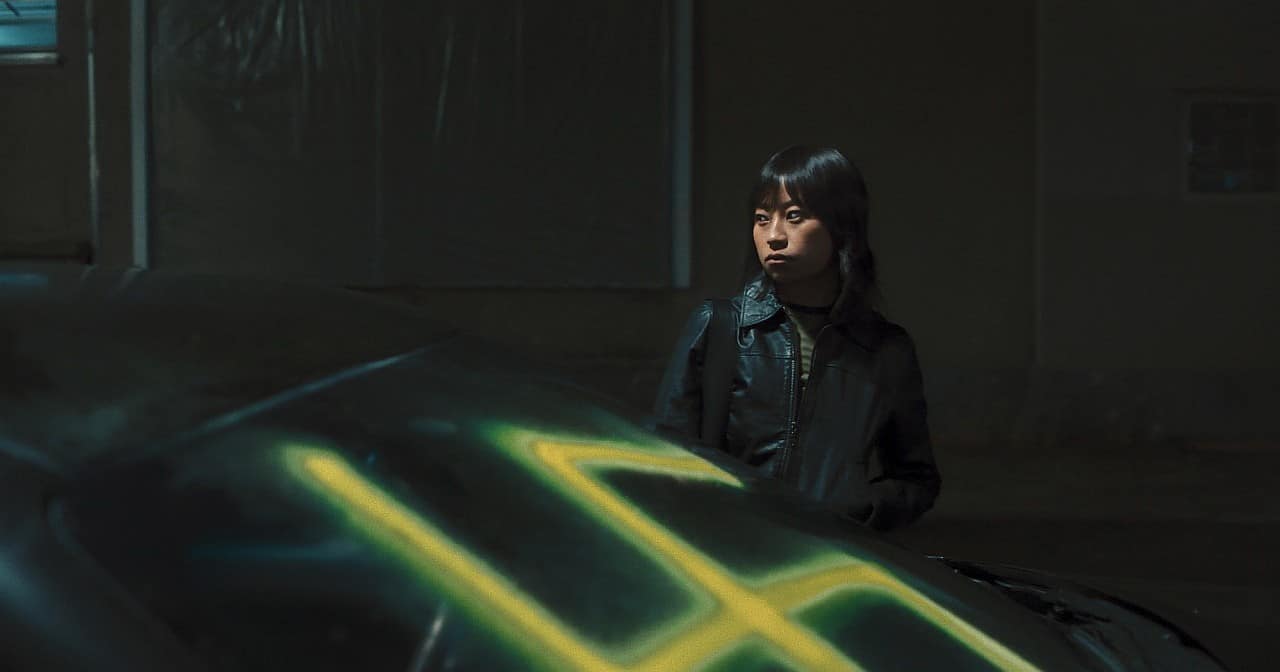
“We are the most objective authority in the world.” This oft-repeated line condenses the central double standard of “state protection.” The film shows how state institutions invoke neutrality and the rule of law, while structural racism, right-wing networks, and institutional turning a blind eye continue to have their place. At its center is Seyo Kim, a young prosecutor who lives in Brandenburg and works in Berlin — and who, both in everyday life and within the justice system and security agencies, repeatedly confronts patriarchal and racist power structures.
The director Faraz Shariat’s second feature initially follows Seyo’s professional routine in a seemingly calm, almost factual way. Right at the start she prosecutes in a drug case and must seriously tell a neo-Nazi to take off his swastika shirt in court. Even more telling than the defendant are the audience’s reactions: racist interruptions, mocking laughter, and an atmosphere in which right-wing hatred has long since become normalized. Repeatedly the film turns its gaze toward the courtroom audience and underscores how societal polarization has already been brought into state spaces — sometimes a bit schematic in pairing Nazis with the anti-fascist movement, but still effective.
Pushed off her bike, struck by Molotov cocktails
The real starting point, however, is a shocking act of violence: Seyo becomes the victim of a racist assault. She is first pushed from her bike, and later Molotov cocktails are hurled at her from a bridge. When the investigations stall and she suspects ties to the far-right scene, she begins to investigate herself.
She works her way through old files on right-wing violence and unsolved murders, steals documents, and repeatedly encounters resistance within her own agency. Particularly because the chief public prosecutor Forch (Arnd Klawitter) takes the case outside his purview, suspicion deepens that this is no longer about a few perpetrators but about a system that prefers to manage far-right entanglements rather than uncover them. The film does not hinge on a single case, but draws on years of research and numerous real continuities of right-wing violence in Germany.
Neutrality does not automatically equal justice
The line “We are the most objective authority in the world” lands with particular bite for this reason. It embodies a self-image of state institutions that presents itself as invulnerable and, as a result, blind to its own exclusions. The film vividly shows how conversations about “origin” are conducted with bias, how racist motives are relativized, and how any attempt to name structural racism is quickly delegitimized as ideological or left-radical. Staatsschutz makes visible that neutrality does not automatically signify justice — and that invoking the Grundgesetz (the Basic Law) is not an answer when those who are supposed to uphold it are part of the problem.
Equally striking is the portrayal of the fear many migrants feel in defending themselves against right-wing violence: their residence status, their job, or their housing can be at stake at any moment. This constant balancing act between self-protection and resistance is depicted with great empathy, without reducing those affected to mere victims or exploiting their experiences.
Impressive performance by Chen Emilie Yan
In the midst of this oppressive atmosphere, relationships with other women become a vital counterpoint. In particular, the friendship with Ayten Alican (Alev Irmak), who repeatedly helps Seyo access case files and eventually even introduces her to her daughter, develops into an emotional anchor. Also Min-Su (Kotbong Yang), whose relationship with Seyo Kim oscillates between close friendship and lesbian tension, adds quiet moments of closeness and trust to the film.
Carried by Chen Emilie Yan, who delivers an impressive performance in her first feature-length lead role. She portrays Seyo Kim with a mix of professionalism and stubbornness, coolness and vulnerability. Because she is never cast as an infallible heroine, but makes mistakes and occasionally crosses lines, her character feels credible. In the final act the tone shifts almost imperceptibly and the film moves from a courtroom drama to a revenge thriller — without relinquishing its political stance.
Direct link | Official trailer for the film
|
A film that takes a clear political position
“Staatsschutz” is a slow burn. The film works without big bursts, building a steadily intensifying sense of dread. The few locations — a car on the rural roads of Brandenburg, the brutalist courtroom, Seyo Kim’s increasingly unstable apartment — create a suffocating sense of claustrophobia. Lotta Kilian’s camera captures striking, symmetrical images that make visible the coldness of state spaces as well as the isolation of the film’s central character.
Following Futur Drei (2020), Staatsschutz is Faraz Shariat’s second feature, and he is also a co-founder of the film collective “Jünglinge.” The collective stands for cinema that treats queer, feminist, and anti-racist perspectives not as side notes, but as central. Staatsschutz picks up exactly there: a film that takes a clearly political stance, demands empathy rather than supposed neutrality, and actively counters the country’s rightward shift rather than merely describing it. With the forthcoming elections, its late-August release feels like a deliberately chosen political moment. Faraz Shariat and the “Jünglinge” are likely to have more to offer in the coming years.
Staatsschutz. Political thriller, drama. Germany 2026. Director: Faraz Shariat. Cast: Chen Emilie Yan, Julia Jentsch, Alev Irmak, Arnd Klawitter, Sebastian Urzendowsky, Kathrin Angerer. Running time: 113 minutes. Language: German (original). Rating: FSK 12. Distributor: Plaion Pictures. Theatrical release: August 27, 2026


Staatsschutz
11 images