With his debut feature film, he landed an invitation to the Berlinale and won a Teddy Award—a pretty slick move for director Kai Stänicke. Drawing on his own experiences, he tells in “The Homelandless” about a young man who returns to the island of his childhood. Yet there, no one seems to know him, neither his mother nor the childhood friend (Film review by Fabian Schäfer).
For the nationwide release of “The Homelandless” on August 27, 2026, we spoke with Stänicke.
Mr. Stänicke, congrats again on the Teddy Jury Award. How important is such a prize for you?
The Teddy is very important to me and a wonderful honor. I’ve lived in Berlin for 17 years and have become a Berlinale regular. Having my own film in the festival’s program as a world premiere was incredibly exciting. And the Teddy, as a special crowning finish, made it even more meaningful.
Your film comes across a bit like a fairy tale. Was that always the intention?
I’ve always wanted to tell the story in a timeless, classical way. I’m also a big fan of fairy tales and allegorical narratives, as you can see from the film’s structure. Our protagonist must pass three trials on three days of proceedings. The setting is on an island in the middle of nowhere, which naturally adds a fairy-tale quality to it.
How fairy-tale-like do you find the comparisons to Lars von Trier’s “Dogville,” which likewise painted its backdrop rather than building it?
I take the comparison to Lars von Trier as a tremendous compliment; “Dogville” was indeed an inspiration. We aimed to merge this theatrical stage with the island’s landscape. Together with production designer Seth Turner, I considered what we truly needed from the houses to tell the story as I envisioned it. Which walls do we need, and which can we do without? The village court was always planned as something of an amphitheater, where the trial unfolds like a theater piece and becomes a big happening for the residents. In this village there are no retreat spaces; everything is open to others’ judgments.
What does home mean to you?
Home is the place where you can be yourself, where you feel you belong. The film hints that home cannot be a place where you have to pretend and where you cannot be fully yourself. There is, after all, no real life in the wrong life. For Hein, returning marks the start of a journey in which he has to learn a lot about himself. It takes a while for him to see things he might not want to see, and to realize that the life he’s being asked to lead isn’t really the life he wants—and that he carries within himself. That is the realization he must come to at the end.
Was there a version in which the secret isn’t revealed at all? That everything is left to the viewer?
No, the queer core of the story was always clear. Why isn’t Hein recognized? Why do the village residents remember him so differently? Friedemann’s relationship with Hein was always just a pathway to reach that queer experience for me.
How autobiographical is this story?
The story draws on my own experiences. I grew up in a small town in North Rhine‑Westphalia in the 1990s and often felt I couldn’t be my true self there, and that parts of me only began to be accepted after I moved to bigger cities. Whenever I returned to that town, it felt like a different life I had lived—a life that never quite felt like my own and that I could never truly return to. Out of that feeling, the story emerged.
Does the Friedemann from the film exist in real life?
Friedemann didn’t exist as a real person — at least not in one individual. (laughs)
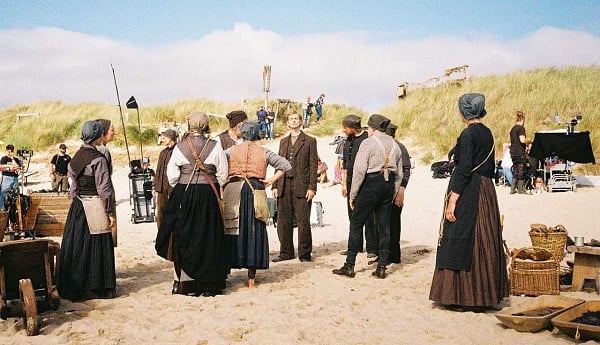
How did you find your cast?
During casting, Philip Froissant played the interrogation scene in the courtroom, and it quickly became clear: this is Friedemann. He immediately embodied the character, and for the first time I saw what could be possible with this historical register. For the suitable Hein, we found Paul Boche. It’s immediately evident how strong the chemistry is between these two. By the way, the beards on the men in the film are real; even Philip, who had another project right before filming, let his beard grow for weeks to months, and I think it suits him very well.
How did the process of working with the actors unfold?
We pulled the main cast away to a small lakehouse for a week. It wasn’t about rehearsing scenes so much as building a connection. We discussed the book’s various layers and the symbolism in many things at length. That strong bond made working on set much easier. Paul Boche is an actor who goes deeply into his roles and wanted to know what each line means and what I think about it with every sentence. He brought his own experiences into the part.
There’s a debate that queer roles should be played only by queer actors. Is that still relevant or yesterday’s news for you?
I see it from two angles. I’m not someone who tries to tell a story about a queer experience with someone who isn’t connected to it. I’m telling my very personal story in this film, and I don’t want to limit how I do that. We held an open casting, inviting people regardless of sexuality. The role went to the person who could best embody what I see in the character. It isn’t my right to ask who loves whom. That boundary is not mine to cross. And it can all change anyway.
Direct link | Official trailer for the film
|
How difficult is it to secure funding from film boards for such a rigorous material?
It was very challenging. It took ages. I had the initial idea for the film ten years ago. We faced a lot of rejections from funds. It’s almost a death sentence for a project. Can we even do this? Is there another way to finance it? Ultimately, my fantastic producers in Hamburg, Tamtam Film, found a path. But we had to do it with a tight, underfunded budget.
Has the Teddy had any international impact?
Definitely—the Berlinale brought a lot of attention. “The Homelandless” is now traveling the world and screening at many festivals. I just came from San Francisco, where we also won an award. Invitations to Ireland and New Zealand are next on the program.
What’s your advice for moviegoers?
Go see it. It’s a film you can revisit, and it should absolutely be seen on the big screen. For a date, “The Homelandless” is actually an excellent choice.
The Homelandless. Drama. Germany 2026. Director: Kai Stänicke. Cast: Paul Boche, Philip Froissant, Emilia Schüle, Stephanie Amarell. Running time: 122 minutes. Language: German (original version). Rating: 12 and up (FSK 12). Distributor: DCM. Release date: August 27, 2026