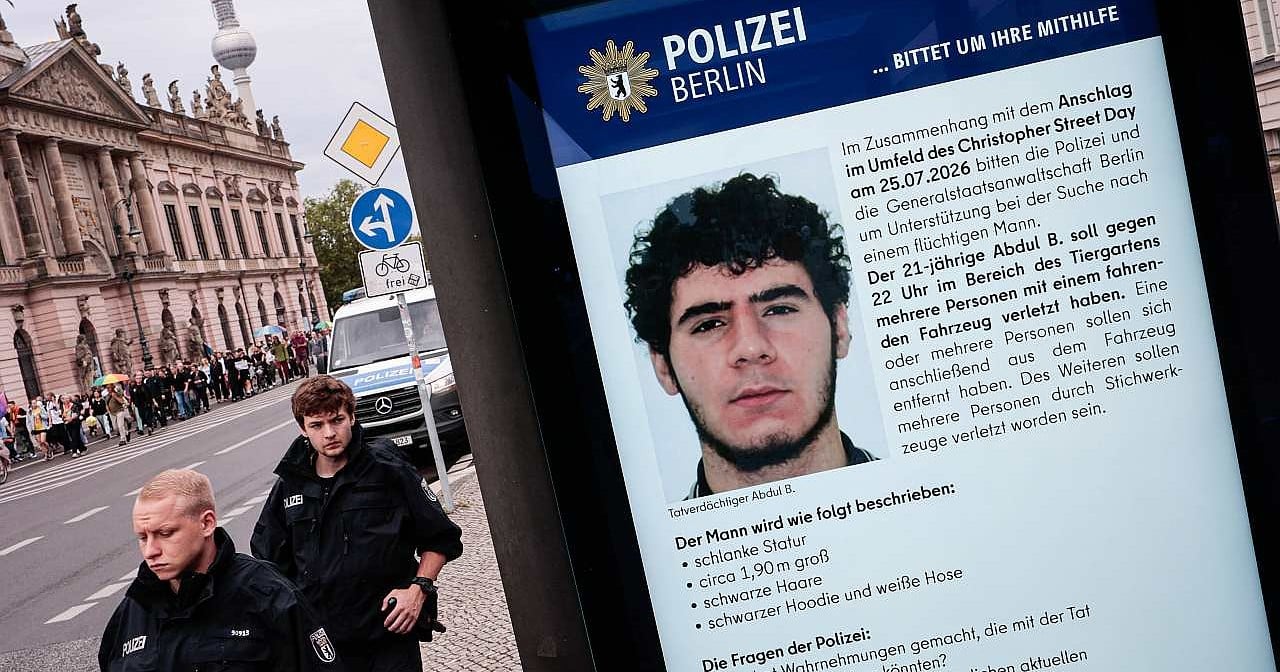
The Islamist assailant Abdul Ballout, who on Saturday carried out an attack during Berlin’s Pride parade (CSD), killing a woman and injuring 31 others, some severely, could have been driven by more than one motive. Reports cited by the Berliner Morgenpost suggest a mix of Salafist and anti-queer beliefs, possibly intertwined with a personal grievance.
According to security circles cited by the paper, Abdul’s father is said to be homosexual and reportedly lives in Berlin with his partner. The parents, who are from Lebanon, lived separately. The 21-year-old attacker, who was shot dead by police a day after the attack, grew up with his sisters at their mother’s home, where all were devoutly religious.
Authorities are said to have had Ballout on their radar from early on, but the parents did not cooperate. After initially holding good grades, he developed poor marks and frequent absences and had displayed aggressive behavior as a primary schoolchild, later escalating to violence. Ballout reportedly faced emotional and social difficulties and qualified for special education support. He left the special-education school a few years ago without a diploma or prospects.
Under Five Years of Scrutiny by the Domestic Intelligence Service
Since 2021, a growing radicalization trend had been detectable in Ballout, Berlin’s Interior Senator Iris Spranger (SPD) told the Interior Committee of the House on Wednesday. Berlin’s domestic intelligence agency had known him since November 2021. He moved within the Salafist scene and at times belonged to a Salafist group that went door to door recruiting followers. In police records, he had already drawn attention since 2019 for offenses including assault, fraud, robbery, and insults.
Recent reports indicate he made two attempts to travel to Syria to join the terror group Islamic State. He was detained in Lebanon and sentenced to three months in prison for “incitement to religious and confessional conflict.” After his release, he was arrested again upon return and remained in pretrial detention. He remained there until May 12, when a Tiergarten district court youth panel sentenced him to 22 months in a juvenile facility—among other charges including planning a serious act of violence against the state. The court, however, granted probation, and did not impose immediate detention or continued pretrial confinement.
Berlin’s Police President Barbara Slowik Meisel stressed during a special session of the Interior Committee the profound impact on the force that the attack could not have been prevented. “We have not succeeded; we will not sugarcoat that. And it hits me and my colleagues to the core,” she said. Meisel indicated the police had classified Ballout as a “high-risk case” following his release from pretrial detention. He was subsequently observed with surveillance cameras, wiretapped, and his movements monitored. “We found nothing, not a single thing, that would have allowed us to forecast a trajectory leading to ankle monitoring or preventive detention,” she added. The police had even conducted a house search after Ballout was spotted with an apparent weapon, which turned out to be a toy pistol. A continuous 24/7 watch by the State Criminal Police Office (LKA) would have stretched Berlin’s resources too thin: “That would have tied up roughly half of the capacities Berlin has.” The media reported Ballout had been captured on video leaving his house merely an hour before the attack.
Greens’ Criticism
Following the Interior Committee session, numerous questions remained, and many answers seemed to come primarily from newspaper reports, criticized Green parliamentary group leader Werner Graf. “Why couldn’t this attack be prevented, given that the perpetrator had already been flagged as a risk? Why were measures scaled back before the attack? Were there gaps in the security concept around Tiergarten?”
Much of what transpired could not be fully explained by the Senate. It became clear that “it does not appear there was a deficit in intelligence among security authorities beforehand,” Graf argued, and he cautioned against premature conclusions and blunt calls for broader legal powers. Nevertheless, he urged a thorough, uninterrupted clarification, potentially including a parliamentary inquiry.
Spranger, for her part, had pledged to work toward a complete airing of the incident to ensure transparency. “But we all know that we cannot prevent such incidents with absolute certainty.” The senator noted that Berlin houses about 1,250 people connected to the Salafist scene, of whom around 350 are violence-prone. In total, the city has roughly 2,590 Islamists, according to the intelligence service. The scene, which had retreated into private life and online spaces in recent years, has become noticeably more visible again. In the past two years, there have been more planned or encouraged departures to fight for IS, according to Spranger. “There remains a high threat level in the area of Islamist terrorism,” she warned.