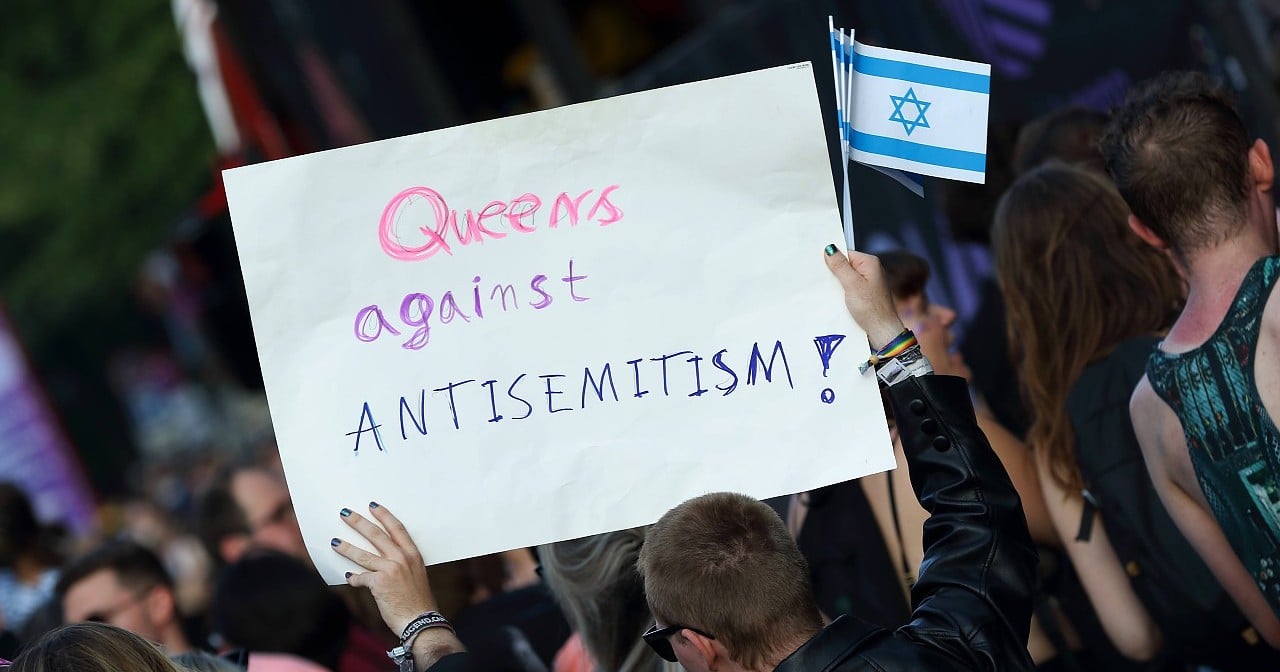
The Berlin Senate recently released a dossier titled “Extent, Spread, and Relevance of Antisemitism in Queer Scenes in Berlin” (PDF). The report, issued in the wake of the Hamas terror attacks on October 7, 2023 and the subsequent Gaza war, contends that Jew-hate has grown within the German capital’s queer community in the wake of those events.
The dossier was commissioned by the office that coordinates Berlin’s anti-Semitism work at the State Office for Equal Treatment against Discrimination (LADS). The investigation was authored by journalist Stefan Lauer, who has co-edited works such as “Judenhass Underground.”
Methodologically, the dossier frames itself as a qualitative “spotlight” rather than a representative quantitative study. Given substantial gaps in research on queer-specific antisemitic attitudes and the scarcity of statistical data, the work relies on analyzing discourses—particularly on social media—along with a review of scholarly literature and interviews with queer people.
Problem “Israel-Related Antisemitism”
The report documents a troubling rise in what it terms “Israel-related antisemitism.” It argues that this form of antisemitism transfers classic stereotypes—such as world conspiracy, greed, malice, and even the “murder of God”—onto the State of Israel, which is perceived as a Jewish collective. Among the findings is that in parts of Berlin’s increasingly international left-leaning queer scene, a hard line against Israel is increasingly treated as a prerequisite for belonging, or as a “loyalty test.” Those who do not condemn the State of Israel uncompromisingly or who minimize Hamas’s massacre as a liberation struggle are said to be excluded from the community.
Because of this, Jewish people within the community feel they must constantly justify themselves or withdraw from spaces and events. Queer Jews are depicted as facing a persistent “loyalty pressure” from other queer people.
According to the dossier, Israel-related antisemitism mainly plays out in digital spaces and within specific, highly interconnected subcultures. It notes that alternative gatherings—such as the “Internationalist Queer Pride,” which arose as a counterpoint to the “commercial” CSD, the Dyke March, and segments of Berlin’s club culture—are particularly affected.
The dossier argues that Israel-related antisemitism operates as a kind of “global integration ideology.” This creates a paradox where progressive queer activists find themselves aligned with Islamist actors—such as Hamas or the Iranian regime—whose value systems are profoundly hostile to women and LGBTQ people.
Many queer Jewish individuals find themselves unable to simply walk away from this antisemitism. Ariel Elbert, speaking for Keshet Deutschland e.V., is quoted in the dossier: “In Berlin we are at an extreme tipping point in queer communities. Many Jewish people are fleeing it, leaving the city, or even moving to Israel despite the war.”
Queer Scene Fails to Address Antisemitism
Within the queer scene, critical confrontation with antisemitism is effectively non-existent, the dossier concludes. External responses are scarce and tend to fall into two broad categories: polemics and repression. The former includes provocative rhetoric such as equating “Queers for Palestine” with “Chickens for KFC,” an argument that has even been used by Israeli Prime Minister Benjamin Netanyahu to delegitimize protests against the Gaza War.
The latter category encompasses repression: demonstrations on the topic are regularly banned or met with heavy-handed police action, and when state responses to antisemitism are limited, deportation is sometimes the only recourse—and safety for Jewish people is used to advance a conservative political agenda.
The dossier argues that a meaningful response to antisemitism must originate from the queer community itself, which must take responsibility. It calls for empirical data first: although the Friedrich-Ebert-Stiftung’s Mitte-Study has long shown antisemitic attitudes in mainstream society, data specific to the queer community are lacking. It also emphasizes the need for targeted, audience-specific educational work.
The conclusion reads: “A liberation struggle that sacrifices a minority to claim the supposedly righteous side of history betrays its own ideals. A queer utopia that only welcomes Jewish people if they deny their identity is not a real utopia. The fight against antisemitism is not a sidebar, but a prerequisite for a credible queer politics.” (dk)