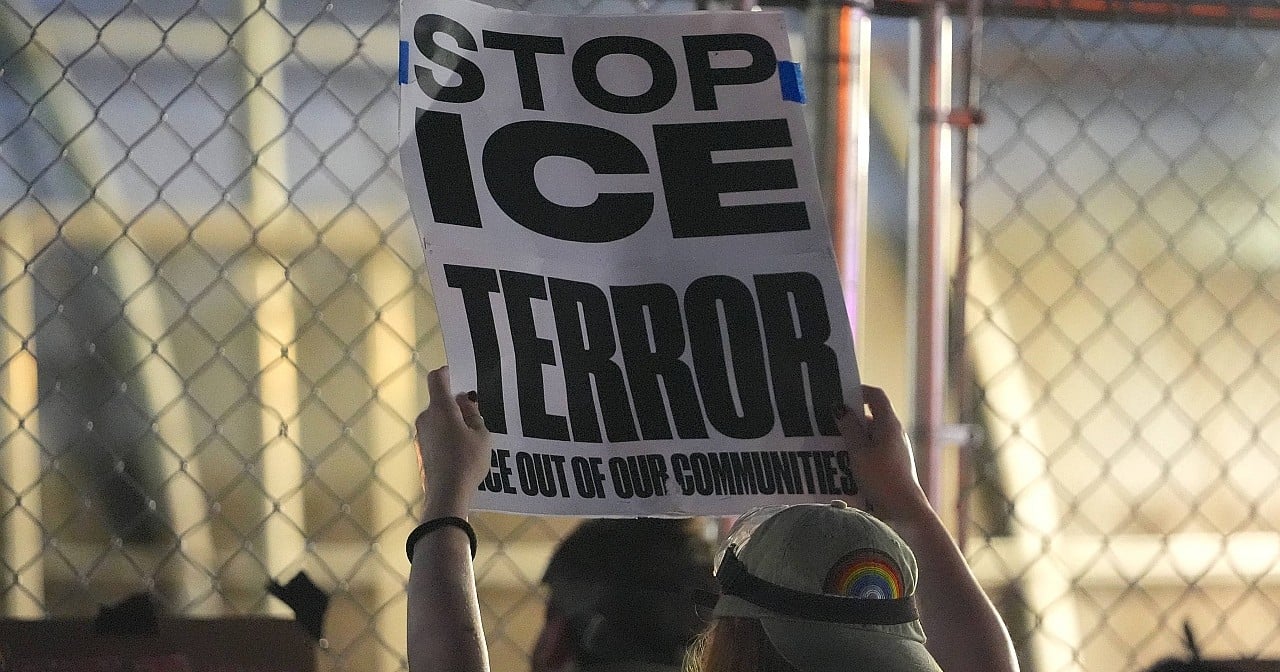
On Tuesday, June 23, 2026, the U.S. Department of Justice issued a press release with the headline: “Leader of Antifa Cell Members in North Texas Sentenced to 100 Years in Prison for Terrorist Attack on ICE Facility.” In total, two federal judges handed down sentences totaling 450 years to eight defendants, with individual punishments ranging from 30 to 100 years. The case stemmed from a July 4 protest against the U.S. Immigration and Customs Enforcement (ICE) outside the Prairieland Detention Center in Alvarado, Texas. Among those convicted are two transgender women, Autumn Hill and Meagan Morris, who each received 50-year terms. Benjamin “Champagne” Song is included as a nonbinary individual as well.
What happened that evening
According to the defendants and their supporters, the gathering was a “noise demonstration”—a loud protest in solidarity with migrants being held at the detention center. Some protesters set off fireworks, damaged vehicles and a guard shack, and spray-painted slogans on walls. When local police arrived, shots were fired.
How the incident unfolded remains disputed. Prosecutors say Benjamin Song, described as the group’s “leader,” struck a police officer in the neck. The defense offers a different account: Lt. Thomas Gross allegedly aimed his weapon at the backs of two fleeing, unarmed protesters without provocation, and shots were fired at the ground in an attempt to de-escalate the situation. The extent of injuries is also contested. Authorities described a neck wound, while defense counsel asserts there is only a grazing shoulder wound, with medical records never released. It is consistently reported that Gross left the hospital within hours and made a full recovery. Song received a 100-year sentence for attempted murder.
In a statement, Song described the event as a defensive act:
When I saw Lt. Thomas Gross stop pursuing and point his gun at the back of a running, unarmed protester, like he testified, I was terrified. As a firearms instructor and a United States Marine Corps veteran, I understood what I was seeing. I knew what it meant for someone to lean forward into a gun, like he testified, to prepare for recoil.
Yet at trial, Song could not rely on this account. The judge presiding over the case, Mark Pittman—a federal judge appointed by former President Trump—granted the prosecution’s request to bar all defendants from invoking self-defense or necessity as a defense.

What matters for the court’s assessment is what the other defendants did with the shot. None of them fired a weapon themselves. Meagan Morris, for example, was already seated in a car and driving away at the moment shots were fired. Nevertheless, she was convicted of decades in prison on the charge of “aiding terrorism.”
The construction of an “Antifa cell”
This case marks the first time in U.S. history that people were convicted of “Antifa terrorism”—a legal possibility that may have become feasible only after President Trump, in the fall of 2025, declared Antifa a “domestic terrorist organization” by executive decree. The legal legerdemain behind the charges rests on the crime of “aiding terrorism,” which does not require a demonstrable tie to an actual terrorist organization; it suffices to show that someone intended to assist a terrorist act.
Under this framework, the so-called “cell” was assembled: members wore black clothing, used the Signal messaging app, possessed seized zines, and engaged in discussions about weapons. Several defendants did not know one another before the protest and only connected at the rally. The fact that penalties were imposed consecutively—accusation piled upon accusation—turned separate charges into a multi-decade sentence for each defendant. Legal scholars warn that such a precedent could chill broader protest movements.
Prairieland is not an isolated case. In Alabama, two people faced “aiding terrorism” charges for allegedly setting a Walmart shopping cart on fire after a Black Lives Matter protest. In Minneapolis, prosecutors recently charged a group of ICE opponents as part of a terrorist plot. In these cases, symbolic actions are expanded into the language of terrorism to justify repression.
When rhetoric becomes judgments
The case also has a queer dimension. The affair unfolds in a climate where political discourse about gender identity intersects with law enforcement and criminal justice in ways that amplify the stakes for LGBTQ people. In September 2025, the Heritage Foundation—an openly Christian-nationalist policy think tank—urged the FBI to classify a form of extremism “inspired by transgender ideology” as terrorism. In media coverage, Fox News popularized a portmanteau—“Transtifa”—to describe such phenomena, while the German outlet Nius spoke of a “new Trans-Terror.” Although the current verdicts center on Antifa and ICE, the broader discourse ties transgender identity to left-leaning protest, weaving a narrative that can conflate minority identities with political threat.
Several transgender individuals appear on the docket in this case. Autumn Hill, 30, is one of them; her spouse, Lydia Koza, portrays the group as far from a terrorist cell. A Guardian profile quotes Koza describing herself and their circle as “a bunch of fucking nerds.” For Meagan Morris, the situation is more complex: she testified as a witness and attended the rehearsal meeting the night before the protest, suggesting her involvement went beyond mere spectator status. Both women currently languish in Johnson County’s men’s wing of a detention facility. The DFW Support Committee notes that the prisoners have faced restrictions on hormone therapy and shaving privileges; these claims are difficult to verify independently. What is certain is that a transgender woman serving lengthy sentences in a Texas men’s prison carries a particular vulnerability that a straight, cisgender defendant would not encounter, especially in a state known for harsh enforcement of laws and heightened scrutiny of trans lives.
Punishing solidarity
The DFW Support Committee, which advocates for the defendants, describes the verdict as a sanction against solidarity itself. The group asserts that its clients did nothing wrong and would face lifelong imprisonment not because the evidence proved their guilt, but because ICE and the federal government behaved in ways that made their protest seem illegitimate. They vow to continue fighting until the defendants are released.
Everyday, Texans face increasing repression by both the federal and state governments. Those on the front lines especially are being met with this repression despite our constitutional right to protest and dissent. Instead of listening to us, the government is arresting protestors, creating false narratives about their actions, and wholly ignoring their own obligation to due process.
Looking beyond the United States, the case resonates with a broader pattern. In 2023, Russia labeled the international LGBTQ movement as extremist, triggering raids on queer clubs and escalating repression. The same vocabulary—extremism and terror—appears in various countries to justify cracking down on dissent. The Prairieland appeal is underway, but the prospects for leniency remain uncertain.