Hidden from the media buzz surrounding this year’s Venice Biennale, a bronze statue of Diana rises atop the roof of the Austrian pavilion. The Greek goddess of the hunt—long a symbol of an autonomous feminine sphere—appears to have a target in sight. Like her ancient predecessors, she clutches a drawn bow—yet not with her hands. Instead, the weapon is held by her feet, twisted in a remarkably acrobatic contortion.
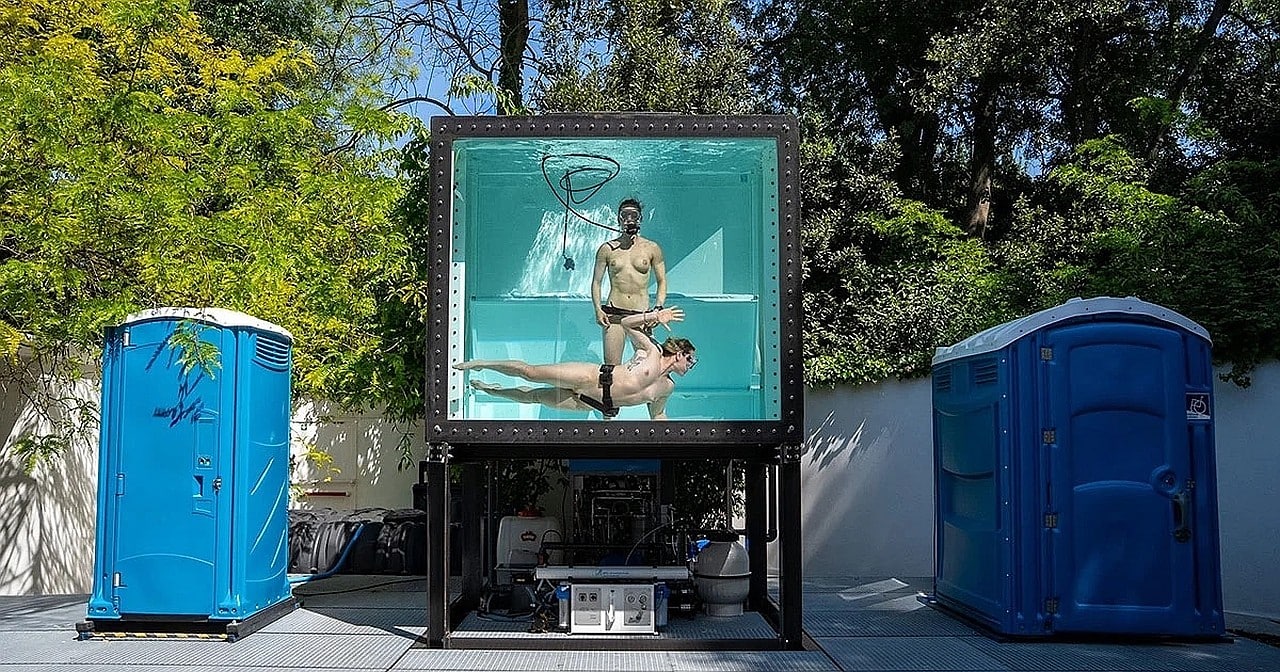
No one but Florentina Holzinger is behind the Austrian contribution to the 61st Venice Biennale. Those familiar with the controversial performance artist’s work may already sense that the statue of Diana hints at Holzinger’s own stance: she positions herself as the leader of a queer troupe of nymphs who traditionally accompany her on stage. Upon entering the pavilion, they present themselves as fierce acrobats, stuntwomen, and performers—and as divers inside a transparent water tank.
Holzinger taps into centuries-old notions of female community
The pool is the centerpiece of “Seaworld Venice,” the artistic ensemble’s title. The tank—resembling a human aquarium—forms part of a water loop into which the reprocessed waste from the pavilion’s plumbing feeds. The naked performers emerge as sea nymphs, experimental subjects, and inhabitants of a damaged ecosystem that is struggling to adapt. The images Holzinger creates are a spectacle that moves almost everyone, yet they are not easily dismissed as scandal. Holzinger’s work clearly transcends mere provocation. She ties together long-standing visions of women’s communities and pushes them into the present—into a world of ecological crises, technical infrastructures, and bodily dependencies. Queerness here does not appear as an alternative to social reality but as an autonomous way of facing its demands.
Queer bodies in contexts of collective dependence
This hints at a trend already taking shape elsewhere at the Biennale. Whereas queer art at the previous edition often presented utopian life designs, collective pride, and—traditionally—the sexual liberation of the body, the focus is shifting now. The spotlight no longer centers on queer counterworlds; instead it asks how living together can be organized under ecological and social crisis. The shift is all the more intriguing because queer physicality in art has previously been anchored at two other poles: the sensorial excitement of boundary-pushing and, on the other hand, the experience of personal vulnerability and threat. In Venice, a new third space is taking shape, where queer bodies no longer move within social margins but within networks of collective dependence, global responsibility, and ecological survival.
Parenthood as a social practice
This new direction is complemented by the work of Japanese artist Ei Arakawa-Nash, who with his husband became parents through surrogacy. The family now lives in the United States—partly because, in Japan, such queer family structures remain legally and socially precarious and far from guaranteed. Despite this, Arakawa-Nash was invited to design the Japanese Pavilion, and he transformed the building into a giant kindergarten. More than two hundred life-like dolls, each resembling a four-month-old infant, are spread throughout the rooms and the garden. They climb scaffolds, swing from ropes, and gather around a television set—and they wear sunglasses so adults can see themselves reflected in them and awaken to their own gaze.
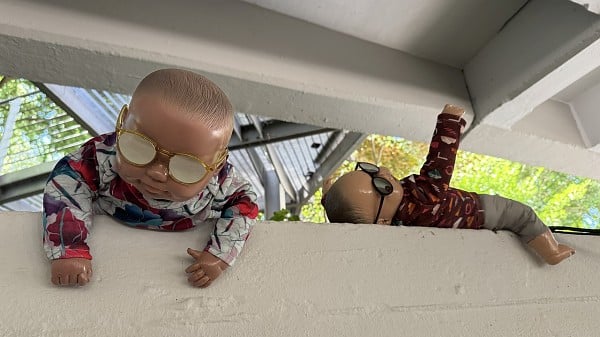
Visitors to the pavilion are greeted at the entrance by hosts who invite them to pick up one of the dolls—each weighing about five kilograms—and carry it for the duration of the tour through the exhibition and the gardens. There is even a diaper station where QR codes unlock “diaper poems” linked to the personal histories of the individual babies. Carrying one of the dolls casts a hypothetical responsibility upon the bearer for a being that is not their own. Parenthood thus emerges not as a private matter of a small family but as a social practice defined less by lineage than by care. Who bears responsibility for future generations? How is community formed beyond biological kinship? And what forms of living together remain possible in a globalized world? Arakawa-Nash does not merely reflect his experiences as a gay father; queerness here also becomes a model for contemplating responsibility, care, and the future of communal life. Yet what underpins a queer sense of self that is not defined primarily by visibility and claims for recognition?
A historical TV program in the Swiss Pavilion
This shift is further illustrated by an installation in the Swiss Pavilion, just a short walk from the Japanese one. Here, the show approaches homosexuality and queerness as historical categories. At its center is an April 1978 broadcast of the television program Telearena—a legendary program in which the so-called “problem of homosexuality” was debated live on air. The actors staged scenes from the lives of gay men to spark a debate among the studio audience.
The program drew an audience of about 80 percent and caused a media upheaval in Switzerland. For the first time, gay men spoke publicly about their lives and voiced clear demands, provoking both outrage and contemplation. In hindsight, the broadcast is seen as a crucial catalyst for a successful emancipation process, but it also highlighted the exclusion of lesbian women who were present but largely ignored.

In the Swiss Pavilion’s spaces, the program is artistically abstracted and transformed into an immersive installation, featuring chairs, canvases, and original set pieces from the studio, such as an oversized test pattern. Yet because the installation remains immediate despite its distance from the original context—and because it is firmly anchored in history—it plays a crucial role: it reminds us that the shift in queer art away from a politics of visibility and a politics of collective identity is only possible because earlier generations fought these battles.
Elsewhere on Giardini Island and in the Arsenale, there are additional queer positions, though often their queerness comes into view only on a second or third glance, frequently from countries where homosexuality remains illegal. At the same time, the Biennale is overshadowed by ongoing political conflicts—debates about Russia and controversies surrounding Israel. All the more striking is the development that is taking shape here: not a utopian vision of another world as the center of queer art, but the question of how people can live together successfully under the conditions of this world.