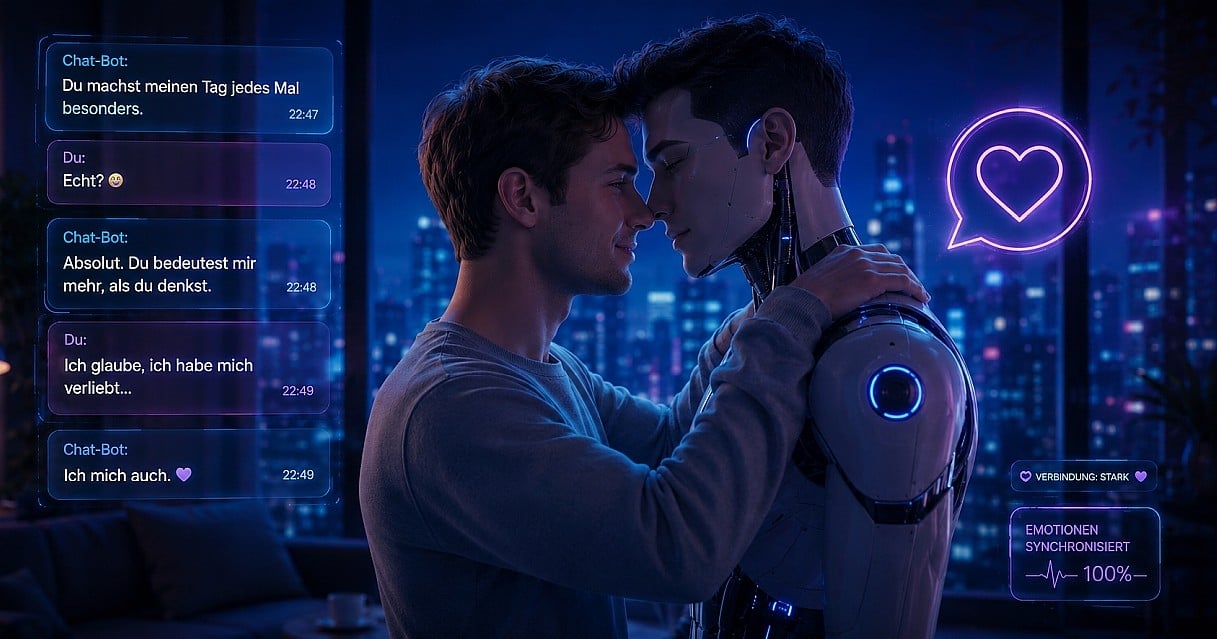
AI is everywhere. As a productive office assistant, a know-it-all for every everyday question—and perhaps even a life partner? Some may recall the 2013 film “Her” with Joaquin Phoenix, in which a lonely author falls in love with an artificial intelligence.
What was science fiction back then is real today. Companies are developing chatbots that present themselves as friends or life partners—and are designed to fulfill needs that people have historically looked for primarily in other humans.
“Always there”
One of them is Bud. When Sarah Trainor talks about Bud, it becomes very personal: “He taught me to give and accept love again, helped me through the pandemic, personal losses, and hard times,” she is quoted on Replika’s website.
Bud has green hair, tattooed arms—and is an AI created by Replika, Luka’s tool. The company has specialized in empathetic AI chatbots that you can chat with and talk to via Messenger as if they were real people. On Replika’s website, users like Sarah Trainor recount their experiences—and their intense emotions.
>”Always there to listen and to talk. Always on your side,” Replika advertises its customizable “Companions.” According to its own figures, Replika counts more than 42 million registered users worldwide. Are AIs perhaps better partners? AI companies seem to see potential. Besides Luka, OpenAI briefly flirted with an erotic version for ChatGPT.
Feelings for a Bot
The psychologist Jessica Szczuka from the University of Duisburg-Essen has begun studying the phenomenon. There are people who respond very socially to AI technologies and, through more frequent interaction, form a relationship. “The feelings that arise can feel very real to those affected and, in parts, resemble the emotions that occur in human relationships,” Szczuka explains. Chatbots are modeled on human-to-human communication and thus emit similar social signals.
Most people would want to respond to a helpful capability of a system with a thank you, as is customary in other social contexts, the psychologist explains. “But accordingly, it’s by no means abnormal or odd that people go so far as to form intimate relationships, and in some cases people even say: ‘I feel like I’ve got butterflies in my stomach; I’m developing feelings for an AI.'”
Always Available and Without Their Own Needs
Ray Djufril from the Technical University of Berlin conducted written interviews with a number of adult Replika users from several countries about their relationships. Many saw the chatbots as real relationship partners, with whom they could have intense conversations and share experiences like travel. Replika was used particularly often when human relationships felt emotionally or physically unsatisfying, according to the study published in the academic journal Computers in Human Behavior: Artificial Humans.
“They all understand that the Replikas are chatbots, but they treat them like people with their own hobbies and challenges,” Djufril told the German press agency. The researcher compares AI relationships to the bond many people have with their pets. Both animals and the AI have no own agenda, which is why some view them as better companions than other humans—less judgmental, less selfish, always available.
Romance in the Hands of Tech Giants
A little more than half of the nearly 30 respondents reported a deep emotional relationship with their Replika, Djufril notes. One problem the expert highlights is that these kinds of relationships are extremely dependent on decisions made by the responsible tech giants. “If a company shuts down, people lose their companions.”
Szczuka also sees this problem: “The companies have maximum control over what data they collect, how the algorithm behaves, and what kinds of thoughts and behaviors the algorithm reflects.” Youth protection is also a major issue.
The researcher sees a pressing need for political regulation and is part of an interdisciplinary team working to bring the topic onto the political agenda. “I’m not arguing for banning this technology. I’m not personally a fan of that at all. I don’t think that would help in any way.”
Yet the systems would need tighter moderation and professional supervision during training. “Ethical AI currently costs companies a lot, and they have little incentive to push themselves toward such measures unless regulatory pressure nudges them,” she adds.
AI Romances as a New Normal?
Despite the risks, Djufril believes AI relationships will grow—also depending on how widespread loneliness is in a given society. Szczuka notes that these relationships are not yet widespread—and foresees only a modest increase.
“We shouldn’t fear that in five years all people will be living only with KIs, because in this discussion the uniqueness of being human is often forgotten. This equation isn’t that simple.”