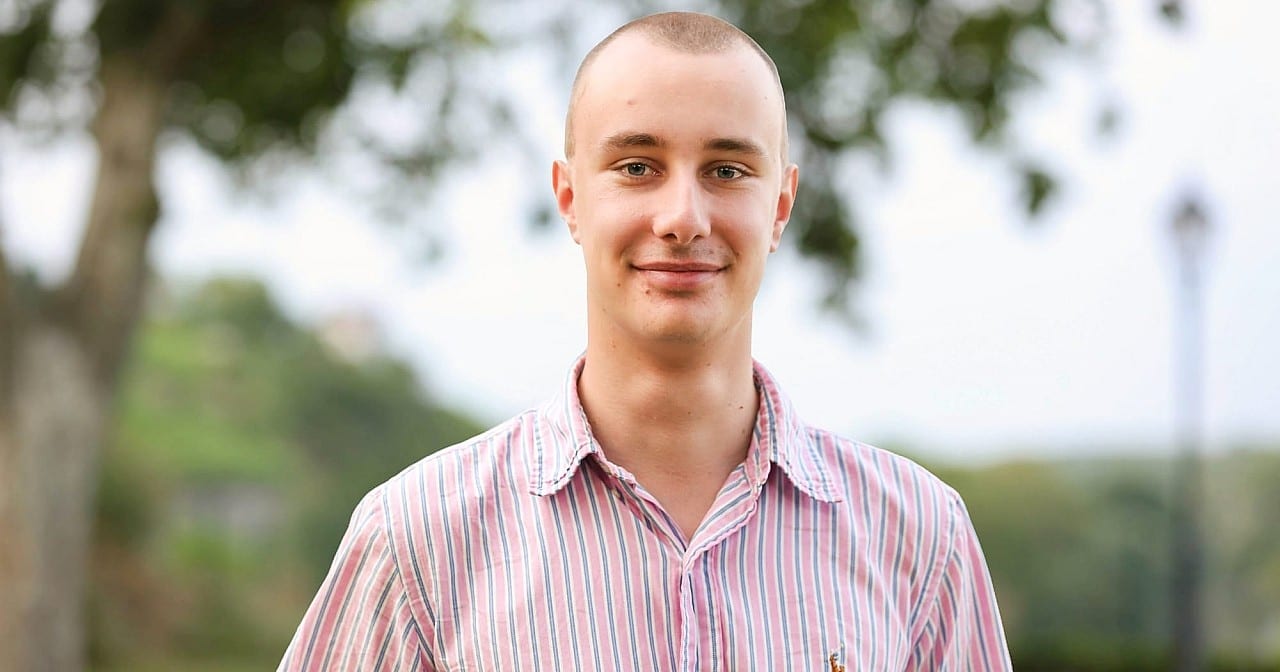
Eric Stehr lives in Weißenfels, a town in Saxony-Anhalt, Germany, and he has strong odds of soon joining the state parliament for The Left. The Left’s youth-wing candidate was placed on list position 2 for the state election on September 6. His political commitment began in the city’s youth advisory council, later followed by his entry into the city council.
Today Stehr focuses primarily on youth, transportation, and urban development policy, while also bringing a queer perspective to his political work, including organizing the first CSD festival in the Burgenlandkreis district in 2023 (TheColu.mn reported). In the past year, he was among the central figures in the MDR documentary “Queer in the Province” (TheColu.mn reported).
In an interview with TheColu.mn, Eric Stehr talks about his political path, his experiences as a queer politician in a rural region, and the looming rightward shift in Saxony-Anhalt.
Eric, how did you even get involved in politics?
I’ve been a member of The Left since 2021. Before that, I was with “Die Partei.” My entry wasn’t so much a plan as it was an attempt to become active somewhere. In parallel, I was asked whether I’d like to work on the youth advisory council or help build something up. Through that, I gradually grew into political work. In school, I was more of a class clown and not very politically active. “Die Partei” reached out to me via social media — it was easy to engage with, and it sparked my curiosity.
You joined the city council at a relatively young age — how did that happen?
I ran for the city council back in 2019 mostly for fun and was elected during my high-school graduation year. That surprised everyone — including me. Still, I decided to stay in the region and accept the seat because backing out would have felt wrong. I felt comfortable in the city council, but I also realized I was becoming more involved in real-world policy work. After the 2021 federal election, when The Left dipped to 4.9 percent, I decided to actually join The Left. I stayed on the city council largely because no one else on the party’s list wanted to take the seat. In this way, I gradually slid into different areas of the party — and now I’m here.
View this post on Instagram
Instagram
|
You’re now running on list position 2 for the state parliament. What does that mean for you?
I haven’t fully realized yet that I’m very likely to land a seat in the state parliament. Right now I’m focused on the campaign and watching what happens in the end. When you join Die Partei at 16, you don’t imagine a political career would spring from that. Even my switch to The Left wasn’t planned as “someday I’ll run for something bigger.”
I joined the party at a moment when many others were leaving. That meant I arrived at a point where opportunities suddenly opened up — a lot of it was timing and happenstance.
How have you experienced visibility as a queer politician?
At first, it didn’t really matter. I didn’t think much about my public image and didn’t emphasize it. The topic became political for me in 2023 when I co-organized the CSD in the Burgenlandkreis. With the CSD, we really started speaking openly and saying: we’re organizing this here. Of course there were also hostile reactions. But you can’t always tell whether the backlash comes from my political stance, my being gay, or simply from advocating a progressive politics in a rural area where that isn’t always welcomed.
What role does queer politics play for you?
I’m queer myself, but I don’t view queer politics as my central issue. For me, queer politics ultimately also means class politics: I want everyone to do well — workers, queer people, migrants, and people with disabilities. At the same time, engaging with queer people and organizations gives me a special perspective. In an environment with many male voices, it’s important that this perspective is represented. I try to raise it, listen, and participate in shaping policy for these people — because I cannot speak for everyone.
What role does your local work play in the campaign — especially in the countryside?
In a rural electoral district like mine, it’s hard to be everywhere at once. So I focus on staying broadly visible while also working on state-level strategies. You have to be on the ground. At events, I notice we often attract a more academic audience, while the classic working class — the very people we aim to reach — has at times drifted away from us. That’s why it’s important to be present during strikes or similar moments of pressure.
How realistic is a single-party AfD government in Saxony-Anhalt?
It’s realistic, for sure. Looking at polls, the AfD isn’t far from an absolute majority. Still, we shouldn’t fear it. Fear breeds bad policy and a tendency to resign. The aim is to pursue consistently anti-fascist policy. Especially with an eye on queer groups, the trajectory is dangerous, so the stance is clear: no right-wing politics — whether it comes from this party or another.
The queer community needs a strong journalistic voice — now more than ever! Please contribute to support the work of TheColu.mn.
What would an AfD-only government mean for queer people in concrete terms?
I think the danger would be a rise in targeted attacks, because the tone would become harsher and the threshold for insults or violence would drop. On a structural level, many organizations and clubs would be put under severe pressure due to cut funding. In particular, queer support services could disappear, with direct consequences for safety and health.
What would constitute personal success for you in the upcoming state election?
Regardless of the outcome, I don’t want to let it get me down, especially given political configurations I find problematic. A success, for me, would be that The Left can look back on the campaign and be satisfied with what we did. If I can look at my district and say I gave everything, built a good team, gained a lot of experience, and saw that people support our work and say we’re needed — then that would be a positive signal and, in the end, a success.