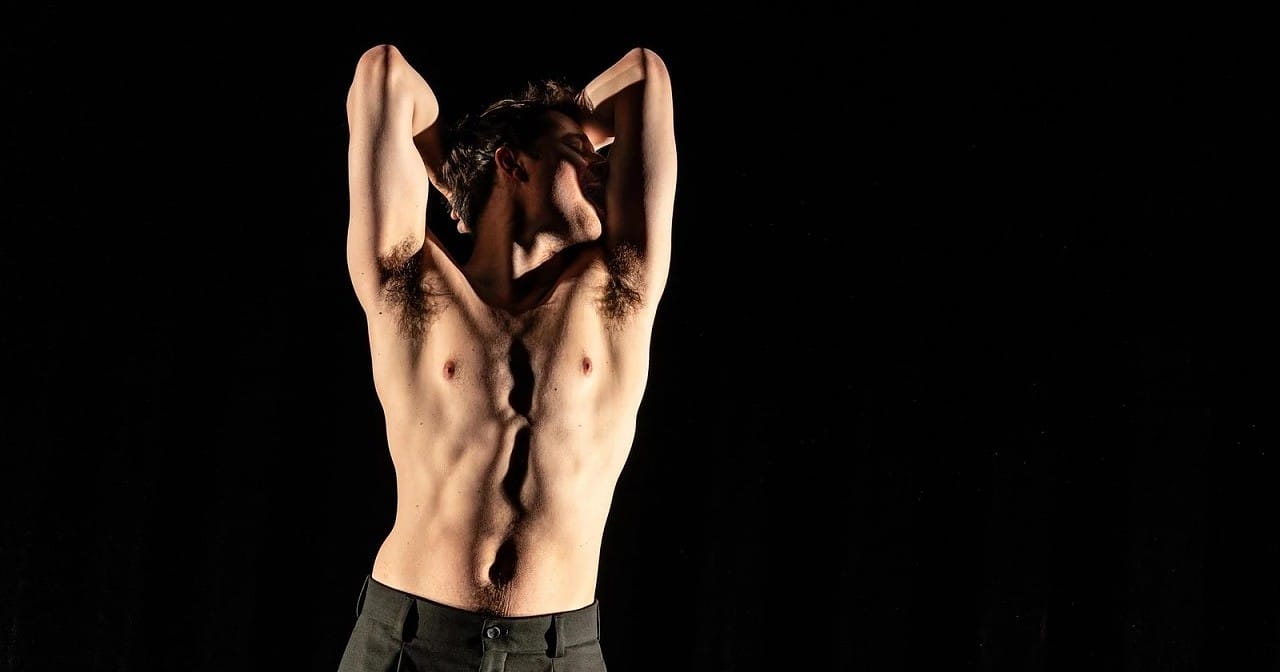
Michel Marc Bouchard’s play “Tom in the Country,” which reaches far beyond the central theme of queer hostility in rural areas, found success at the Deutsches Theater Göttingen, at Theater Regensburg, at Theater Schloss Maßbach, and other venues. As a film by Xavier Dolan (“Don’t Tell Who You Are”), it was already in 2013 a psychological thriller and, alongside the writings of Édouard Louis, part of the ironclad canon of 21st‑century literary documents on homophobia.
It still reads as a monumental and brutal work, even though its world premiere took place in 2011 in Montreal, followed by the German premiere in Münster in 2016 under the Meininger Theatre director Frank Behnke, more than a decade ago. It also grapples with the already existing knowledge about what must be whispered outwardly or filtered for public consumption, and yet is all too clear: The advertising designer Tom comes to Guillaume’s mother Agathe and his brother Francis after the death of his partner Guillaume. In the countryside a short distance from Montreal, Tom must face the fact that nothing about his relationship with Guillaume, or Guillaume’s sexual orientation, was known within the family—or even by the public.
On Saturday the piece premiered at the Meiningen State Theatre, directed by Simon Werdelis.
Hidden Sex and Many Lies
Francis, whose allure bears a likeness to his dead brother, has built a long‑standing web of deception with a fictitious girlfriend of Guillaume, through which he tries to instrumentalize Tom. An intensity—symbolic and physical—deepens and escalates between them in the Meininger production. At the premiere in the Kammer stages, audiences were predominantly fascinated, though a few faces remained cool, and the show closed with a long ovation. Despite the tragic claustrophobia, Bouchard disassembles his three central characters. The mother rejects Francis, who maintains the outward order of a norm‑driven life and a farm that is at risk, and accepts Guillaume as he was in death.
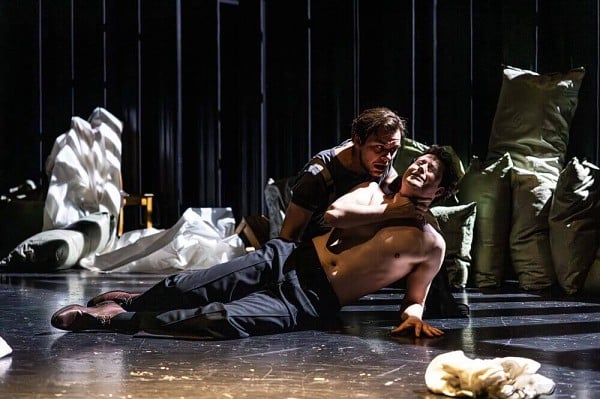
The director Simon Werdelis, who has found success with other queer subjects, presents a Francis who is suggestively tight‑fisted and smothering. One can tell from the first moment that beneath Agathe’s seemingly sympathetic maternal light lie abysses. And Francis is, in every moment, strong, definite, clear: in sowing, in calving, and later in the initial, then increasingly sadomasochistically influenced and later solidaristic—and even intimate—approach to Tom.
Stall, Playroom, Mysterium
Max Schwidlinski’s vision of country life makes the audience shudder in the dark stage space: cold walls and floors, plastic bags with seed and indistinct contents, a propeller for unforeseen purposes, and retreat niches on top of plastic sacks. An associative wash of gray and black: almost playfully Schwidlinski also teases urban‑playroom fantasies as Tom sinks deeper into Francis. It is striking that men in the audience watch such subtler moments with more openness than women, who convey quiet skepticism and discomfort.
Elsewhere the Meininger production is brutal, because neither the unshown nature nor the people are in order: when Christine Zart, as Agathe, ejects her son Francis even though he has stayed with her, softness here carries an undeniable hardness. And when Werdelis also shows in the setting that there is no rural idyll at all, only function and performance, it says a great deal about how tightly people are squeezed. In the end, the farce trap snaps shut: Sara pretends to be Guillaume’s girlfriend solely for financial gain, thereby destroying Guillaume’s pure image as a faithful man and explicitly gay.
More than a Play About Homophobia
The production touches on christological references when Tom opens his arms, and this crucifixion stance simultaneously acts as a sexual impulse. This overgrown bundle of text and symbol says a lot: the Meininger acting quartet shifts from claustrophobic psycho‑realism to a jagged, drastic register, becoming grippingly lifelike at decisive moments and occasionally veering into exaggerated exaltation. That this performance centers less on the relatively clear Tom and more on the driven, deeply unhappy, unfree, and sharply angular Francis is natural. Beyond the theme of queerness, this 110‑minute evening is therefore a stark meditation on life itself.
“Tom in the Country” is recommended for ages 16 and up. The production takes a high risk with a strong payoff for audiences, reframing homosexuality not as a stigma but in the context of the Christian martyrdom trope. A powerful evening.