Some say those were his best years: Freddie Mercury’s time in Munich has been the subject of many stories and writings. To this day, a mosaic near the legendary “Deutsche Eiche” testifies that the Queen frontman was a regular there between 1979 and 1985, and city guides show visitors the places where the queer singer lived, celebrated, and loved.
The party for his 39th birthday is legendary, held at the Travestie Club “Old Mrs. Henderson”—later renamed “Paradiso”—and immortalized in the music video “Living on My Own.” The bill for the celebration came to DM 82,500, and in 2023 it was auctioned as part of a Mercury estate for more than €30,000.
Urban and Music History, Biography, Philosophy
Munich’s Residenztheater is bringing this era to the stage. In the Marstall, the play “Mercury” premiered to enthusiastic applause. It is more than a retelling of Munich’s wild years; it is a compelling, moving, deeply heartfelt blend of urban and musical history, biography, philosophy, and social critique.
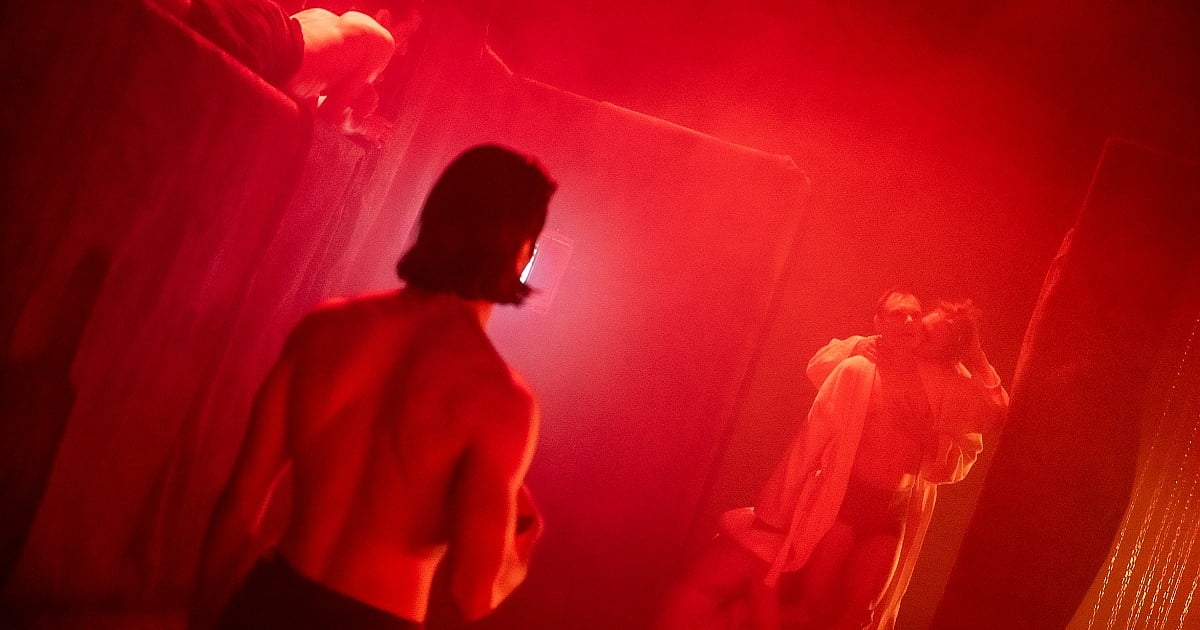
In the first act, the production by director Michał Borczuch dives into the “Ochsengarten,” that famous Munich gay and fetish bar where leather-clad “men in ox hides” used to gather, and where Mercury is said to have spent as much time as he did at the “Deutsche Eiche,” where he liked to breakfast in the afternoons when no one else was around and where—according to the play—he “ate meat patties straight from the pan.”
“The salt of unfamiliar skin mingled with the salt of tears”
There, several men share their experiences as homosexuals in Munich under the shadow of Cardinal Wetter and Cardinal Ratzinger: underground orgies, fleeting yet intense encounters in a steamy sauna, persecution and police raids in the English Garden, and a sense of freedom within confinement—and the fear and sorrow that swept through the scene as more men—Mercury among them in 1991 at the age of 45—died of AIDS. One line that lingers: “The salt of unfamiliar skin mingled with the salt of tears.”
Moreover, the play asks whether the freedom of those ostensibly unfree years may have been eroded as gay men began entering conventional marriages and starting families, and it also asks what comes next in a society moving to the right.
“We had the sense for a long time that things would keep getting better,” says one of the men—especially in Munich, this “pink island in black Bavaria.” But will we be “back in the Middle Ages in ten years”? His fear: “I think queer culture will disappear again.”
Four Freddies, One Journalist
Only in the play’s second act does Mercury speak for himself—and four times at once. Vincent Glander, Thomas Hauser, Max Mayer, and Pujan Sadri share the role of the singer, dressed in white pants, red suspenders, and a flamboyant parroted shirt. They recreate original interview scenarios. Niklas Mitteregger plays the journalist, while the four ensemble members each focus on a different facet of the musician’s character.
Glander, for example, conjures a compelling British accent; Mayer emphasizes the gestures. Only through the ensemble’s combined effort does a full portrait emerge: the radiant, multi-layered singer who was celebrated and solitary, extroverted and reserved, drawing on abundance and yet dying of illness—always iconic.

Mercury
10 photos