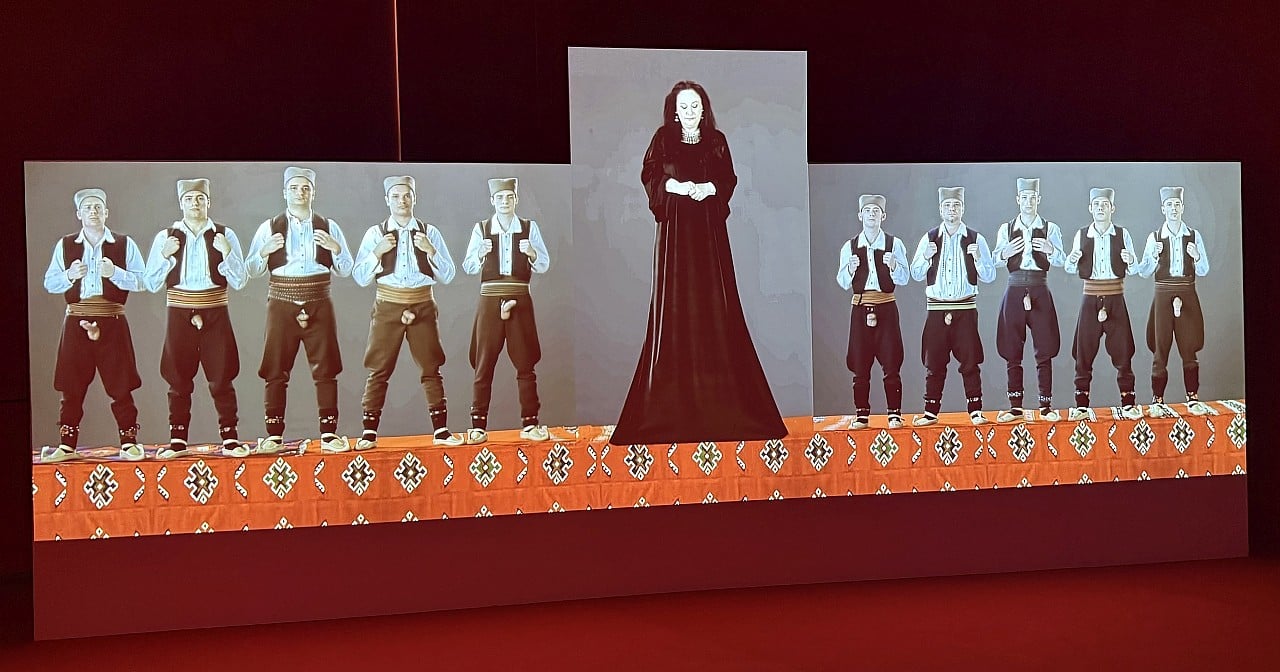
The video installation resembles an altar—rigidly symmetrical and imbued with a sacral aura. But at a second glance, the piece reveals its gay camp aesthetics. At its center stands the singer and actress Olivera Katarina, one of the great divas of Yugoslavia, whose staging evokes a sacred figure. She is flanked by sturdy young men in Serbian uniforms, their erections bulging through the flies of their trousers.
Ironically fractured images of hypermasculinity and heteronormativity, as in this example, are typically part of the repertoire of gay cultural history, used to point to repressed same-sex desire. Yet, according to the exhibition text, the work aims in a different direction. It cites a mythically charged song, performed by Olivera Katarina, that conjures the enforcement of a Serbian Orthodox identity.
“Slavic Soul” is the work from 2005. It belongs to the cycle “Balkan Erotic Epic”—the same name as Marina Abramović’s solo show at the Berlin’s Gropius Bau. It’s a mega-exhibit largely built from multimedia installations. In it, the performance artist treats sexuality not merely as pleasure but as ritual, as a collective choreography, and as a politics of the body.
Eroticism and Ideology
How tightly sexuality and ideology can be braided is already evident at the outset of the exhibition routing in Abramović’s piece “Tito’s Funeral” from 2025, which sits in the luminous, thousand-square-meter atrium on a monumental canvas: An army of black-clad mourners claps their hands to their chests in time with the music.
In a conversation with the curator and museum director Jenny Schlenzka, Abramović talks about her partisan family background and her parents’ enthusiasm for Tito. As a child, she recalls, her father took her to the autocrat’s speeches. “I remember that vast square with thousands of people and the electricity of the crowd rushing through my body. When Tito died, there was an incredible erotic charge in the air, because women of all ages cried and showed their naked breasts: They cried, ‘Why did you take him and not me?’ This shared mourning, fused with so much passion, was deeply erotic.”
Queerness is not a theme for Abramović
Abramović uses her Balkan Erotic Epic to offer a deeply personal take on sexuality and society, and that may be precisely why deeply rooted homophobia and repressed same-sex desire in the show are treated only indirectly, at best. Queerness seems not to be a topic the performance artist—who has become a global star over the past decades—has engaged with publicly so far.
Yet Abramović knows from personal experience what it feels like for teens when desire is stained by shame: “I was always told that sex is dirty, everything was forbidden. And I felt incredibly ugly; I was kind of the black sheep.” A positive relationship with eroticism emerged only slowly, and only after she had long passed her fiftieth birthday could she fully enjoy sexuality. She wants to send this message into the world and encourage people to take more risks through real encounters, rather than waste life in the virtual space. “It is an existential need for us to be erotic, to really have sex, and to feel alive.”
The artist is “completely heterosexual”
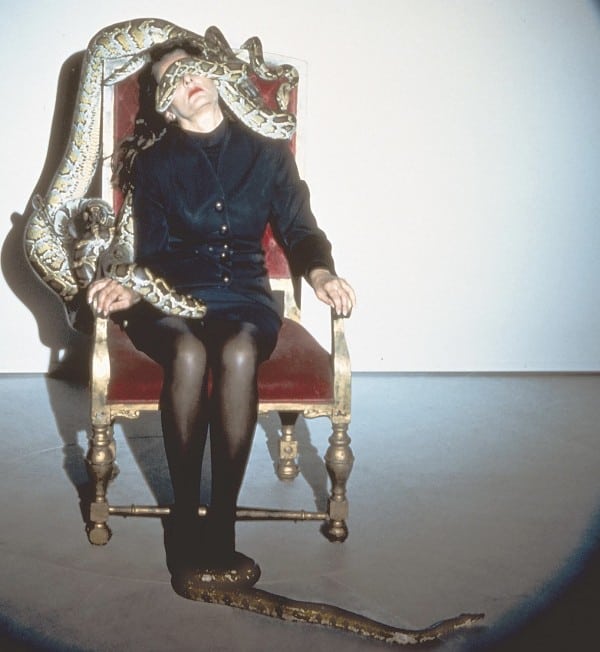
Abramović clarifies in a recent interview with Monopol Magazine that a woman is not an erotic counterpart for her. She is “completely heterosexual,” says she has never desired a same-sex relationship, and she believes that will remain unlikely in the future. What’s notable is not that she quotes her orientation; what’s striking is the firm boundary she draws for an artist whose work thrives on extreme transgressions and on a force of transformation—and, as in her latest work, on the invitation to transcend the ego in collective rituals.
“It’s one thing if you have a private romantic relationship,” Abramović tells the two curators, Jenny Schlenzka and Agnes Gryczkowska. “But eroticism is something else. Especially when you do something collectively as a group experiment, as I propose in Balkan Erotic Epic. You open this erotic side of yourself to the universe and make it as public as possible.”
The Balkans as a land of heterosexual myth
With Abramović’s universal claim for the show, the question arises whether this collective openness in regions like the Balkans also leaves room for same-sex desire. Especially within a framework that examines society’s power over erotic life—a power that continues to sanction homosexual relationships and perhaps needs taboo to preserve its binary order. In “Balkan Erotic Epic” there is no visible or audible display of this homophobia; as a pink elephant in the room, though, it remains omnipresent.
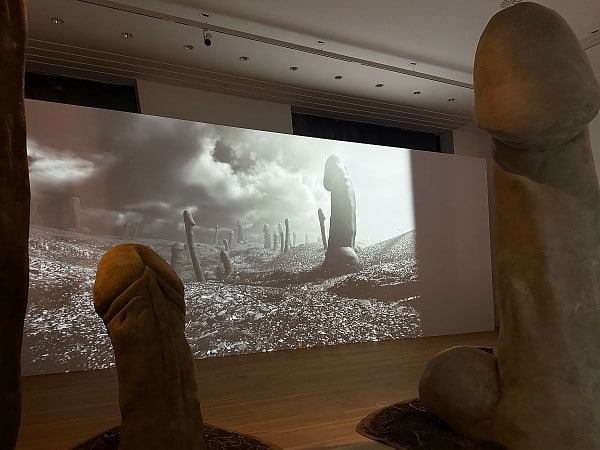
It speaks for Marina Abramović that, while she aims to be taken seriously, she does not want to be taken too literally, and she approaches the subject with irony, exaggeration, and humor. Her monumental piece “Love Potions” consists of a forest of erect giant penises against the backdrop of a screen in which the Balkans appear as a place of heterosexual myths. In the video, one tale recounts a love spell in which a woman inserts a fish into her vagina and leaves it there overnight, only to pulverize it the next day and mix it into a man’s coffee—so that he loves her forever.
That sounds almost like a deconstructed St. Olaf anecdote from the Golden Girls. And indeed, Abramović proves once again to be a gifted storyteller. Yet nothing can quite bridge the gap: the ironization of myths leaves exclusionary mechanisms unaddressed, and queer bodies remain a blank space in the show.
Sexual energy not harnessed
It is not the case that Abramović ignores homophobia or same-sex desire in her work—quite the contrary. In the 2018 documentary “Why Are We Creative?” she is asked, alongside other stars, where her creativity comes from. At the edge of the filmmaker’s interview, she feels compelled to tell what she calls a “shabby joke.” The punchline hints that she does keep the taboo of gay desire in mind, artistically speaking:
“Sarajevo in wartime. There’s nothing to eat, no gasoline, people sitting dejectedly in bars. And this man from Bosnia walks in, in an Armani suit, with a Montblanc pen and a Rolex on his wrist. He orders champagne for everyone. When asked how he can afford it, he says, ‘I run a brothel—everybody comes to screw. Russians, the peacekeepers, just everyone.’ People stare and ask, ‘How many women work for you?’ He replies, ‘At the moment, it’s a one-man operation.'”
The queer community needs a strong journalistic voice—now more than ever. Do your part to support TheColu.mn’s work.
Perhaps “Balkan Erotic Epic” would have gained depth if the joke’s punchline had been integrated as artistically processed material, given that the interview with her curators comes very close to this idea: “It’s important how we use our sexual energy. We can apply it to creativity and spiritual concerns, or we can suppress it, and then it turns into aggression, war, anger, and suffering.” Wouldn’t that thread deserve further exploration within the exhibition? Still, despite this gap, the show remains highly worth seeing.