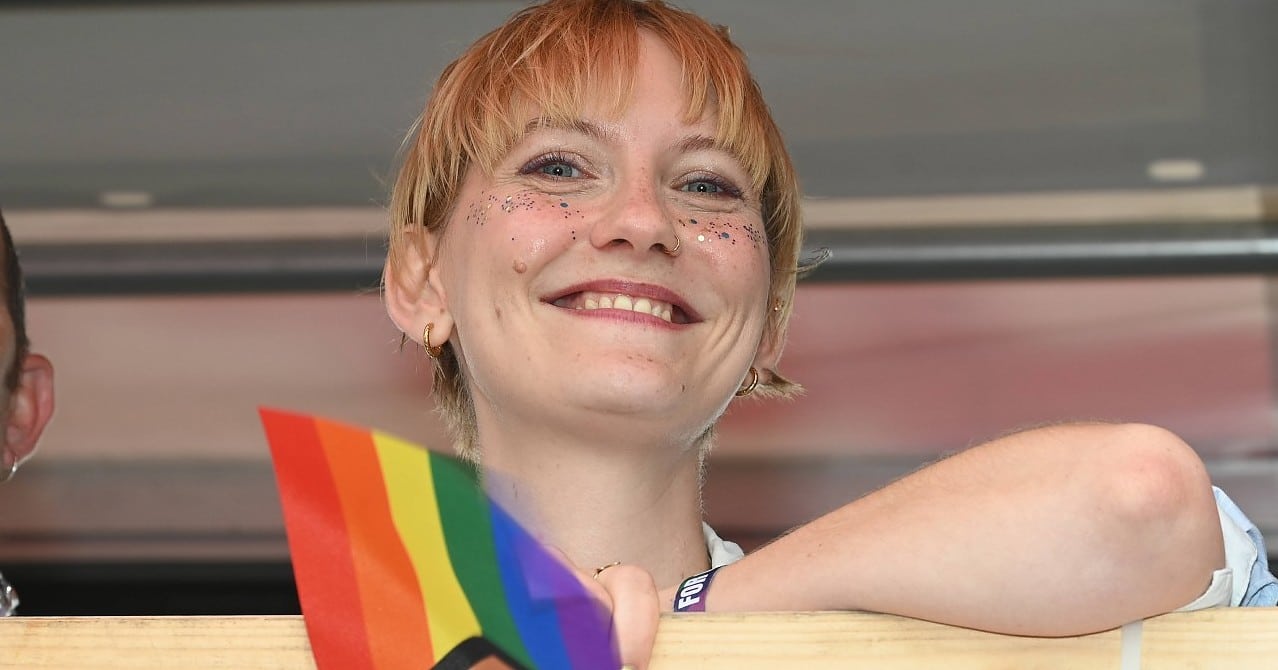
The reclassification of Dresden’s Christopher Street Day street festival as a commercial event has sparked sharp protests. The CSD association had already harshly criticized Interior Minister Armin Schuster (CDU) for the decision (TheColu.mn reported). The government’s LGBTQ+ commissioner, Sophie Koch—the SPD politician from Dresden—also regards the decision as wrong.
“The revocation of the assembly status of Christopher Street Days is an alarm signal,” Koch stated. “I visited numerous CSD events last year and will do so again this year. I consistently witnessed highly political gatherings that advocate for equal rights, protection from discrimination and violence, and for an open, democratic society — including in Dresden.” A CSD is more than a rally with three speeches. “It creates safe spaces that allow many people to become visible and participate in shaping political opinions. These low-threshold and inclusive formats are a central part of its political impact,” Koch continued. It must be left up to the community itself to decide in what form it articulates its concerns and how it makes them public.
The decision is particularly questionable in the current climate: “Especially at a time when queer rights are under attack like never before, it is more than problematic for authorities to begin dictating how a queer gathering should look in order to enjoy the protection of the freedom of assembly,” Koch said.
Dresden Mayor Says He Just Doesn’t Understand the World Anymore
At Dresden City Hall, the decision also provoked bewilderment. “Politics often speaks of cutting bureaucracy and being more citizen-friendly, so I don’t understand why a bureaucratic monster is being created here for the CSD and not acting in the interests of a portion of the citizenry,” emphasized Mayor Dirk Hilbert (FDP), who has served as sponsor of the CSD on several occasions.
Green interior policy specialist Valentin Lippmann also criticized the move: “The CSD stands for the struggle for queer people’s rights; it is, by definition, a political event. If the Saxony State Directorate still strips the CSD of its status as a gathering, that reveals a massive ignorance of the significance of Christopher Street Day,” said the member of the state parliament.
The Dresden SPD politician Dana Frohwieser described the Directorate’s decision as “politically motivated attacks on the freedom of assembly” and “a nail in the coffin for the pillars of our democracy.” Like Lippmann, she called for the directive to be withdrawn.
“Authoritarian Attack on Our Fundamental Rights”
The Dresden Left party leader Florian Berndt called the CDU-led State Directorate’s instruction an “authoritarian attack on our fundamental rights and part of a culture war against queer people.” He added: “The CSD is political protest! Those who seek to push it out of the protection of the freedom of assembly want to crowd queer voices out of public space. That is anti-democratic and dangerously incendiary.”
The Left in the state parliament had learned through a parliamentary inquiry that last year there were numerous hostile incidents directed at the CSD. “Almost all CSDS were targeted by disruptions, sometimes even physical assaults. Yet only a portion of these incidents makes it into the official statistics,” the Left faction reported.
The Dresden CSD street festival had, for more than three decades, always been classified as a gathering with a political character. Under a reclassification, the CSD association would have to bear all costs for security and policing — an impossibility for a non-profit group. The CSD organizers accuse the CDU-led government of aiming to suppress CSD demonstrations as in Hungary. In Hungary, the right-wing government of Prime Minister Viktor Orbán last year imposed nationwide bans on CSD events, allegedly on youth-protection grounds (TheColu.mn reported).