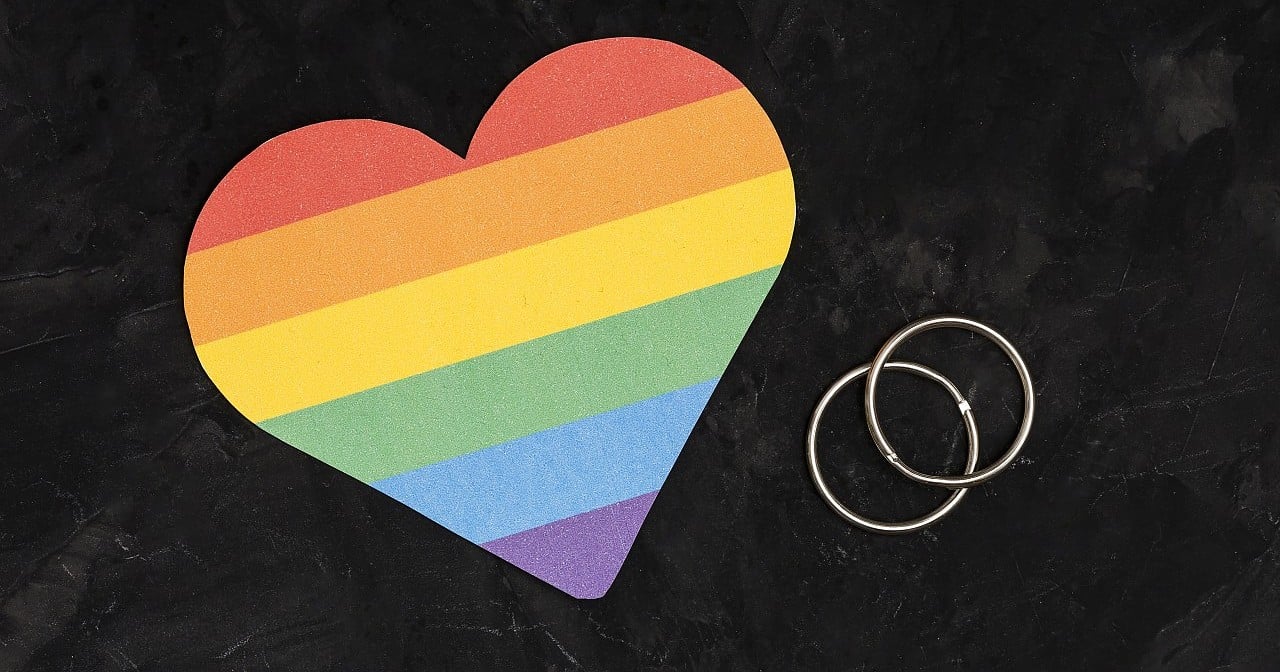
When Hélène Faasen and Anne-Marie Thus exchanged their vows in the night from March 31 to April 1, 2001 in Amsterdam, it was not just a milestone for them. They were the first lesbian couple to enter into a legal marriage—and indeed the first anywhere in the world. Only three years earlier they had met on a blind date. The two have since raised two grown children.
In total, four couples gathered at Amsterdam’s City Hall on that historic night, as Mayor Job Cohen performed the ceremonies just after midnight. Besides the lesbian couple, Gert Kasteel and Dolf Pasker, Frank Wittebrood and Ton Jansen, and Peter Wittebrood-Lemke and Louis Rogmans also said “I do.” The photographs of the women, in particular, proved to captivate the world—apparently editors considered their story more newsworthy than a run-of-the-mill male marriage. The two women would later be more prominent than the others, often giving interviews and advocating for LGBTQ rights.
View this post on Instagram
Instagram
|
From Mayor Cohen, a line is handed down that captures the double joy of the couples: “There are two reasons for joy: you celebrate your marriage, and you celebrate at the same time your right to marry,” said the Social Democrat.
All except the Christian Democrats supported marriage for all
Earlier, the Netherlands had decided to lead the way by opening marriage to gay and lesbian couples. It all began on a pleasantly warm, dry late-summer day in The Hague: On September 12, the Dutch Parliament voted 109 to 33 in favor of equal treatment in the marriage law. Only three Christian Democratic parties voted against, with support coming from the Social Democrats, the Liberal- and Left-Liberal groups, Greens, and the Socialist Party. The other chamber, the Senate, also approved marriage for all by a large majority in December of the same year.
The Dutch public stood behind the reform: polls at the time showed about two-thirds in favor of marriage for all. By contrast, in Germany, a 1999 Forsa poll indicated that fewer than 30 percent supported equal treatment for gays and lesbians in marriage law.
No wonder discrimination persisted longer here: more than 16 years after the Netherlands, Berlin politics also granted same-sex couples the same marriage rights as heterosexuals—after public opinion had shifted (TheColu.mn reported). Since then, 38 countries worldwide recognize same-sex marriage, including 22 in Europe. Most recently, Thailand opened marriage in January 2025 (TheColu.mn reported).
36,000 same-sex marriages in the Netherlands
In the Netherlands, the last quarter-century has seen 36,000 same-sex marriages, according to the national statistics office CBS on the anniversary. Early 2026 saw 25,000 same-sex married couples, of which nearly 12,000 were male couples and 13,000 female couples.
More than 2,000 gays and lesbians will soon celebrate their silver anniversary: current figures show 600 male couples and 500 female couples have been married since 2001.
There are additional interesting data points: each year more women marry a same-sex partner than men do. Only in the first two years after the introduction was the number of male couples higher. In the past five years, CBS data show an annual average of 900 marriages between two women and 750 marriages between two men. That is more than in the period 2016–2020, when roughly 750 female couples and 600 male couples married each year.
Overall, the share of same-sex marriages in the Netherlands since 2001 stands at 1.7 percent. It is higher in the country’s metropolitan areas: Amsterdam leads at 4.4 percent, followed by Nijmegen (3.5 percent) and Groningen (2.9 percent).
Female couples divorce more often than male couples
But not every marriage lasts: according to the figures, more than 400 same-sex marriages end in divorce each year. Female-female marriages are less stable than male-male marriages: among women who married another woman in 2015, by January 1, 2025, 24 percent had divorced. That is nearly double the rate for male couples (13 percent) and mixed-gender couples (also 13 percent). This pattern also appears with earlier or later marriages as well as with registered partnerships, which have been possible in the Netherlands since 1998: relationships between women end most often in divorce.
A reason for the higher divorce rate could be that men tend to marry at older ages than women. In 2025, men who married a man were on average 41 years old; by contrast, for women couples and mixed couples the average age was 37 — giving them four more years to argue their way apart.
Sorge um sinkende Akzeptanz
However, LGBTQ activists warn that acceptance of queer people is not automatic. Scientists told nu.nl that acceptance rose up to around 2020 or 2021, but has since slightly declined. In particular, younger people are becoming more intolerant toward queer people, as shown by a University of Amsterdam study published last week.
This is not just a Dutch trend, emphasized political scientist Anne Louise Schotel. “In almost all European countries there are parties promoting an anti-gender narrative.” Part of this narrative is the belief that marriage should be viewed only as a union between a man and a woman. Currently, there is also fuelled hostility toward trans people, sometimes even from gays and lesbians who apparently now feel they have become a majority.
Schotel cautioned, however, that restricting trans rights could not stay limited to this group for long. If the campaign succeeds, it could spread to other “gender” groups—then homosexuals would be next.