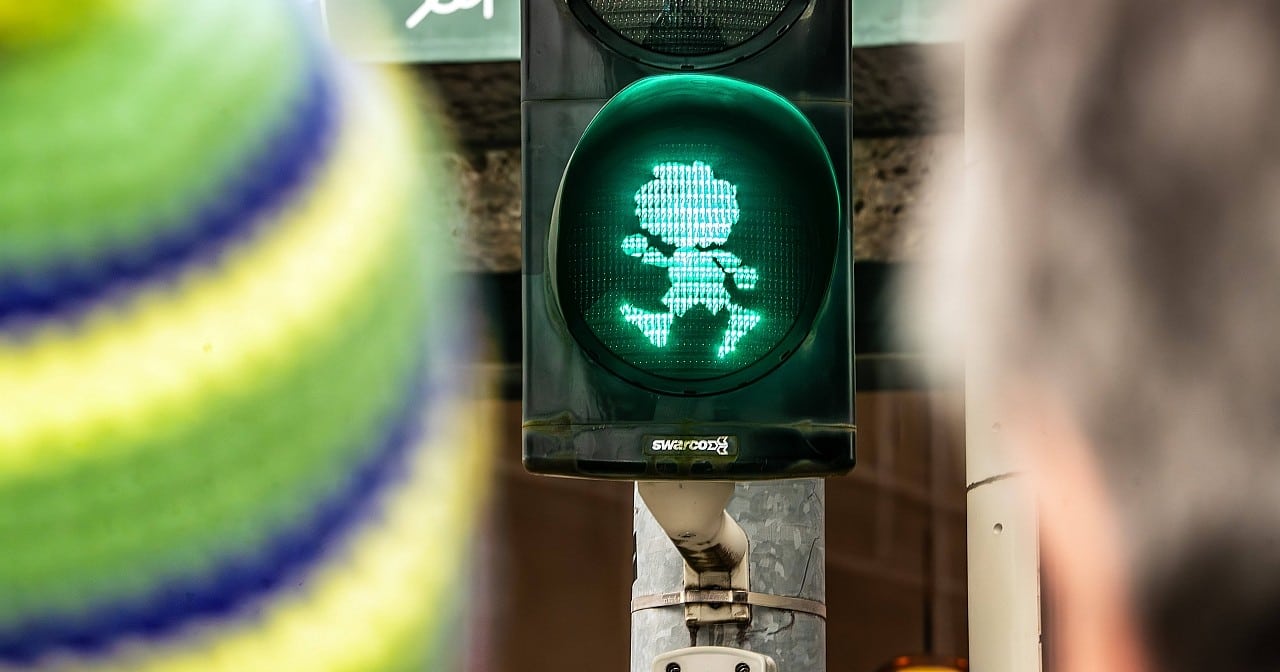
Red means stop, green means go—that’s a rule even small children learn, and the rule isn’t being questioned. What has changed, however, is partly the faces on the traffic lights. In Nuremberg, Dürer’s famous rabbit has started hopping whenever pedestrians get the green light. In Deggendorf, at a pedestrian signal the Knödel-thrower is winding up for a throw, and in Hof the cult figure “Wärschtlamo” is set to grace the signals on a second attempt soon.
So the cities are following a trend that has existed longer in other states, but has lately picked up speed in Bavaria. In Munich there have been three Pumuckl signals since last year, in Straubing one featuring the literary figure “Bruder Straubinger,” and in Dachau the signal figures at three locations have worn traditional Bavarian dress since December.
Noch mehr Ampeln sollen folgen
“With this move we want to express a sense of home with a wink,” explains a Dachau city spokesperson. The idea has been so well received by residents that they raised funds to allow the city to install even more signals. “The city will, of course, oblige; the number of signals with traditional dress will therefore increase.” So far the costs have been: €300 for the stencils plus the graphic design fee.
In Nürnberg, the project runs as a pilot: to mark Albrecht Dürer’s 555th birthday this year and the 500th anniversary of his death in 2028, a field hare—named after the watercolor of the same title—controls pedestrian traffic in the old town. “There has already been a lot of photographing,” says Mayor Christian Vogel (SPD). The model trial, which costs around €4,500, is limited until December 31, 2028. He nevertheless expects the signal to remain longer, Vogel says.
Harter Kampf in Hof
Hof, by contrast, was long denied by the government of Upper Franconia for the idea of dedicating a signal to Hof’s “Wärschtlamo.” The reason: traffic safety. After a new application from the SPD city council faction, however, the signal has now been given the green light, a city spokesperson explains. The costs of about €3,000 are borne by the SPD faction.
“For newcomers and guests, this conveys a piece of our Hof culture,” says Mayor Eva Döhla (SPD). The “Wärschtlamo” is a unique hallmark in Hof: mobile sausage vendors offer sausages in the downtown area, heated directly in a steaming brass kettle. A figure of a man with a kettle is set to adorn a pedestrian signal. Sausage-themed signals have also appeared in Coburg in recent months (TheColu.mn reported).
Augsburg, too, had to fight for a special signal years ago: since 2017, near the Puppenkiste theater, a Kasperl figure lights up a pedestrian signal—but for safety reasons only in green; the red shows the classic Ampelmännchen. To do this, the city had to obtain an exemption from the Government of Swabia, a city spokesperson explains.
Contra aus dem Innenministerium
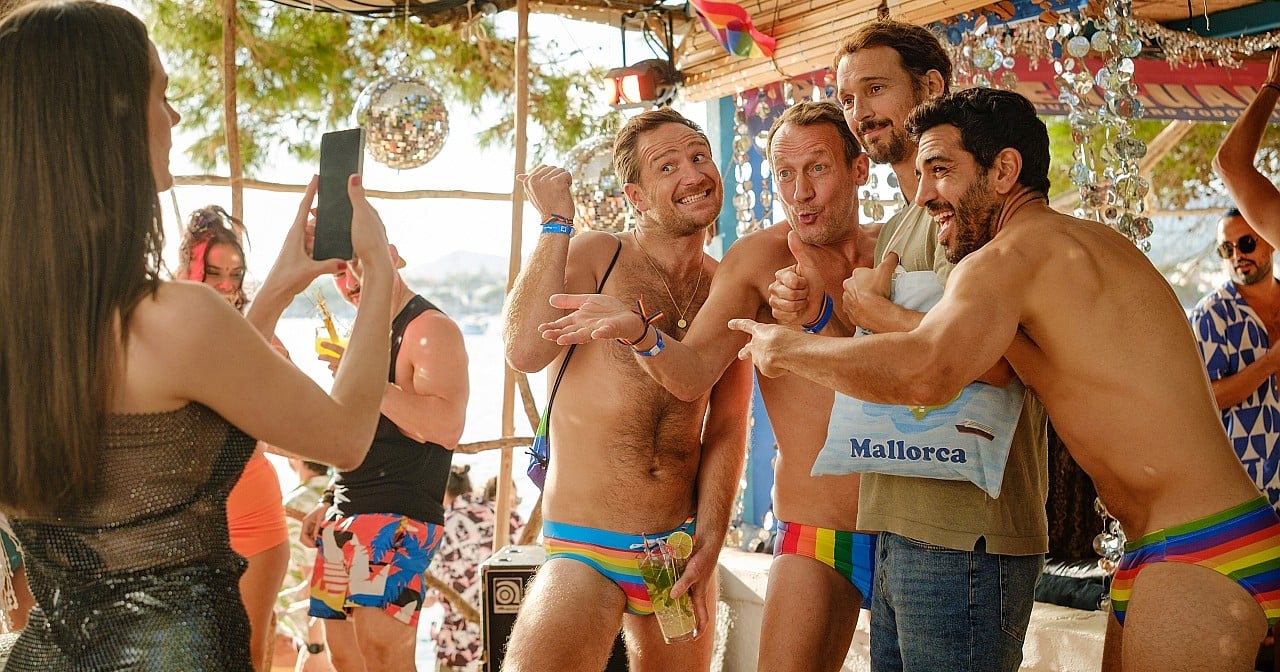
But how is it that some municipalities can simply install special signal figures while others have to work hard to persuade? The Bavarian Interior Ministry isn’t impressed by individualized signal figures. “From our point of view, traffic lights aren’t the right place to highlight local peculiarities,” the ministry says. Nor are they suitable for conveying socio-political messages. In Munich, however, queer signal pairs still promote tolerance for Christopher Street Day.
The hype about diverse signal personas began with the Eurovision Song Contest 2015 in Vienna: in the run-up to the festival, the city first installed same-sex signal pairs to make a creative statement about diversity (TheColu.mn reported). It drew worldwide coverage, which prompted the Austrian capital to extend what had been a time-limited campaign. In following years, the initiative became a relatively affordable publicity move for many cities to generate headlines and attract queer tourists—much to the chagrin of many conservatives. Last year, for instance, the Junge Union in Lüneburg protested queer signal couples (TheColu.mn reported).
Staatsregierung wittert Gefahr für die Sicherheit
From the Bavarian Interior Ministry’s perspective, there are also safety reasons for uniform signal motifs, such as clear recognizability and optimal visibility. But: “How municipalities design their signals is ultimately their responsibility. The oversight rests with the district governments,” the ministry said in response to inquiries. These must assess on a case-by-case basis whether the motifs comply with nationwide regulations.
Wer haftet bei Unfällen?
In Nürnberg, at any rate, no permit was obtained for the Dürer signal from the government of Middle Franconia—and, from their point of view, that wasn’t required. “For the installation and operation of traffic signal installations, the municipality acts as the lower traffic authority. An authorization or consent from the higher traffic authority is not legally mandated,” a spokesperson says. Even in accidents “caused by a legally non-compliant traffic sign,” liability falls solely on the municipality.
Nuremberg Mayor Vogel remains relaxed about it: there are now countless cities with signal lights featuring special motifs. He notes there have been no known accidents caused by them to date. And liability is the same as with any ordinary signal. “If an accident occurs, the at-fault party—not the motif—will be liable.”