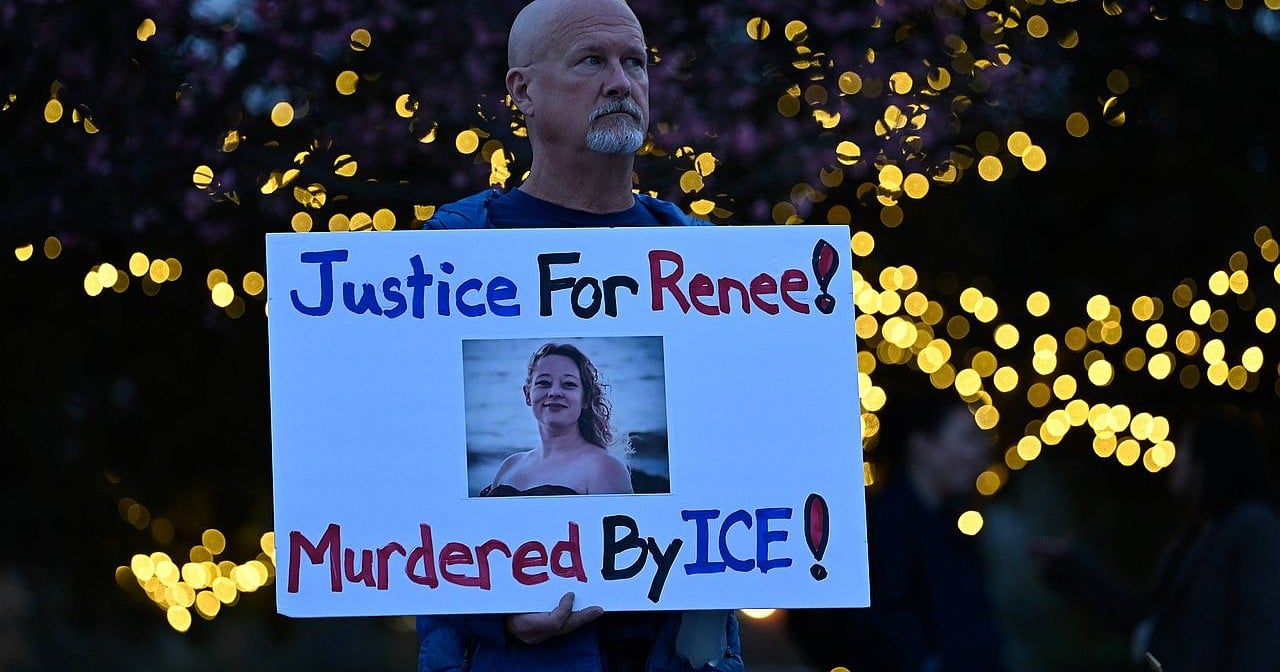
There are disturbing scenes that have unsettled the United States for days: cell-phone footage from witnesses shows an ICE operation in a Minneapolis neighborhood in Minnesota on Wednesday that ended with the death of Renee Nicole Good, a queer American mother. An officer fired multiple shots at the 37-year-old from close range, as TheColu.mn reported.
There are clips recorded from different angles that American and German media have analyzed in recent days to reconstruct what happened in the moments before the shots. On Friday and Saturday, additional perspectives emerged—this time published through government channels as well. “The evidence speaks for itself,” the Department of Homeland Security wrote about one of the videos, paired with pointed criticism of how the media had covered the incident.
But what conclusions can actually be drawn from these videos?
The following overview is based on edited videos evaluated by the New York Times, a cell-phone video from the officer who fired, and a video released by the Department of Homeland Security on Saturday showing the minutes before the incident.
What the footage can tell us
– Good is already in the neighborhood minutes before the confrontation with ICE in the area where the agency is carrying out its operation. Her car is parked crosswise in the street, though other cars can pass. A chorus of honks is heard repeatedly.
– Then there is a direct encounter between the 37-year-old and the officer who would later shoot her. He approaches her car and films. As he moves around the vehicle, Good speaks to him directly. “It’s all right, man. I’m not angry,” she says. She keeps her left arm hanging out the window, while her right hand grips the steering wheel. The officer says nothing.
– Another woman, identified by media reports as Good’s wife Becca, films the officer and speaks to him in a heated tone. Again, he offers no reply. When another officer tells Renee Nicole Good to exit the vehicle, Becca Good tries to open the front passenger door.
– The officer who is trying to get Good to exit the car makes futile attempts to open the driver’s door and reaches through the open window into the interior as the woman backs up and steers to the left.
– It appears the woman is trying to leave the scene. She makes a hard right with the steering wheel—away from the officers—and moves forward.
– As the car moves forward, one of the officers draws his weapon. At the moment the shots are fired, the tires are clearly angled to the right, toward the direction away from the officers.
– The situation escalates in under a minute.
What cannot be determined from the videos alone
– The context and backstory are unclear. In a message to a Minnesota radio station, Good’s wife said they wanted to support their neighbors—possibly to shield them from the authorities. The honking and the wail of sirens in the videos suggest protests in the neighborhood against ICE operations, something that has occurred in many places as immigration enforcement has intensified.
– It is not clear why Good’s car was parked crosswise in the street. The Department of Homeland Security accuses the woman of trying to block the operation.
– It is not clear what prompted the 37-year-old to tell the officer that she wasn’t angry. We can only speculate why she did not comply with the officer’s command to exit the car.
– It is not clear how far the officer stood from the car. Depending on the camera angle, the distance looks different.
– A central open question is whether the car touched the officers at any point.
What the U.S. government and other politicians see in the videos
– The Department of Homeland Security and Vice President JD Vance present the video from the officer’s perspective as evidence that he fired in self-defense.
– DHS views the Saturday video, which shows the minutes before the incident, as evidence that the woman was obstructing the operation.
– After reviewing the footage, Minneapolis Mayor Jacob Frey, a Democrat, dismissed the portrayal that the officer acted in self-defense as “bullshit.”
– On Wednesday, Minnesota Governor Tim Walz, also a Democrat, said he had seen a video. He wrote on X: “Don’t believe this propaganda machine.”
Where the limits of video material lie
– Videos give the impression of objectively reflecting reality. There are several recordings of the Minneapolis incident that can help piece together what happened, but they can also be used to lend weight to a particular interpretation.
– Depending on the vantage point and what is cropped, situations can look very different and be interpreted in contrasting ways. It is all the more important to consider multiple angles.
– Videos can, in some cases, answer how something happened, but not always why. Why do people act as they do?
– Videos do not answer how the people involved subjectively perceived the situation. Did they feel threatened? The officer’s video does not answer that either. Nor do we know how the woman in the car perceived the scene up to the moment of the shots.