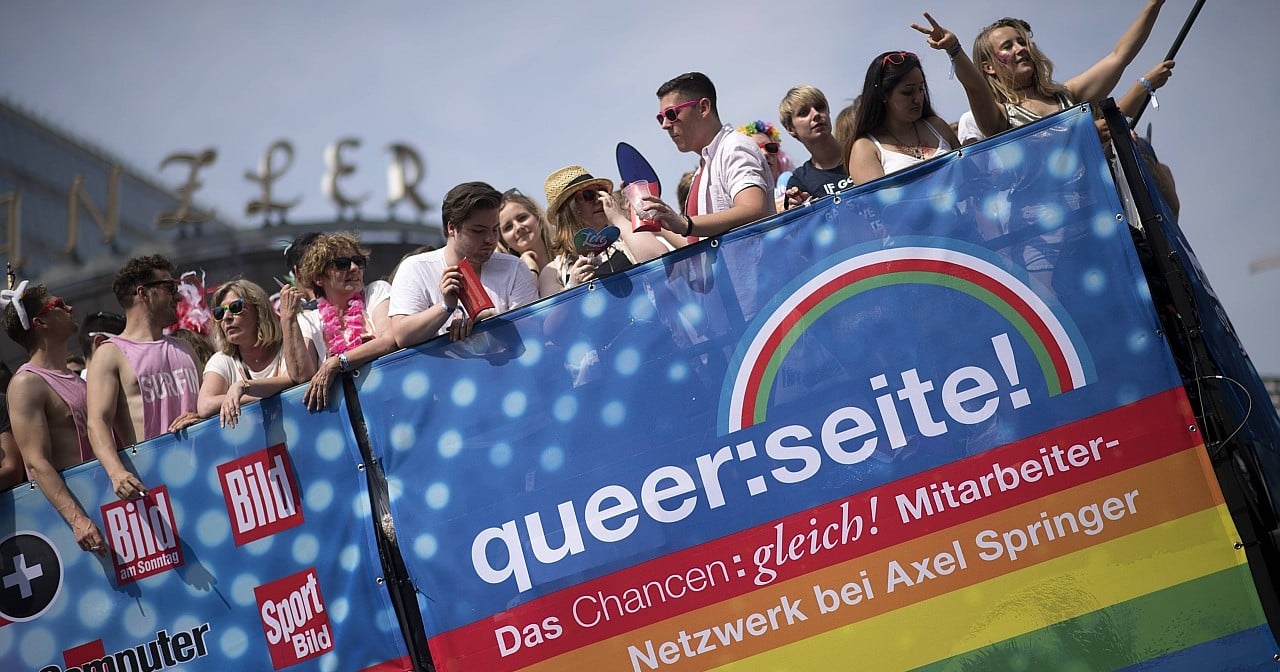
The Bundestag spent about a half-hour on Wednesday evening, right before the day’s close, debating a Left Party motion aimed at better protecting CSDs (Pride events). The backdrop is that this year there have been as many right-wing extremist assaults on Pride events as ever before.
In their motion, the Left faction called on the federal government to put the safety situation of queer people on the agenda. “The subject of the consultation should be measures to better recognize motives behind queer-hostile crimes and to record them within police reporting systems, as well as to provide enhanced support to victims of queer-hostile hate crime,” the document states. It also calls for the government to develop a comprehensive strategy “to ensure, by 2026, safe participation in CSD/Pride events and the full exercise of the right to freedom of assembly.”
Brückner: “Everywhere queer life is visible, it is attacked”
Maik Brückner, the Greens’ queer-policy spokesperson, opened the debate by noting that many queer people in Germany do not feel safe. “Wherever queer life is visible, it is attacked. Every second CSD this year was assaulted. Behind that often stand far-right groups, and that is a scandal,” said the 33-year-old. “Our history of persecution makes us sensitive to danger.”
He accused conservatives of spreading “racist propaganda” as a proposed solution. “One police week here, more deportations there, and then the world is safe again for white, comfortable gay men,” Brückner said. He also argued that their “polemic against the Self-Determination Act” or the rainbow flag drags the discourse further to the right.

Union: Queer-hostility is “imported”
The two speakers from the CDU and CSU rejected Brückner’s charges—and even insisted on their claim that right-wing extremism is not the main problem: Christian Social Siegfried Walch explained that “hate and prejudice have also been imported into this country.” “Anyone who comes to our country must accept that our laws apply here, that our rules and our value system are recognized. Sharia does not apply here. Fundamentalist ideas do not apply here.” He offered no comment on far-right violence, although that was the subject of the motion.n
CDU politician Florian Oest described the Left’s motion as merely “symbolic politics.” He accused the opposition party of being hostile to the police: “It is very hard to tolerate when those who distrust our police so often—and in parts even tolerate violence against police officers—now claim to demand more police work.” He praised German security agencies as “learned, professional and vigilant.”

Both Union politicians, however, stressed that queer people should be equal and possess the right to demonstrate: “It is a great good that all people in Germany can live and love as they wish,” Oest stated. Walch added: “Quite apart from anything else—I can say this as a liberal-conservative and as a heterosexual man—being gay or lesbian is now something completely normal.”
Slawik criticizes “distraction debates” by the Union
The Greens’ queer-policy spokesperson, Nyke Slawik, harshly criticized the Union for not tackling problems in the country— not only in queer policy but also rising rents and the climate crisis. Instead of taking action, she argued, “we see a politics that, whipped up by the right, conducts distraction debates and creates enemies. This is how refugees, poor people, or trans people are ‘scapegoated.’” This is fueled by right-wing extremists “and their parliamentary arm,” namely the AfD. “Dear government, you are partly complicit with this societal mood.”

AfD talks about “perverse” queer people
The AfD MPs Christopher Drößler and Beatrix von Storch portrayed queer people and migrants as a threat to the nation. Drößler described drag queens as “often perverse.” The 30-year-old police officer accused the Left faction of an “obsession with the rainbow lobby and so-called queerness.” “What you label as queer-hostility is in fact only a rejection of your subversive agenda.”
Von Storch, as with the earlier CSU member Walch, pointed to a specific group as responsible for queer-hostility in Germany and spoke of “Muslim violence in large cities.” Discussing this topic, she argued, is “totally taboo” for the Left.

Lindh: AfD denounces CSDs
Helge Lindh of the SPD sharply criticized the AfD for its rhetoric: “Your game is to denigrate all CSDs in Germany as hypersexualized events. The point is that you yourself promote sexualization and hypersexualization.” He cited statements from the AfD that cast CSDs as “degenerate perversion and sick fantasies.” He added: “Our responsibility is to ensure people can safely attend CSDs, which is jeopardized by your actions.”
His fellow SPD member Hakan Demir emphasized that the state must serve as a “shield” for queer people. He cited Berlin bar owner Danjel Zarte, whose queer café “Das Hoven” in Berlin’s Neukölln has repeatedly faced attacks—employees were assaulted, SS runes and Nazi slogans were sprayed on the facade: “Some of his regulars stopped coming,” Demir recalled. “To keep his business running, Danjel pulled 14-hour shifts, just so no one would have to work alone.” The SPD politician urged: “Those who are attacked should not have to rely on their own strength alone.”

At the end of the debate, the motion was referred to the 42-member Interior Committee.