On October 11, in Krefeld, the theater piece “No Word From Us” will celebrate its world premiere — right on Coming Out Day. Written by Simone Saftig and directed by Marvin Wittiber, a TheColu.mn contributor, it marks the first German-language play explicitly aimed at young people aged 14 and up and addresses the Nazi-era persecution of men under Paragraph 175. The story follows three boys living in a residential training home, as they wrestle with their feelings and identities amid coercion, loyalty, affection, and betrayal.
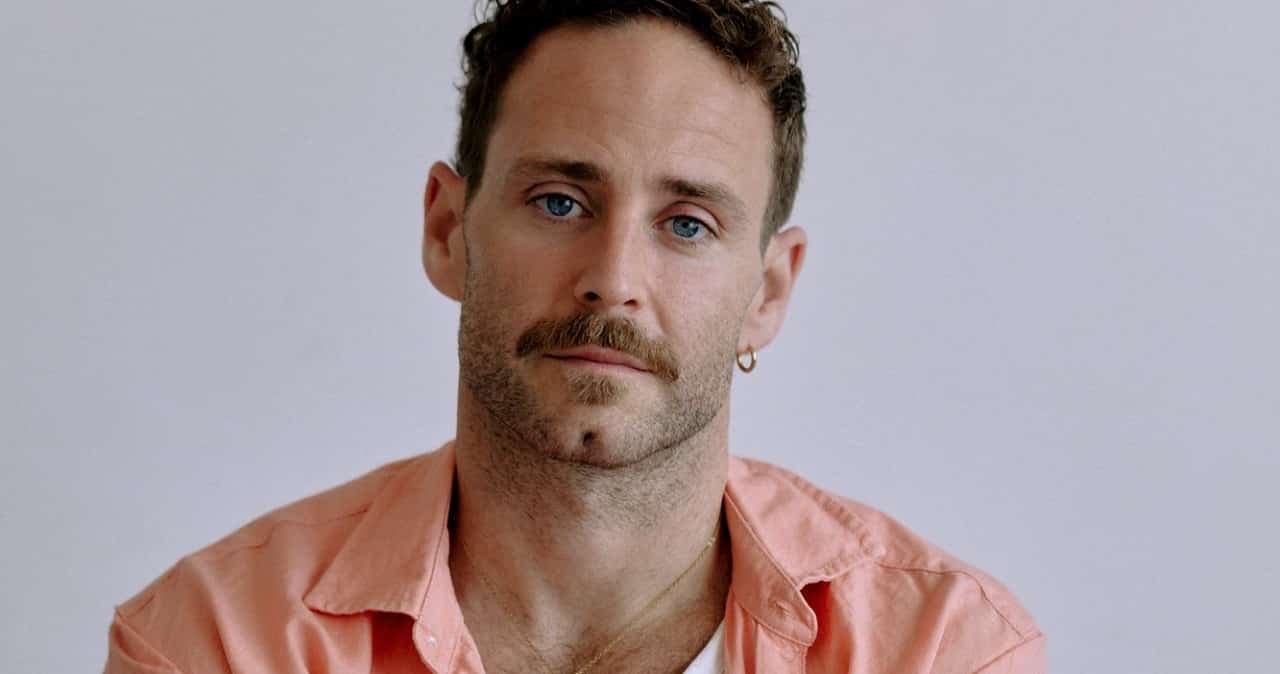
Einer von ihnen ist Kaspar, gespielt vom queeren Schauspieler Victor Maria Diderich. Für ihn ist die Rolle mehr als nur historische Auseinandersetzung sie ist auch ein sehr persönliches Erinnerungs- und Empowerment-Projekt. Wir sprachen mit ihm über queere Verfolgung, die politische Aktualität des Stücks und die Frage, warum Zärtlichkeit zwischen Männern für ihn ein Akt des Widerstands ist.
You play the lead role Kaspar in “No Word From Us.” What is the play about — and why is this story, in your view, especially important today?
The play follows three boys who live in a training home during the Nazi era. It centers on the persecution of men deemed homosexual — those accused of same-sex acts under Paragraph 175. The characters embody three stances: loyal to the regime and homophobic, insecure and torn, rebellious and freedom-loving. Yet in the end, all suffer under the repression.
I’m struck by how timely the topic remains. Queer rights are under threat worldwide — and even without political setbacks, we’re far from hitting our goals. “No Word From Us” offers an alternative way of relating to one another: a queer sense of normalcy, and especially a tender, loving, unparalleled closeness between men.
Kaspar experiences affection for another boy in a time when Paragraph 175 criminalized any closeness. How do you stage this mix of tenderness and danger on the stage?
Kaspar is not blindly loyal to the system or to ideology, but he has internalized the regime’s hatred. Inside him, attraction and aversion, love and disgust, desire and prohibition clash. He teeters between the eruption of real feeling and the impossibility of speaking or living within the ban. On stage we’ve translated this choreographically: anger surfaces as a struggle, tenderness as a game — a framework of rules Kaspar needs to feel safe. And even this tenderness is never fully relaxed.
Historical queer figures from the Nazi era are almost entirely known through perpetrator records. What does it feel like to embody a character like Kaspar in that gap?
I had to be very precise about whose perspective speaks in the texts. I can’t build a character from perpetrator records. Instead, I developed Kaspar through his dialogue and reactions — supplemented by empathy, experimentation, and imaginative process. And always with the question: How would I have felt in that situation, how would I have behaved?
The piece is explicitly aimed at a young audience from 14 onward. What do you hope young queer viewers take away from this production?
For the first time I consciously realized that I belonged to a group that was persecuted back then. In school I never learned this. Although I studied a lot about Nazism, the persecution under Paragraph 175 remained almost invisible. I hope the piece contributes to shedding light on our queer history. I want young queer people to learn their own history and, at the same time, to be inspired by the courage of the characters who acted on their true feelings despite the worst circumstances, who were queer even without knowing the term. That brings to mind a line from Dieter Forte: “Believe in your dreams. They are reality. Believe in your feelings. They are the truth.”
You’re part of the #ActOut initiative. What does this collective coming out in the industry mean for you and your work as an actor?
Before #ActOut, I looked for ways to veil my private life — out of fear that I wouldn’t be trusted with heterosexual roles. Actors were advised not to come out. That’s ridiculous: acting means embodying a character who isn’t me. In 2021, #ActOut greatly strengthened visibility. I recommend everyone check the manifesto at act-out.org.
You and the director are the only openly queer artists on the team. Do you feel that this brings specific perspectives or sensitivities into the work that would be missing otherwise?
Definitely. For this piece, a queer perspective is essential — whether from personal experience or from deep engagement with the topic. The dialogue between Marvin and me, our alignment of experiences and opinions, was a crucial input. And I think it’s important that not just one queer voice is present: every experience is individual, and sometimes universality emerges precisely from the dialogue between different perspectives.
Kaspar discovers feelings for another boy under life-threatening conditions. Were you able to draw on your own experiences or memories while performing — and how has that shaped your work?
That’s always a personal decision. I handle it carefully, especially with topics that move me deeply and linger after performances. Of course my own experiences help as reference points and inspiration. In the performance, I try to think and feel as Kaspar. Rather than recalling personal memories one-to-one, I create — inspired by my life — new images and memories for Kaspar. I can empathize without overburdening myself.
Since #ActOut, a lot has moved. How do you experience the representation of queer people on German stages and screens today — and where is there still a gap?
In recent years, progress has been made: more queer roles and more visible role models — on stage and on screen. That’s a good path. But often queerness remains the conflict itself, the problem around which the plot revolves. We’re not at a point where characters can simply be queer — without commentary. That may reflect a painful reality, but art can do more. It can foster acceptance by showing not only what is, but what could be. To do that, we also need more queer characters in plays or films that aren’t explicitly about queerness — people who simply live as they live.
Three young actors carry this piece. You’re the only openly queer person in the ensemble. Do you sense in rehearsal that your two colleagues aren’t affected in the same way — and does that change your collaborative process?
My colleagues approach the topic with sensitivity and empathy; they listen and want to understand. But I carry it differently inside. For me it’s personal: the quotes from the perpetrators strike me and trigger anger, disgust, and fear. When I go home after rehearsal and embrace my husband, I realize I can’t just switch off. In relation to my own life, I inevitably see parallels — which makes it harder than simply feeling with others from the outside.
“No Word From Us” is described as an “Act of Tender Disobedience.” What does that phrase mean to you personally?
I find the phrase beautiful! There’s still far too little tenderness in our society — especially among men. “Tender Disobedience” means trusting your feelings, even when they’re deemed forbidden. The resistance lies in tenderness itself, which at the time was labeled “soft” or “harmful to the community.” So the characters resist twice: against the system — not with its violence, but with the forbidden tool of tenderness.
If you could truly meet Kaspar today — what would you say to him?
Kaspar, as he’s described in the play, never existed exactly as such. But he stands for many young queer people who were persecuted under Paragraph 175. I’d tell him: your resistance was not in vain. Paragraph 175 was finally repealed in 1994, and in 2025 we tell your story on stage. Maybe he’d be glad that he inspires and empowers people. I’d invite him to lie hand in hand with my husband and me in a meadow — to thank him for defending tenderness.
Victor Maria Diderich was born in 2000 in Cologne. From 2020 to 2024 he completed his professional acting training at the Schauspielschule der Keller in Cologne. He gained his first stage experience at the Bonn Theatre, performed at Theater der Keller in “Rettet den Kapitalismus!” and “Frühlings Erwachen: Baby, I’m Burning!”. In 2023, Victor was awarded the Cologne Theater Prize PUCK as Best Emerging Actor. At the Landesbühne Rheinland-Pfalz in the Schlosstheater Neuwied, he appeared in “What the Rhinoceros Saw When It Looked Over the Fence” by Jens Raschke. In “Kardinalfehler” by Alistair Beaton and Dietmar Jacobs, Victor appears as a priest seminary student at various theatres. He has already played several guest-star roles in TV series (including “SOKO Köln”, “Der Staatsanwalt”, “IaF — Die jungen Ärzte”) and supporting roles in TV films (including “Eine Klasse für sich”, “Laim und das Hasenherz”, “Käthe und ich”).