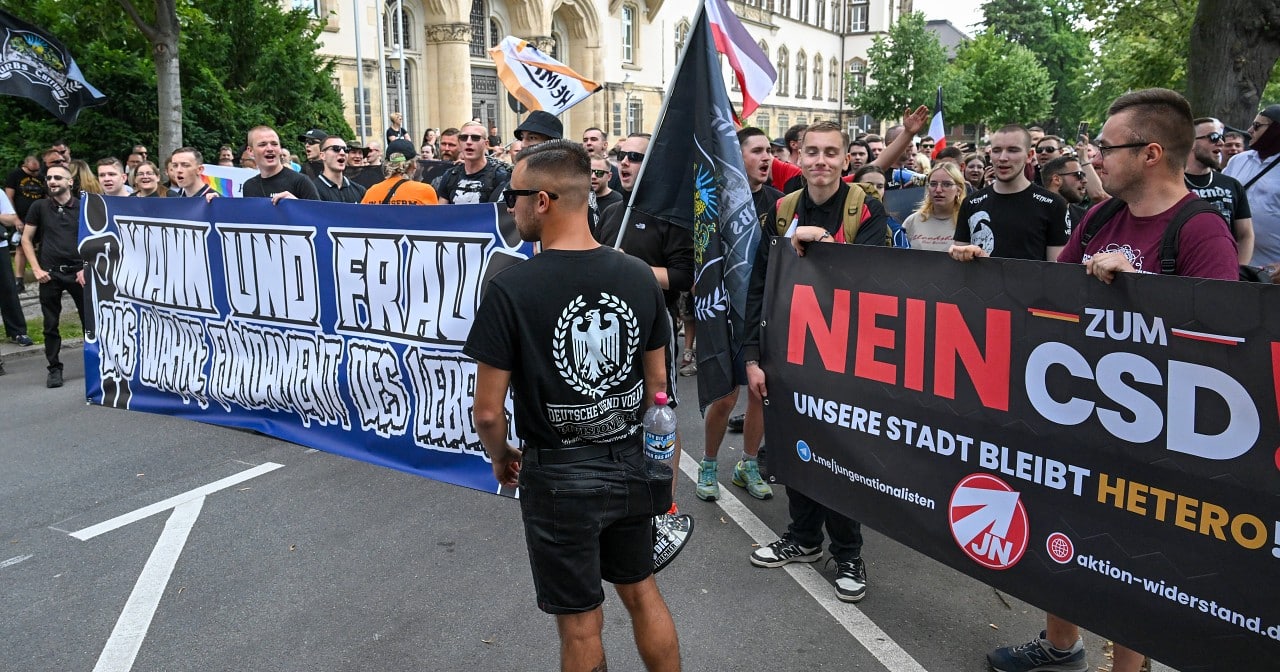
This year Germany hosted more CSDs than ever before — but the share of attacks rose sharply as well. The monitoring report presented on Monday by the Amadeu Antonio Foundation shows that assaults and disruptions are now present at every second CSD.
According to the report, 299 CSDs took place across the country this year. 156 of the events were disrupted — that amounts to 52 percent. In some cases, there were multiple disruptions at a single CSD.
Compared with previous years, the number of attacks on CSDs has risen and reached a record high. In 2025, there were 245 CSDs with 112 disruptions — or 46 percent of Germany’s Pride events.
“Queer people are not safe in Germany — not least highlighted by the deadly Islamist attack on the Berlin CSD,” explained Ronja Pohl, author of the monitoring report and right-wing extremism expert at the Amadeu Antonio Foundation. “There are more and more CSDs happening; that is a reason for hope. But the danger for organizers and participants of CSDs is enormous. Right-wing counter-demonstrations, physical assaults, and verbal hostility have become part of the sad reality of CSDs. This is not normal.”
Increasing Violence
The number of physical assaults against CSD participants has also surged: the monitoring recorded four physical attacks in 2025, and by 2026 there were at least 19 — a rise of 375 percent. There was also an uptick in property damage: 27 incidents, five times higher than the previous year. Insults against CSD participants (58 incidents) rose by more than 50 percent compared with the prior year.
“In addition to far-right rallies, we are also seeing increasingly spontaneous attacks by bystanders and individuals against CSDs,” warned Tahera Ameer, board member of the foundation. “This growing violence and the normalization of queero-hostility show: queer-hostility is once again within reach. The normalization of queer-hostility is extremely dangerous and must be fought with all means.”
Despite the Risk: CSDs Receive Less Support
Because of the heightened threat environment, CSDs will need higher security measures in the future, increasingly funded from private sources. The foundation assumes that without financial backing fewer CSDs, especially in rural areas, will be able to take place.
“CSDs are being made harder to fund. In some authorities they are considered too political to receive funding, in others they are deemed too apolitical to be recognized as political assemblies,” Pohl explained. “Against this backdrop we funded safety measures for 28 CSDs this year — many of them in small eastern towns. But that cannot be the solution forever. The state must ensure that queer people are safe.”
Recently, it became particularly difficult for CSDs in eastern Germany: in Dresden and Görlitz, authorities initially refused to recognize Pride in full as a political event and thereby shifted large costs onto organizers. CSDs are also under pressure from federal politics: the Federal Ministry of Education, led by Karin Prien, cut the entire funding for the CSD in Rathenow, Brandenburg at short notice this year (TheColu.mn reported). The CDU minister had previously stated that many funded projects were too left-leaning. (dk)