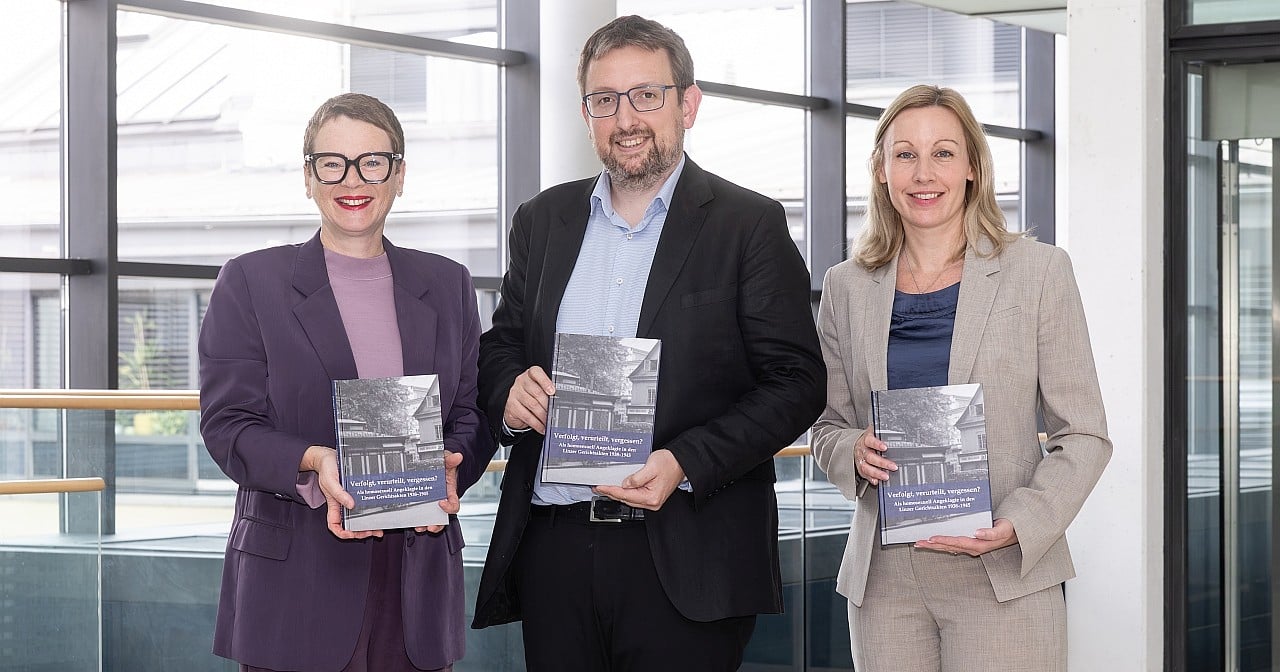
The Linz City Archive has conducted a scholarly examination of the persecution of gay people during the Nazi era. The collected volume “Pursued, Judged, Forgotten? As Homosexually Accused in Linz Court Records 1938-1945” will be unveiled on November 10 at 6:00 PM in the Council Chamber of the Old Town Hall. Please register by November 2 at [link].
Linz thus ranks among the first cities in Austria to tackle this topic in a comprehensive, dedicated volume, said Eva Schobesberger, the City Councillor for Education. “The reckoning with our history must not stop with those whose fates are already part of public memory. We must also bring to light those whose persecution and suffering were silenced for decades.” The research, anchored in individual cases, shows how discrimination and persecution could destroy people’s lives.
Court records analyzed
The basis consists of court records from 1938 to 1945 that are housed in the Upper Austrian State Archive. The City Archive compiled them into a specially created database—with information about the accused, judges, witnesses, charges, and procedural steps. The investigations often began with a personal advertisement in a newspaper, a meeting in a public place, or a denunciation.
“Today we know a great deal about many of those affected largely because courts and authorities turned private relationships into matters of criminal investigation,” said Archive Director Johannes Kaska. The records, however, primarily document “the perspective of the prosecuting authorities of the time.” Not every person described as homosexual in the files would have identified that way themselves.
In Austria, lesbian sex was also illegal
The ten contributions in the volume, including an interview, examine the topic from legal-historical, social, and biographical angles. Historian Thomas Buchner, who also built the database, analyzes the proceedings statistically and places them within Austria’s broader history of persecution. A focus is placed on lesbian women: unlike German law, Austria’s penal code criminalized sex between women as well. Natascha Bobrowsky investigates the relevant cases at the Linz Regional Court under Paragraph 129 Ib.
Gerhard Obermüller shows, using the example of the Brothers of Mercy, how the National Socialists deliberately weaponized charges of homosexual acts against members of the Linz-based religious order. Elisa Frei summarizes the current state of research on the queer history of the Mauthausen concentration camp complex. In the camps, homosexual men had to wear the pink triangle, and for many, the imprisonment proved fatal.
Persecution also after 1945
Even after the war’s end in 1945, persecution did not cease. Paragraph 129 Ib, dating from 1852, remained in force, and the number of convictions reached a peak around 1955. Austria did not fully lift the total prohibition until 1971, and the last discriminatory special provisions were repealed in 2002. Homosexual people were explicitly recognized as NS victims under the Victims’ Welfare Act only in 2005. Since February 2024, a law has stood in place for the rehabilitation and compensation of those convicted in the Second Republic.
“Many of the affected individuals had to endure discrimination and stigmatization even after 1945,” said Deputy Mayor Karin Leitner. The publication serves as a reminder that equality and social acceptance are not, by themselves, guaranteed.