You don’t have to like him to remember him. No German actor has polarized audiences the way Klaus Kinski did. He was born on Sunday, October 18, 1924, in the Baltic Sea resort town of Sopot near Danzig. Even 35 years after his death, he still has a presence that few others can match. Here are six reasons why that remains true.
1. The Evening That Becomes a Myth
In November 1971, Kinski hoped to premiere his monologue “Jesus Christus Erlöser” at the Berlin Deutschlandhalle. But the night, attended by roughly 5,000 people, turned into a fiasco. The audience ridiculed the performance with laughter, sneers, and interruptions (“Kinski is not Jesus”). The actor let himself be provoked and answered with insults. When a spectator argued that Jesus had been “tolerant” and had not cried out “Shut up!” when confronted, Kinski fired back: “No, he did not say ‘Shut up.’ He took a whip and punched him in the face! That’s what he did. You stupid pig!” Kinski chased the grand stage, but not dissent.
2. Fruits of Wrath: The Five Herzog Films
With director Werner Herzog, Kinski wrote a chapter in cinema history. The two teamed up for five feature films: “Aguirre, the Wrath of God,” “Nosferatu — Phantom der Nacht,” “Woyzeck,” “Fitzcarraldo,” and “Cobra Verde.” Kinski repeatedly voiced scathing criticisms of the director, calling him cowardly, money-driven, sadistic, and malevolent. On the set of “Aguirre,” there were rumors that he threatened to walk off the production. Herzog later recalled that he once warned Kinski that he could shoot him. During the shoot of “Fitzcarraldo,” one of their most legendary clashes erupted (“Screw you!”). Afterward, an indigenous man reportedly offered to kill Kinski for the director. Herzog would alternately call him a “world wonder” and “the ultimate pest.” The manic, combustible dynamic between the two is best described as a volatile, perhaps even obsessive, love-hate bond.
3. Short Fuse, Big TV Stage
A trifling provocation is sometimes all it took—and Kinski would erupt. Equally famous as for his films is his on-air temper on German television, which could be entertaining or excruciating, depending on the moment. He snapped at a ZDF journalist: “From an illiterate person, I must endure such nonsense!” In an ARD talk show, he retorted to a heckler from the audience: “I can’t insult you as much as you irked me.” On the NDR Talk Show, he repeatedly complimented the host’s posterior on camera, yet refused to share details about his current projects: “I have no ambitions to seek publicity.” And in a conversation with Thomas Gottschalk, he left him waiting as Gottschalk spent minutes stammering, “I don’t understand the question.” The volatility of his TV persona became almost as legendary as his films.
4. Allegations by the Daughters
By the time the abuse allegations from his two daughters—actresses Nastassja and Pola Kinski—entered public discourse, the father’s image had already shifted in the public eye. Pola (now in her mid-70s) accuses him, in her 2013 memoir Kindermund, of years of sexual abuse and of ruling the family with despotism. Nastassja (now in her mid-60s) says he harassed her when she was just four or five years old. With Kinski passed away, he cannot publicly respond to these accusations, leaving the conversations around his legacy more contested than ever.
5. Kinski, Reenacted
For those who never saw him on the big screen, a different portrait of Kinski has circulated—the impressions of him that live on in comedy. The German comedian Max Giermann performs a flawless parody of Kinski, so precise that audiences sometimes struggle to tell the two apart. In the 2022 film “Die Geschichte der Menschheit — Leicht gekürzt” (A Brief History of Humankind, Lightly Cut), Giermann embodies the role of Jesus as Klaus Kinski, turning the legendary intensity into a comic mirror of the actor’s persona.
6. The Queer Monster
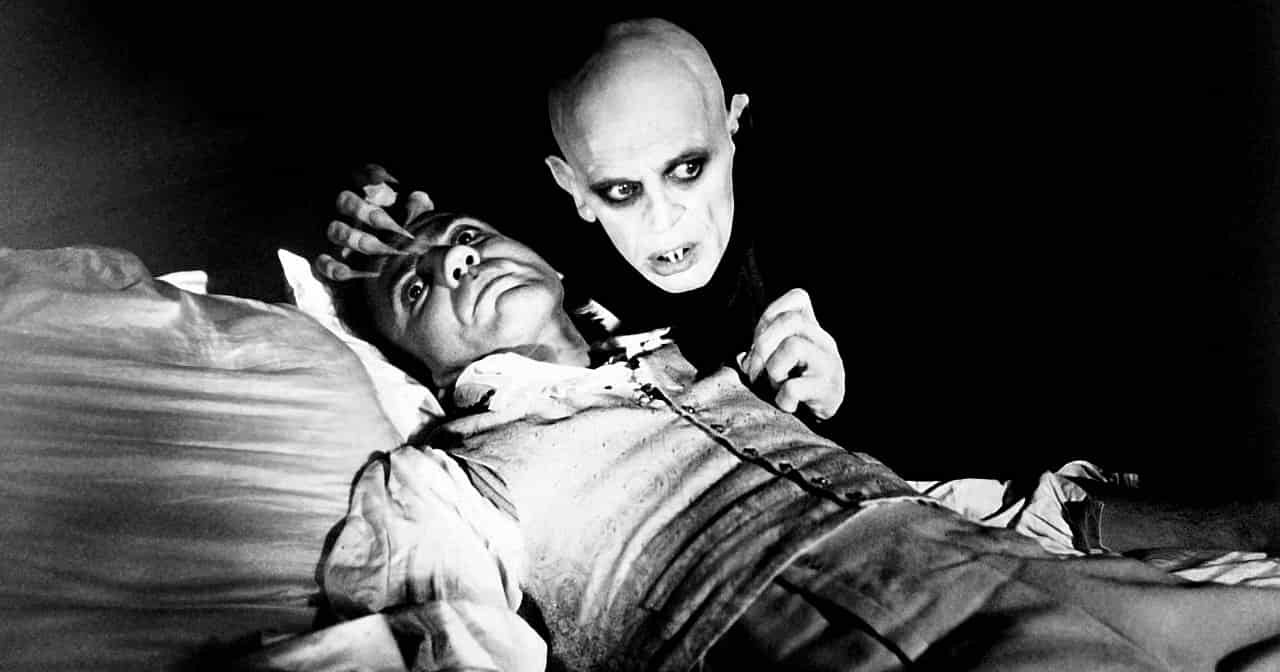
In film history, Kinski’s most intriguing contribution to queer cinema lore centers on one role. In “Nosferatu — Phantom der Nacht” (Nosferatu: Phantom of the Night) from 1979, he portrays the vampire first brought to screen by F. W. Murnau in 1922. Murnau’s Nosferatu is widely read as a queer-coded monster. Film scholar Thomas Elsaesser reads the figure as a reflection of the director’s suppressed homosexual desire. Kinski’s other parts often orbit misfits and fractured masculinity. In “Kinski Paganini” (1989), he took the helm behind the camera and starred as, in his final film, a flamboyant and eccentric artist.