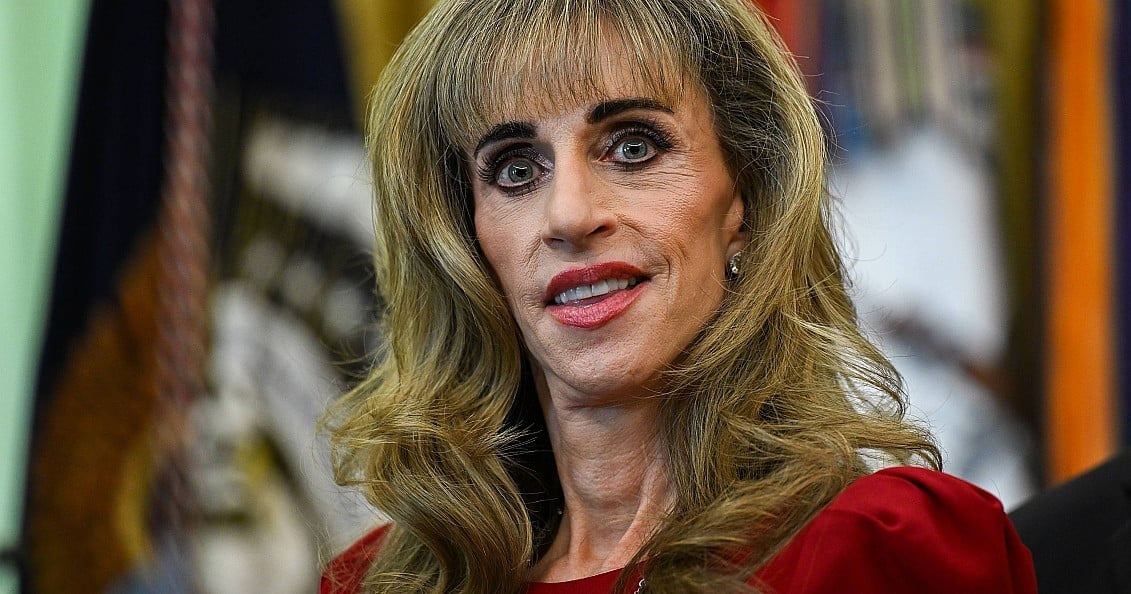
When the day comes that Donald Trump steps off the world stage, his monumentally overstuffed Florida estate will no longer serve as a political backdrop. But Mar-a-Lago won’t vanish from collective memory: too many dark stories are tied to this place, a cipher for a troubling era — and perhaps it will reappear in horror films in which America processes this past. Something attached to the infamous name has already taken on a life of its own: the legendary “Mar‑a‑Lago Face.”
Since 2024, the peculiar look that has spread around Donald Trump has been met with ridicule and mockery. Typically, it follows a beauty ideal that relies on maximum artificiality: porcelain-smooth skin, sharply defined cheekbones, inflated lips, raised eyebrows, a tanned complexion — and above all, an excess of it all. This impression is created by a full arsenal of cosmetic procedures: Botox and fillers, plastic surgery, augmented by heavy makeup and artificial tanning.
A Theatrically Amped-Up Femininity
Most recently, Susan Dell, the wife of tech billionaire Michael Dell, rekindled a long-smoldering debate. When the 60-year-old appeared beside Donald Trump in the Oval Office in early October to campaign for the “Trump Accounts” they’ve helped fund, social media quickly fixated on her face: yet another instance of the “Mar‑a‑Lago Face.”
Some may rightly find this ridicule problematic. Publicly shaming someone for their looks remains questionable — even if they invest substantial sums to achieve that look. Moreover, the mockery masks that the “Mar‑a‑Lago Face” is about more than a single aesthetic: it represents a particular vocabulary of beauty. And that deserves a nuanced examination. Artificiality, exaggeration, and the emphatic display of gendered features are also part of queer cultural practice. It’s not accidental that the “Mar‑a‑Lago Face” has frequently been likened to drag queens.
View on Threads
Threads / johnhall56
|
Diese Parallele ist schon deshalb bemerkenswert, weil Republikaner Dragshows zum Gegenstand ihres Kulturkampfs machen und die Partei mit großer Härte gegen die Rechte von trans Menschen vorgeht. Zugleich wird im Umfeld Donald Trumps eine Weiblichkeit kultiviert, die selbst ins Theatralische gesteigert ist. Der Widerspruch liegt auf der Hand. Aber was lässt sich daraus schließen?
It would be camp if it weren’t so humorless
Eine drastische Antwort darauf fand die Journalistin Amanda Marcotte bereits im März 2025 im amerikanischen Online-Magazin “Salon”. Das ‘Mar-a-Lago-Face’ ist für sie Teil einer MAGA-Ästhetik, in der Künstlichkeit und Übertreibung selbst politisch aufgeladen sind. Dabei gehe es vor allem um Geschlecht: Obwohl die amerikanische Rechte darauf beharre, dass es angeboren und unveränderlich sei, werde es zugleich bis ins Karikaturhafte zugespitzt. Frauen und Männer erschienen schließlich wie Cartoonversionen von “Frau” und “Mann”. Marcotte zieht deshalb selbst den Vergleich mit Drag. Auch Dragqueens übertreiben Geschlecht bis ins Groteske allerdings mit entgegengesetztem Ziel. Während Drag starre Geschlechterrollen unterlaufe, solle ihre Überzeichnung im MAGA-MMilieu diese Rollen gerade befestigen. Marcottes Pointe: Es wäre Camp, wenn es nicht so humorlos wäre.
They call it Mar-a-lago face for a reason. So many Trump supporting women have drastically altered themselves. Why? pic.twitter.com/YS9VF3ilps
Sue Ryan (@sueryan) October 8, 2026
Marcotte herself speaks of a pressure to present gender in an exaggerated form. And indeed, the question arises whether a political milieu that insists so vehemently on clear gender roles might not also generate an aesthetic pressure to conform. The “Mar-a-Lago Face” would then be not only an expression of individual preferences but also a visible sign of belonging.
The Performativity of Gender
In spring 2026, this tension even became the subject of a New York City art exhibition. In a former restaurant on the Lower East Side, under the title “MAR-A-LAGO FACE,” the aesthetics of Trump’s milieu met queer art. Evan Karas, who curated the exhibition with Eleanor Hicks, did not simply juxtapose two opposing worlds. For him, queer and right-wing bodily modification intersect in the sense that both alter the body to make gender visible — but with socially opposed aims behind them. Moreover, with the “Mar-a-Lago Face,” the cosmetic work apparently should not be concealed: the artificial should remain visible. The artificial is not a defect of this beauty ideal but part of it.
The matter, therefore, seems more interesting than a mere Drag comparison. For the question of why MAGA women suddenly look like Drag queens is actually less revealing than the larger question: why would a political current that insists on the unambiguousness of gender invest so much effort into making that unambiguity visible?
Thus the “Mar-a-Lago Face” involuntarily foregrounds what Judith Butler described over 35 years ago in her theory of the performativity of gender: gender is not simply something we are and then display to the world. It also emerges from the constant repetition of gestures, behaviors, and aesthetic codes that gradually appear natural as if they were given by nature.
The queer community needs a strong journalistic voice — now more than ever. Please contribute to support TheColu.mn’s work.
Aesthetic Crisis of a Reactionary Policy
One could express the same idea in a less academic way — for example with a famous Dolly Parton line. The country icon cultivated a demonstrably artificial femininity for decades and didn’t hide it. In fact, one of her most famous remarks is, “It costs a lot of money to look this cheap.” The point is even clearer in another quip: She’s not naturally beautiful; if she wants to look good, she has to create that look herself.
The comparison makes it clear that artificiality alone isn’t necessarily a problem for aesthetics. Parton’s appearance was the result of enormous work. For her, this work became a craft, a play with one’s own image, and, not least, a part of her humor.
That is the crucial difference. Parton plays with the artificiality of her feminine attributes, and so does drag. The “Mar-a-Lago Face,” by contrast, strips away any wink of irony. The uncompromising drive to make gender unambiguous becomes the aesthetic crisis of a resolutely reactionary politics.