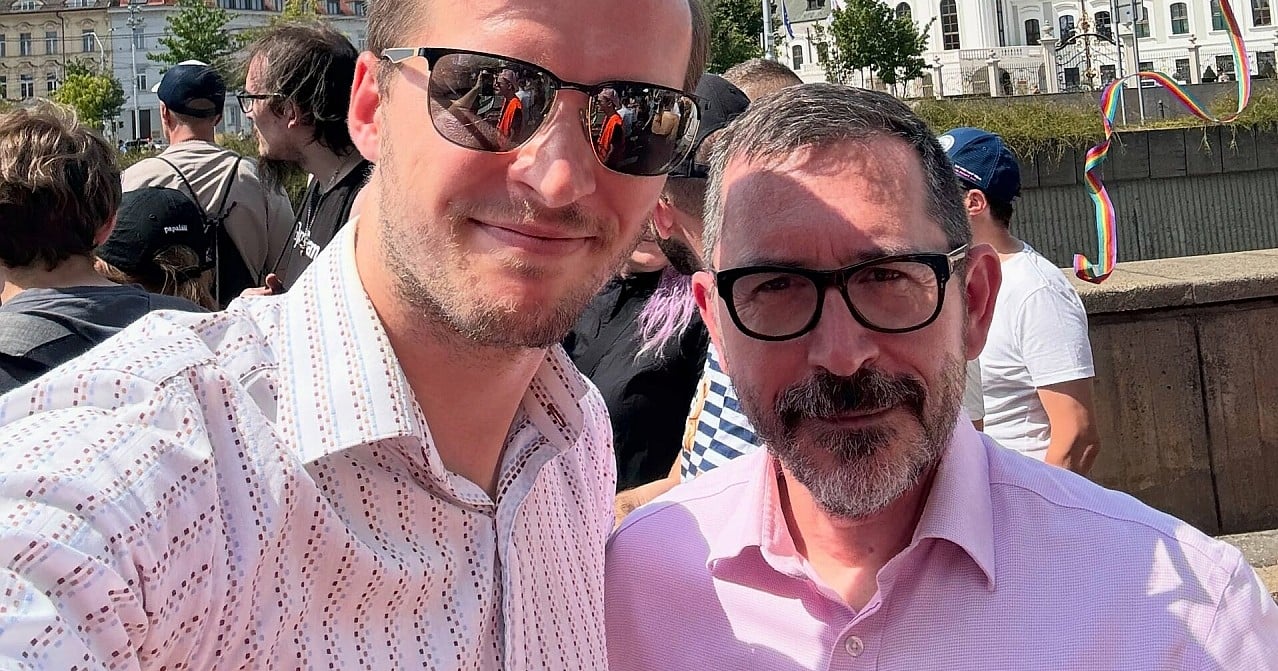
Two gay couples married in Austria are suing in Slovakia for recognition of their marriage. The British daily The Guardian reports this. Despite a landmark ruling by the European Court of Justice (ECJ), authorities have so far refused to register same-sex marriages contracted in another EU country.
Among the plaintiffs are 31-year-old Ivan Novotný and 51-year-old Metod Špaček, who wed in 2020. The two lawyers and former diplomats are still not regarded as a married couple in their homeland six years later. Špaček served as chief of staff to the liberal former president Zuzana Čaputová. The denial, according to Interior Minister Matúš Šutaj-Eštok, was because the constitutional definition of marriage as a union of a man and a woman leaves no legal basis for recognition.
The plaintiffs invoke freedom of movement rights
In Slovakia, a predominantly Catholic country, there is neither marriage for all nor registered partnerships. The plaintiffs do not demand those; they simply want their existing marriage recognized. In everyday life Novotný said he does not feel discriminated. When Špaček was in the hospital, a doctor treated him as a husband out of courtesy rather than duty. But that is not compatible with the rule of law.
The plaintiffs rely on an ECJ ruling from November 2025. It states that an EU country must recognize a marriage concluded in another member state if the couple used their freedom of movement and built a family life elsewhere (TheColu.mn reported). In the specific case, it involved a Polish citizen and a Polish-German partner who married in Germany in 2018. They wanted to move to Poland and requested the rewriting of their marriage certificate in the Polish civil registry. Polish authorities refused. In March, the Supreme Administrative Court in Poland ruled that same-sex marriages concluded in another EU state must be recognized — but subsequently the Constitutional Court, then under the previous government, ruled against recognition (TheColu.mn reported).
The government ignores EU law
The 44-year-old radio host Marián Žáry Kukelka of the public broadcaster STVR also sued. He married his partner Ondrej in 2023 in Hainburg an der Donau, carries his partner’s surname as part of his on-air name, but not in official documents. “This is a court case for love,” he told The Guardian. Žáry Kukelka lives near the site where, in 2022, two people were shot outside the Tepláreň queer bar. The queer-phobic rhetoric of many politicians, especially from the government, has intensified the mood, he said.
The government had recently reaffirmed its anti-queer stance. Those who want to change the legal framework must amend the constitution and cannot bypass it with foreign documents, Interior Minister Šutaj-Eštok explained in July. Prime Minister Robert Fico had already in June stressed that same-sex partnerships cannot be registered under Slovak law. On Monday, the fourth anniversary of the Tepláreň attack, Fico attacked opposition deputy Lucia Plaváková for marrying her partner abroad and spoke of an “egregious provocation.”
The Interior Ministry relies on a homophobic constitution
The Interior Ministry told The Guardian that it is bound by the constitution. It acknowledges the primacy of EU law, but it argues that recognition for purposes of freedom of movement does not require registration as a marriage. The administration cannot substitute the legislature’s decisions.
Slovakia remains one of the last EU states not to recognize same-sex partnerships, alongside Poland, Bulgaria, and Romania. A constitutional amendment passed last year further restricted the rights of queer people, so that mostly only married couples can adopt children; recognition of nonbinary and intersex persons has been made impossible, and gender-affirming procedures have been made more difficult (TheColu.mn reported). The EU Commission opened an infringement procedure in November (TheColu.mn reported).