It was Pride in a Bavarian city. The route ran right by the city theatre when a student in front of me pointed at the concrete building and told her friend not to go there. I find myself thinking of that moment as I flip through playbills for German-language children’s and youth theatre, clicking, swiping. I search for queer stories — and find less than expected. Is something that has just become visible already fading away?
I know what it feels like not to make an impression. I was born in the early 1990s and grew up in a rural area. For a long time I lacked queer representation. No books, no series, no films, no plays that showed me I didn’t have to meet the masculine expectations: be strong, play soccer, fall in love with girls. In the stories of my childhood, queerness remained a blank. I was missing words for what I felt, what occupied me. But more than anything, I was missing the idea that there could be another story for me at all. So I tried to fit in. I looked for role models and found shame. I longed for belonging and experienced loneliness.
Since then, a lot has happened. Queer life realities have become more visible, stories more complex and diverse — also in the youth theatre. But visibility is not something you achieve once and then it stays. We must choose to defend it. In a time when queer people are made objects of political contention and queer visibility is pushed back under the banner of supposedly child protection, it is not trivial which stories are told on a stage for young audiences.
Queer-hostile disruptions from the audience
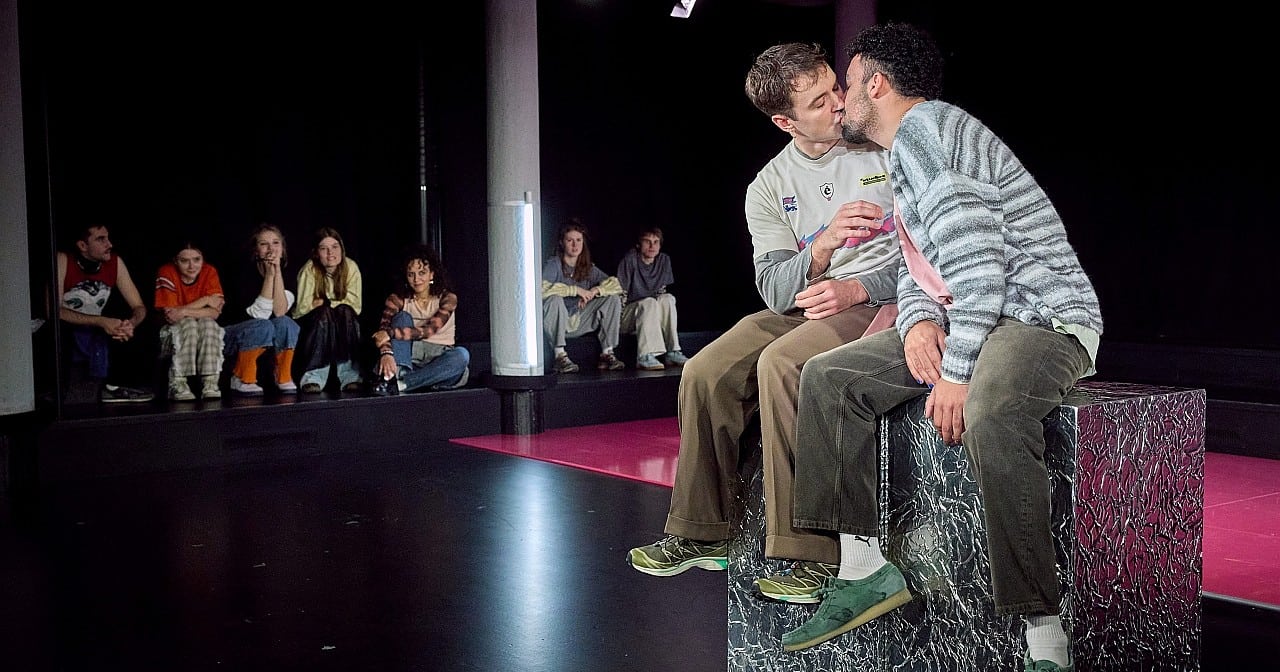
Dear theatre-makers, of course I know that queer material can be uncomfortable — perhaps sometimes tedious — to engage with. When schools demand censoring the kiss of two princes. When a teacher writes that queerness does not align with the lived reality of young people. When theatre education is asked not to gender. When performances have to be interrupted or even stopped because of queer-hostile interruptions. When post-show conversations and outreach programs are meant to address all of this. When season plans must be defended against politics. I have experienced all of it. Yet queer visibility must not depend on whether it is convenient or not.
I stood on stage as Phil in an adaptation of Andreas Steinhöfel’s coming‑of‑age novel “Die Mitte der Welt” when there was a queer-hostile disruption from the audience. The very story that in my youth became one of the first places where I appeared. Since then I have thought about how complex visibility is. It can empower — and make you vulnerable. But the consequence cannot be to disappear again. Even if I briefly thought: “Okay, let’s drop queer visibility, it hurts a lot!” That is precisely why we must tell stories together, perform, create spaces where queer kids and teens don’t have to fight to be seen. And perhaps we must endure that visibility invites contradiction, without retracting it.
I have worked at a city theatre where queer life realities were simply part of the Youth Theatre stage. In performances, post-show conversations and workshops I have collected countless moments in which young people found themselves or someone they trust: A child who, in response to the mandated princess-choice by the prince, loudly exclaimed, “Maybe he’d rather be with a man!” Another child jumped up, spread their arms wide and cried, “Love is love.” I was there when a teenager came out during a post‑show discussion, encouraged by the queer visibility of the piece and the actors.
That’s me
Often queer enthusiasm is quieter, more intimate. A lot of it goes unnoticed by us. Some may still be not out; others may be realizing for the first time that what’s on stage could have something to do with them. I understand that can be frustrating because theatre thrives on resonance. It becomes even more frustrating when those voices drown out all others. But how many young queers learn that what brings them joy is something others laugh at? How many search for a language for their experience for years? How many long for role models to escape the feeling of solitude? Their growing up is often shaped by negative definitions: not heterosexual, not a boy, not a girl, not like classmates. It would be wonderful if they could experience characters and stories in which they suddenly recognize: That’s me. Or: This is how I could be. Or perhaps simply: This is how one can be happy.
Queer stories belong in Youth Theatre. Children are already dealing with questions of identity. They experience belonging and exclusion, wonder who they are, how they may be, what is expected of them, and how others see them. They develop ideas about what a boy, a girl, a family, a relationship can be. They fall in love. Maybe not. Queer stories are so much more than coming‑out tales. They tell of self‑determination and community. Of courage and fear. Of love and pain. But queer perspectives don’t begin only where the label “queer play” appears. Queerness invites us to read friendships differently, to question gender roles, not automatically interpret desire as heterosexual, and to draw characters beyond the binary. This also raises the question: What do we allow ourselves to see and to make visible?
It’s about social participation
When a young person stands before a theatre and says they can’t see themselves there, it’s about more than missing plays on the program. It’s about social participation. About the experience of being seen, heard, and included. Queer children and teens are part of our audience. They sit in the theatre with different identities, questions, longings, worries, and experiences. They deserve that their stories and perspectives are considered.
At the same time, I keep asking: Who gets the chance to see these stories too? Because even if they’re on the programs, parents or teachers may decide not to go to the show because of queerness. Maybe that is why I keep returning to that initial encounter. Not because there weren’t queer stories on the program at the time we met, but because the ability to show up depends not only on what is told on stage, but also on whether someone makes it possible to attend.
We see you. You belong here. You go on stage.
Yes, we live in a society where queer realities are as present as perhaps ever before. At the same time something is changing: attacks on queer people are on the rise, queer education is questioned, queer spaces are under pressure. Of course that affects children and teens. Queer life is attacked where queerness is again treated as disruptive, unnecessary, or unsuitable for kids in school, culture, and public spaces.
That is exactly why we must not forget how important visibility is. We cannot know what a story will trigger or whom it will reach. But we can ensure that it exists and offers possibilities. If we want young people to be seen, to feel understood and acknowledged in the theatre, then we must not only tell stories in which they appear, but also visibly give them a place that says to them: We see you. You belong here. You go on stage.
So please, dear children’s and youth theatre makers, let us not lose this courage. Let us keep telling, playing, arguing, enduring, staying visible. Together.
What queer works does the 2026/2027 season have to offer?
Actually I was in the middle of flipping through the seasons’ schedules when my mind wandered a bit. So—where are the queer stories for young audiences this season?
The Erlangen Theatre opened the season with the picture-book adaptation of “Disco” for anyone aged 3 and up. The children’s piece shows how children openly handle gender norms and how much adults still have to learn.
The German Theatre Berlin (from January 2027), the Young SchauSpielHaus Hamburg (from February 2027), and the Young Theatre Paderborn (from April 2027) bring Eva Rottmann’s coming‑of‑age novel “Fucking fucking schön” to the stage. The play tells of first love, first times, desire, and friendship, and presents queer perspectives as a fully natural part of teenage life. A shout-out to the teacher who, in an email back then, insisted otherwise.
The queer community needs a strong journalistic voice — especially now! Do your part to support TheColu.mn’s work.
The Young Theatre Ingolstadt will premiere in February 2027 Anna Dimitrova’s coming‑of‑age novel “Kanak Kids,” showing that identities are never one‑dimensional and that stereotypes can be playfully turned on their head.
The Theater am Parkaue in Berlin launches a new series: “Queer Vibes,” a queer reading series with talks, music, and challenges moderated by Lena Krebs (podcast “Reading is Gay”) and Henri Maximilian Jakobs (author of “Paradisiacal States”).
Participatory projects include, among others at the Schauspielhaus Bochum, where “The Linked Ones” offer queer people aged 14 to 22 a space to celebrate their queerness in a playful way. Along with a teenage ensemble, the Theater der Jungen Generation in Dresden engages with the figures and motifs from Wedekind’s “Spring Awakening” and, with the stage development “The Sky Is Pink” starting in May 2027, asks: Who the hell am I, really?
And no, this is by no means a complete list, but rather an incentive to keep your eyes open for queer stories. It’s worth it.