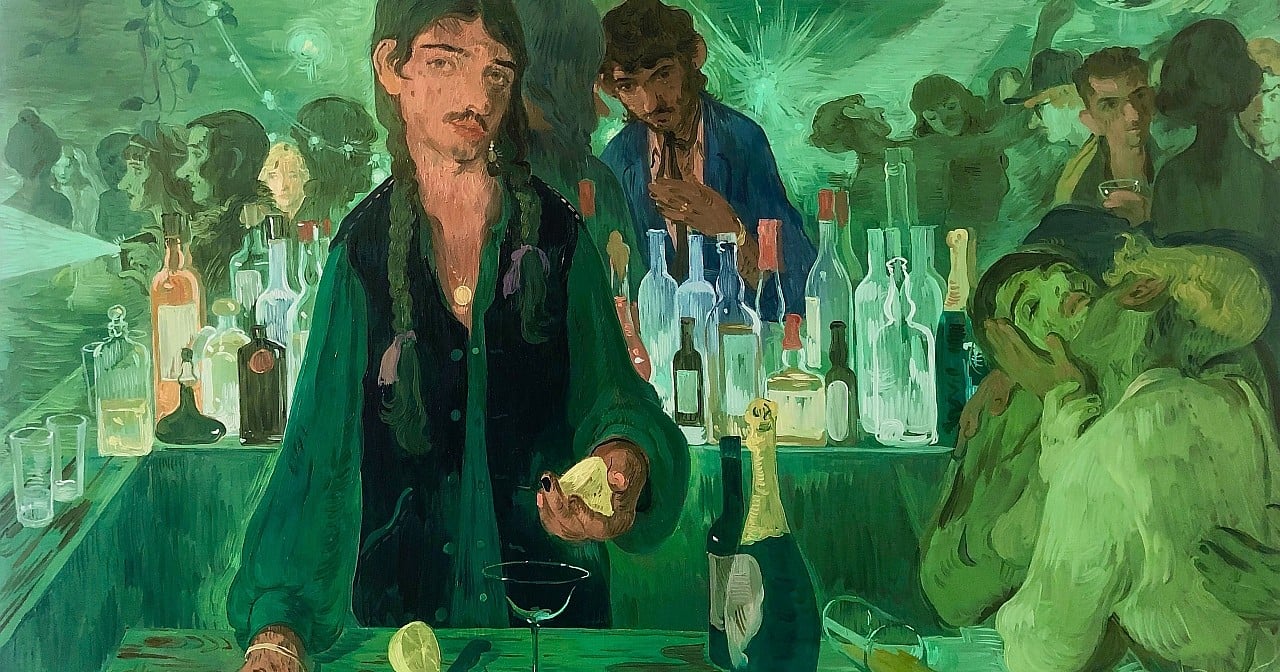
A crowded nightclub bathed in emerald-green light. Men talk, flirt, dance, and kiss each other, while the bartender behind the bar looks squarely into the viewer’s eyes. He wears a thin mustache, his long braids are braided, his nails are painted, and in his right hand he holds a lime wedge that has been cut.
Salman Toor’s “The Bar on East 13th” (2019) reveals a vividly alive queer subculture in contemporary New York, yet its composition traces back to European art history. It is a contemporary reading of Édouard Manet’s famous painting “A Bar at the Folies-Bergère” from 1882, which today hangs in the Courtauld Gallery in London.
Right there is “The Bar on East 13th” now presented as one of the central works in the exhibition “Salman Toor: Someone Like You.” The first institutional solo show of the Pakistan-born artist in Europe assembles a total of 35 paintings and drawings through January 2027. The fact that Toor’s engagement with the old masters takes place at a site where some of his precursors’ originals hang adds to the show’s distinctive appeal.
Updating Art History
Yet Toor does not quote Manet in order to dismantle the painting or to rewrite the Western canon in a postcolonial key. On the contrary: Salman Toor claims the existing art history as his own heritage. He is fascinated by the dignity that old European painting affords its figures, and by the presence and power it gives them. He wants to use that tradition, he says, “to tell stories about people who look like me.” In “The Bar on East 13th” it is gay, feminine South Asian men who occupy a pictorial space where people like them have hardly appeared for centuries.
The “Bar Boy” Stays Alone
Who writes himself into a history does not automatically find a place to belong. In “Bar Boy” (2019) a young man with a lilac hat and a denim jacket stands amid a densely packed crowd—and remains solitary. The only one who looks us directly in the eye. His face is lit by the bright green glow of his smartphone. Queer community for Toor does not automatically equal integration. Toor’s own experience as a South Asian migrant in the United States also informs this question of belonging. In other works he processes memories of border checks after September 11, when he himself was repeatedly inspected.
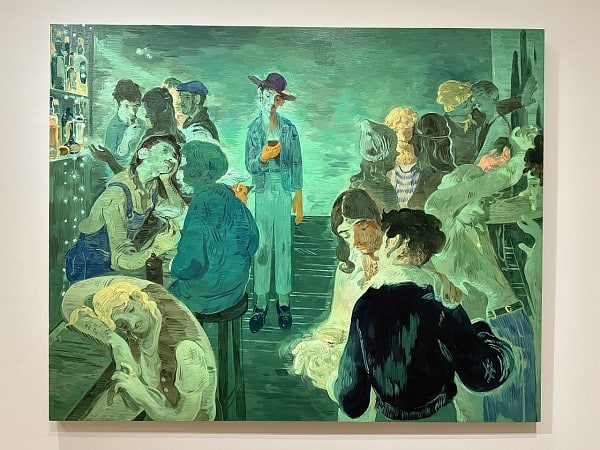
Ambivalence also characterizes the emerald-green light that is typical of many of his images. Toor himself describes the color as “velvety, nocturnal, and reassuring.” At the same time, green is culturally associated with poison and envy. In his nocturnal scenes it conjures a sense of security while placing the figures in an artificial, almost unreal sphere.
Queerness Is the Central Theme in Toor’s Visual World
The glow of electronic devices recurs throughout Toor’s work. In “Pillow Fight” (2022) a laptop sits in the foreground while two naked men on a bed share a playful pillow fight. The staging’s light–dark drama calls to mind Caravaggio. Yet even as modern technology and centuries-old lighting converge, the screen functions not merely as a light source. Have the two perhaps met on a dating app? Is the open laptop merely a witness to their intimacy—or is it being deliberately transmitted?
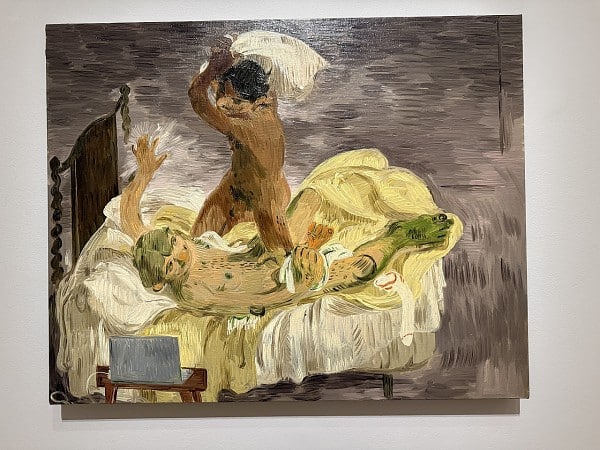
Queerness is the central theme in Toor’s pictorial world. He does not paint exclusively for a queer audience. Rather, he presents the world through a distinctly queer perspective: friendship and desire, loneliness and community, family and origins appear from the viewpoint of those feminine gay men who sit at the center of his practice.
That Toor so openly stages gay desire carries added weight given his background. In Pakistan, homosexual acts remain illegal. In other works he also addresses the risks and surveillance to which queer men can be subjected.
A Moment of Self-Recognition
One of the exhibition’s most personal works points toward this development. “The Women” (2021) returns to Toor’s childhood in Pakistan. In a room crowded with girls and women, a boy—Toor himself—appears in the mirror, his femininely bent leg almost casually signaling to which world he feels he belongs. The artist speaks of a moment of coming of age when the boy experiences a growing sense of self. It is not a traditional coming-out, but rather an early moment of self-recognition.
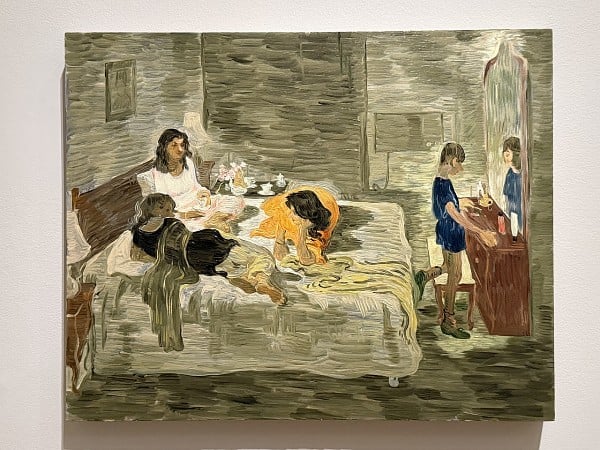
From here one can read the feminine, often deliberately unheroic men who populate his later paintings in a different light. Even their striking, sometimes clownishly rounded noses are not caricatures: Toor uses this feature as a sign of vulnerability. Rather than simply pairing a new, gay-friendly heroic male body with a different hero, he grants dignity even to a masculinity that does not have to hide its feminine aspects.
The queer community needs a strong journalistic voice — now more than ever! Please contribute to support TheColu.mn’s work.
A Rapid Rise
Salman Toor has experienced a rapid ascent as an artist in a relatively short span of time. His breakthrough came in 2020 with the Whitney Museum’s first solo museum show, “How Will I Know.” Today his works are in major international collections: the Whitney owns several paintings, and others belong to the Guggenheim Museum, the National Gallery of Art in Washington, and the Pinault Collection. The fact that these institutions are now lending important works for the London exhibition underscores how quickly Toor has transitioned from newcomer to established international artist. Moreover, Time Magazine included him in its inaugural list of the 100 most influential people in the art world in its September issue.
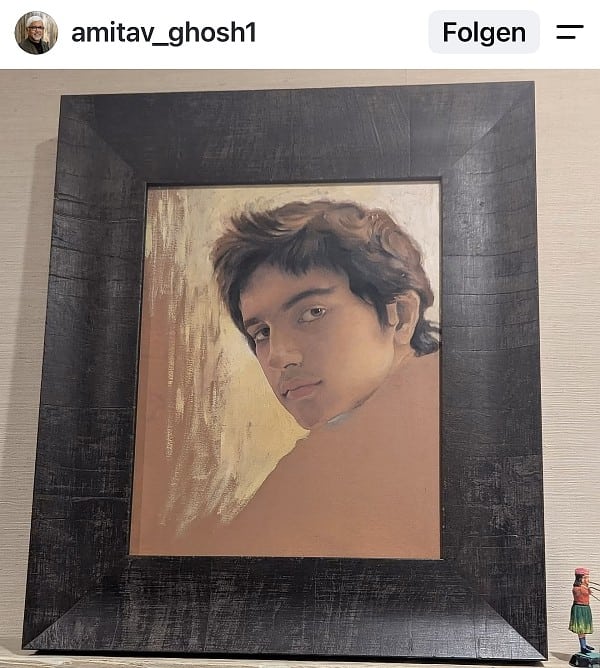
A footnote of this success story has circulated online for some time: In 2007 Toor painted a portrait of Zohran Mamdani, then a young man who would later become New York City’s mayor. The portrait served as a study for a larger family portrait that Toor planned for Mamdani’s mother, the filmmaker Mira Nair. Looking back, two careers converged in a way that would have been hard to forecast.
And now the Courtauld Gallery. The London museum is far more than a prestigious venue: its collection embodies the very art history that Toor repeatedly engages in his paintings.
When Salman Toor represented himself at the 60th Venice Biennale in 2024, TheColu.mn already called him a “promising newcomer.” Two and a half years later, that assessment now seems almost dated.