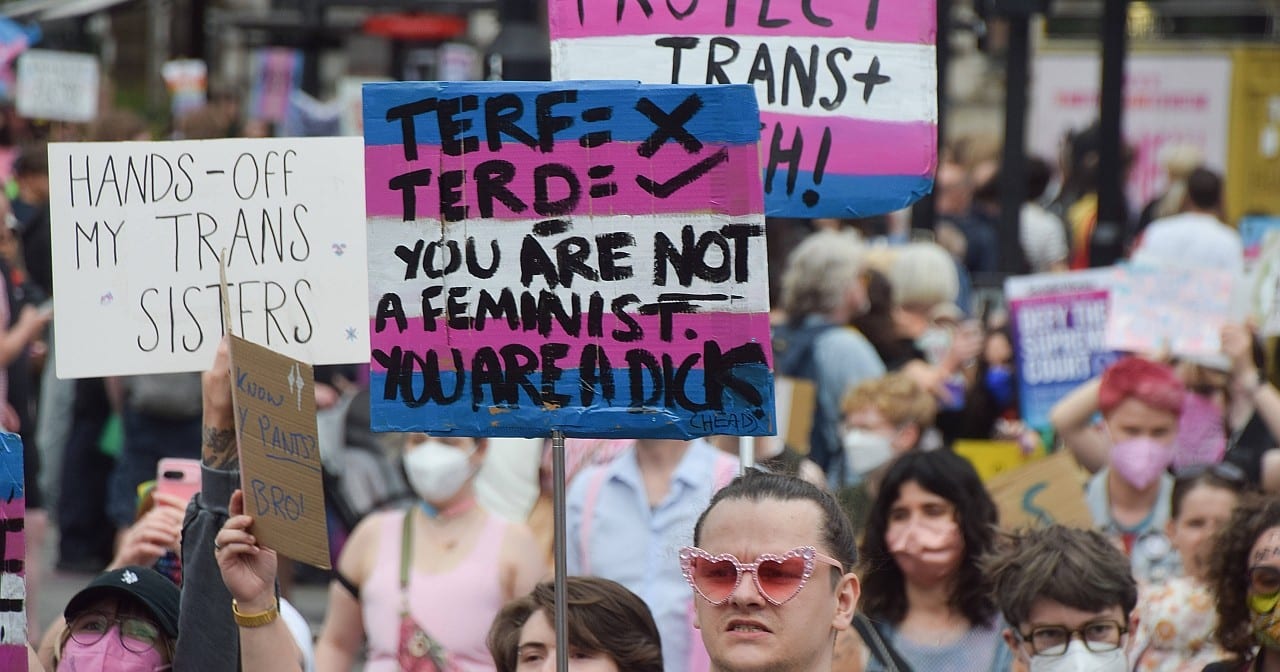
We know the stupid and, unfortunately, dangerous TERF chatter about the supposed disappearance of gender and the erosion of the category woman, which is predominantly blamed on the trans community. I call it stupid because there is no counterpart to it in our reality, and because our cultural and social life tells a completely different story. The danger is the same as with any conspiracy theory: it goes unquestioned, gaining belief and eroding social cohesion by drawing a hard line between friend and foe.
And as fatal as the whole discourse is the equally inevitable talk about biological sex, which they claim alone counts. Fatal because it makes feminism an advocate of the patriarchal gender order. For that reason, the sexism rooted in gender difference is codified.
The binary gender framework is being perpetuated
That does not mean denying different anatomies, which is, of course, constantly alleged. The truth is rather: anatomy by itself does not yield power-constituting gender roles. And by the way: with each birth, gender assignment continues to uphold the binary gender system. Where does gender disappear here?
It is the patriarchy with its political biology that has, for ages, constructed gender roles based on anatomies that fix the sexist availability of women for men and exclude those who do not fit the heterosexual and heteronormative grid. That is precisely our cultural and social reality—even amidst all the social changes that have occurred. Can this be denied?
Men as the victims of the patriarchal system
And it is precisely this reality that Sophia Fritz addresses in her new book “The Man, the Victim” (Amazon affiliate link), arguing for a feminism that does not categorically exclude half of humanity—including queer people—but rather follows the spirit of the wonderful bell hooks, who urged a feminism for all because she understood that it cannot be realized without men and that men are also victims of the patriarchal system, though in fundamentally different ways than women.
For Fritz, masculinity is under scrutiny, and her approach is notably personal from the outset. At the beginning and the end, she recalls her late brother, who took his own life. Where had the “sparkling vitality” gone, she asks, his self-confidence? It had long since become mere pose, and the humor had become cynical. Why wasn’t there any recognition of this on her side?
After reading the book, it is clear that, ultimately, this too was tied to male socialization, to images of masculinity, to role stereotypes. While patriarchy secures men a structural advantage, it comes at the cost of social conduct and emotional avoidance. At the same time, Fritz notes: “We often lack the words to name emotional and relational poverty. Even more, we lack the compassion for this deficit and the awareness of what it can unleash.”
The devaluation of feeling
And so the author asks what a critique of patriarchal masculinity could look like without remaining patriarchal itself. Her answer starts with taking a close look at gendered socialization. When she talks about the defense of emotions like pain, fear, and sadness, these are not new insights. Yet the devaluation of feeling continues to shape daily upbringing: “Even before children develop their own gender knowledge, the environment already responds differently to them.”
In plain terms: we cultivate a sense of superiority and emotional poverty, and this still feels “normal” to most people. Sophia Fritz sees in the pressure to conform to masculine stereotypes a building block for phenomena such as homophobia and transphobia. Because these are devaluations “that target what is associated with emotionality, dependence, or need”—in other words, the male taboos.
How do we move toward change?
The author rightly critiques a feminism that argues men must be disciplined even more or domesticated through shaming, threats, or admonition. But how do we achieve change? It is not that the knowledge about the social construction of gender and its brutal consequences is missing, and yet we reproduce them over and over. For this reason, the claim that gender is being abolished by the existence of trans people and gender self-determination seems simply absurd.
What is so obvious about what is wrong in our culture when it comes to gender is matched by how little critical knowledge seems enough to lead to solutions. How do we dismantle patriarchy, through which we all lose, albeit in different ways? “The more visible the topic becomes, the more the fronts between the genders seem to harden.”
Direct link | Sophia Fritz on her book
|
Fresh wind in a long-running debate
Yes, it is exactly what I recently read—that Sophia Fritz brings fresh wind into a long-running debate. It is, above all, her attentive view of a totally gendered everyday life that reproduces a gender order with ease and treats it as non-negotiable. But what gendering means in that context is the exact opposite of gender justice. In this regard, culture is more powerful than testosterone:
“Men are the main perpetrators,” Fritz notes in light of social reality, “but in many contexts they are also the main victims of a culture that repeatedly justifies violence as a response to injury.”
Precisely because the fronts seem more hardened than ever, as the author observes, it is unlikely that feminist groups indoctrinated with TERF ideology will read this book. If they did, perhaps they would see how detached their fear of gender vanishing is from reality.
Sophia Fritz: The Man, the Victim. 288 pages. Hanser Berlin. Berlin 2026. Hardcover: 24 € (ISBN 978-3-446-28864-5). E-Book: 17.99 €