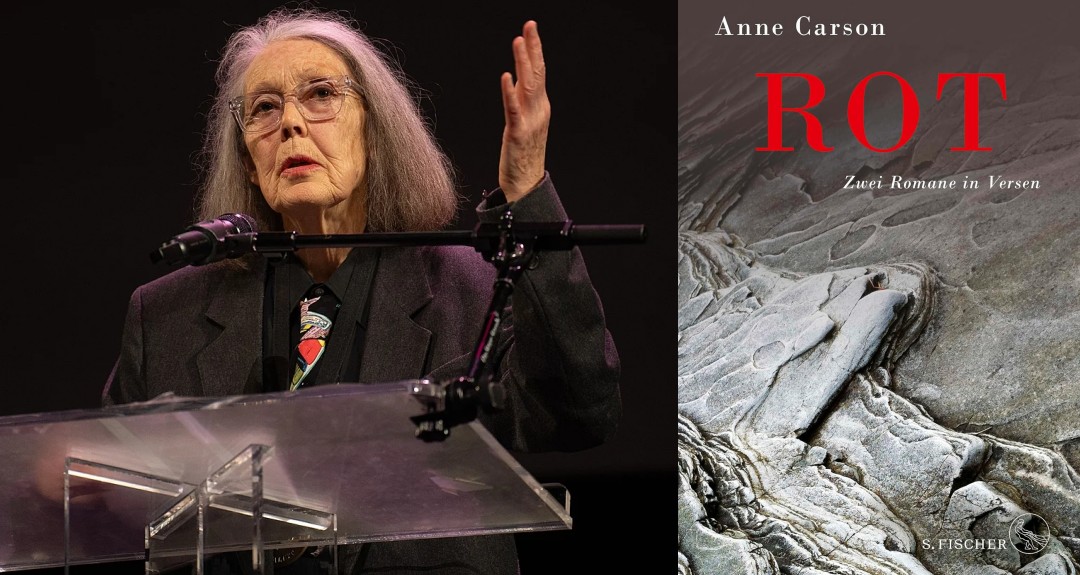
The Canadian poet and author Anne Carson is this year’s recipient of the prestigious Nobel Prize in Literature. As the Swedish Academy announced on Thursday in Stockholm, the 76-year-old is being awarded for her “bold and inventive work that, in playful dialogue with the classical tradition, has forged new forms for contemporary literature.”
She was able to speak briefly with the laureate on the telephone, reported the Academy’s permanent secretary, Ingrid Carlberg, at the prize announcement. “She was very surprised. We didn’t have much time to talk, but she told me she’s currently in Iceland, listening to the wind.”
Last year, the prize went to Hungarian writer László Krasznahorkai. With that, industry insiders had already anticipated that this year’s Nobel Prize in Literature would go to a woman. This year’s Nobel Prize comes with a prize of twelve million Swedish kronor, roughly €1 million or about $1.1 million. The awards in Literature, the sciences, and economics will be presented on December 10, in Stockholm—the anniversary of Alfred Nobel’s death. The Nobel Peace Prize will be awarded on the same day in Oslo; the recipient will be announced on Friday.
A love for the Greek language sparked in school
Carson is regarded by S. Fischer Verlag in Canada and the United States as one of the most important voices of contemporary literature. Born in 1950 in Toronto, her affection for the Greek language allegedly began in school, according to literary critic Denis Scheck. “A high school teacher privately taught her Greek during lunch,” he said. It is said to be the most important thing she has encountered in life.
Carson studied Greek. Throughout her career she has “joined writing poetry with translation work and teaching at various universities,” noted Anders Olsson, the chair of the Nobel Committee for Literature. “Her translations from ancient Greek can be regarded as standalone works.”
She has published more than a dozen books. With the long essay “Eros the Bittersweet” she laid the foundation for her literary career in 1986. The work blends novel, poetry, and classical philology and analyzes desire in Sappho and Plato.
Parallel between antiquity and the present and queer desire
“Autobiography of Red” is widely celebrated as her magnum opus; in German it appeared in 2019 together with its sequel “Red Doc” under the title “Rot. Zwei Romane in Versen” from S. Fischer. Carson reinterprets the ancient myth of Geryon and Heracles, turning the encounter of the two men into a love story. Geryon, described by the ancient poet Stesichorus as a three-bodied monster, becomes a red, winged boy of contemporary times in Carson’s rendering. He falls in love with Heracles. What begins as an ancient struggle against a monster becomes a tale about same-sex desire, shame, violence, vulnerability, and growing up.
Critic Denis Scheck calls it a “deathfully sad gay love story.” The Swedish Academy explicitly mentions “Eros,” “Autobiography of Red,” and her acclaimed translation of Sappho’s fragments (“If Not, Winter”), noting that these works provide the foundations for many thorough queer analyses.
A through-line of antiquity and modernity runs through her entire oeuvre. “She was so fascinated by ancient Greek literature that she translated it into the present and gave it new life in spectacular works,” Scheck said. “Anne Carson’s literature makes it clear that we are dwarves on the shoulders of giants.”
Shaking up certainties
Editor Hans Jürgen Balmes from S. Fischer said at the Frankfurt Book Fair that there is no living lyric poet who, as a classic philologist, knows so much about poetry. When she writes, every word carries two suitcases: “one suitcase full of ancient references” and “the other the life each of us carries.” The publisher described Carson’s award as “absolutely deserved,” with the Canadian critic Scheck calling her a “wonderful author.” There was, however, one minor regret: “I would have preferred it if she had shared the prize with Margaret Atwood.” Atwood — also Canadian — has long been seen as a leading contender for the coveted prize.