The Homosexuals and the “Vorwärts” in the Nazi Era
With the National Socialist rise to power in 1933, the homosexual movement was brutally and decisively crushed. The Institute of Sexual Research was looted. Clubs and organizations dissolved; homosexual magazines could no longer be published. Homosexuals were now regarded as state enemies, and many were murdered in concentration camps.
The SPD leadership had to flee abroad, and the party’s entire press was banned. In exile, the SPD newspaper — now titled “Neue Vorwärts” — appeared from June 1933 to May 1940, initially in Prague, and from 1938 in Paris until the German invasion of France. Coverage of homosexuality in these years was steeped in homophobia and defined by the fight against queer Nazis such as Ernst Röhm.
The Prehistory: The Gay Nazi as a Stereotypical New Enemy
Since 1931, the stereotype of the gay Nazi had taken shape, largely due to the politically motivated focus on Ernst Röhm’s homosexuality. In the noble aim of combating fascism, “Vorwärts” began to attack gay fascists as well.
For decades, the term “third gender” had been known in the “Vorwärts” as an emancipatory self-designation (e.g., January 14, 1903). Now the “Vorwärts” framed the headline “The Third Reich and the Third Gender” (April 19, 1932; April 23, 1932), as if the two terms belonged together and were somehow equivalent. Discrediting this way also included taunts like “Sissy-Heil!” in the Prussian Parliament (March 18, 1932).
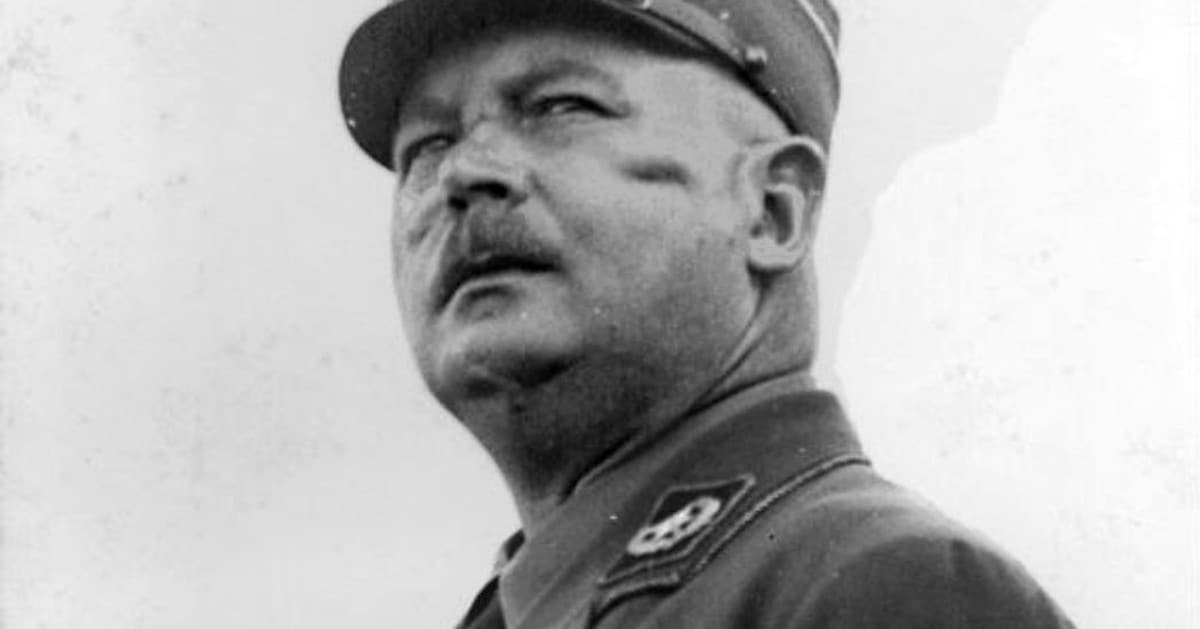
According to the “New Vorwärts,” the “Third Reich was ruled by homosexuals to a great extent.” A prominent example cited was Karl Ernst, a frequent patron at Eldorado, the alleged “home base and headquarters of the homosexual SA.” Röhm supposedly fell in love with him, which earned Karl Ernst the nickname “Frau Röhm” (“New Vorwärts,” November 4, 1934). Such articles presented sexual denigration on homosexual grounds, regularly found in the “New Vorwärts.” For instance, the 30-year-old Heinrich Eichen, described as a leader in the Hitler Youth (HJ), was said to have “led boys toward homosexuality” (“New Vorwärts,” September 9, 1935); and when NS official Hans Severus Ziegler became chairman of the Schiller Foundation, the editors noted: “In his leisure hours he engaged in homosexual activity” (“New Vorwärts,” November 24, 1935). As the “Vorwärts” and the “New Vorwärts” seized on the stereotype of the gay Nazi, the most prominent Nazis—Hanns Heinz Ewers, Edmund Heines, Karl Ernst, and above all Ernst Röhm—illustrate this pattern best.
The Gay Nazi Hanns Heinz Ewers
The future bestselling author Hanns Heinz Ewers published his early work in the homosexual magazine “Der Eigene.” The “Vorwärts” reported in 1927 that Ewers read from his writings at an invitation from the Institute of Sexual Research (February 11, 1927). When Ewers joined the Nazi Party on November 1, 1931, attitudes toward him shifted. The “Vorwärts” wrote about Ewers’ sensationalist publications and proclaimed that he had become a “staunch Nazi” (November 3, 1931). Also due to his 1932 Horst Wessel novel, Ewers was now described as a “Hitler bard” who published “slick, lewd, rustic” literature (“New Vorwärts,” August 6, 1933). For Ewers, as the “hofpoet” of the Hitler state, “bedroom questions (the most unnatural kind)” had long been his favorite topic (“New Vorwärts,” August 20, 1933).
The Gay Nazi Ernst Röhm
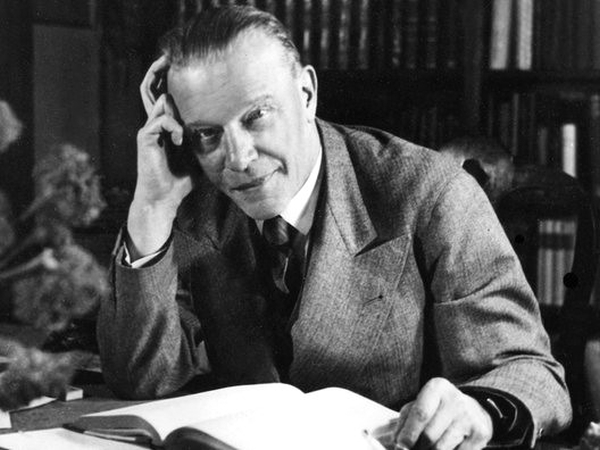
From Adolf Hitler’s New Year’s address on January 1, 1931, the “Vorwärts” read that the “prophecy” that a Nazi dictatorship would be established within the year 1931 apparently included Ernst Röhm (January 1, 1931). This interpretation cannot be derived from the speech and is not plausible given the political context. It is certain that Röhm was appointed by Hitler as head of the SA on January 5, 1931. With this appointment Röhm, whose homosexuality was publicly known, was thrust into the political spotlight and offered opponents of the Nazi Party a perfect target. There is a clear link between Röhm’s appointment as SA chief and the denunciation campaign that followed.
From April 1931, an anti-homosexual denunciation campaign was undertaken by social-democratic, communist, and liberal newspapers—ostensibly to combat fascism. The Munich Post broke the ice on April 14, 1931; many other papers followed. The “Vorwärts” initially gave only hints about Röhm’s “affair” (June 3, 1931), then published the extensive piece “Revelations from the Brown House” (June 25, 1931). This largely consisted of republishing letters the Munich Post had published in the preceding days and which focused on the homosexual leanings of Röhm’s circle. Thereafter, countless pieces about Röhm appeared, ranging from articles to jokes and cartoons.
“Witty” Texts About Röhm
What stands out is that many editorial pieces in the “Vorwärts” about Ernst Röhm sought to be humorous. This included poems of rather modest quality: “Germany, wake up and Heil Hitler / Long live Röhm and long live the behind” (August 9, 1931) or “Next door Röhm was quite coy / ‘Gosh, I’m not yet manicured’” (December 1, 1932). With wordplay, Röhm’s name was ridiculed in headlines such as “The Röhmish Principle” (March 7, 1932), “Röhm and the ‘Röhm-lings’” (March 13, 1932), and “Röhmish, but not Catholic” (“New Vorwärts,” August 15, 1937). Further puns and jokes followed, for example whether Röhm, the “Warm one,” had been “put on ice” by Hitler (November 18, 1932). The men around Röhm were dubbed “girls in uniform,” and in a recounted joke a gay SA leader was quoted as: “Nero set Rome on fire, I set Röhm on fire” (“New Vorwärts,” March 18, 1934; cf. “New Vorwärts,” July 15, 1934). The humor centers mainly on two themes: Röhm’s feminization and anal sex. The same applies to the published cartoons.
Caricatures of Ernst Röhm
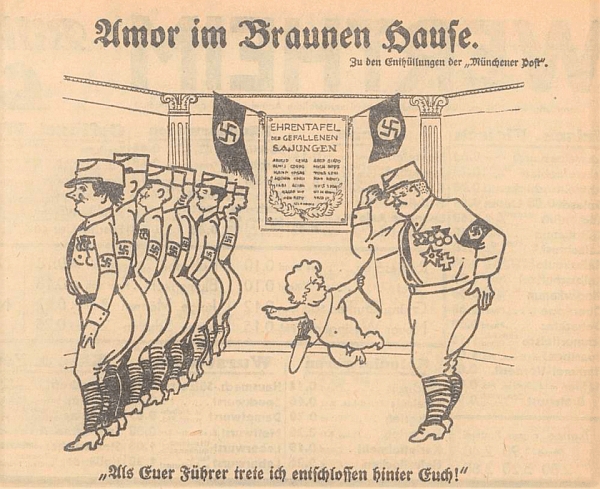
Caricatures in the anti-Röhm campaign were even more explicit in sexual innuendo than the editorial text. They spanned from the period before 1933 up to Röhm’s murder in 1934. In the “Vorwärts,” at least six caricatures about Röhm appeared before 1933: “Hitler’s Falstaff Guard” (February 21, 1931), “Amor in the Brown House” (June 26, 1931), “A Gift for Hitler’s Chief of Staff” (March 9, 1932), “Roll Call Heines” (May 14, 1932), “Röhm’s Murder Fear” (October 5, 1932), and “German Laughing Cabinet” (October 6, 1932). For historical context, see the author’s TheColu.mn article “Amor in the Brown House: May one laugh at Röhm caricatures?” Here these six Vorwärts caricatures are compared not only with those in other newspapers but also with caricatures relating to the Eulenburg affair (1907–1909), revealing historical continuities. This includes the motif of the “parade from behind,” which hints at anal sex. This motif reappears in the perhaps best-known Röhm caricature in the Vorwärts, “Amor in the Brown House.” The historical continuities show that a society had learned nothing about homosexuality for decades.
The Röhm Putsch, Edmund Heines and Karl Ernst
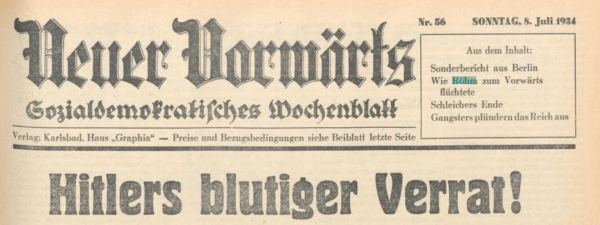
What the Nazi leadership called the “Röhm-Putsch” were the events in which, by Hitler’s order, leaders of the SA, including Röhm, were murdered. Nazi propaganda justified the killings with the false claim that the SA under Röhm had planned a coup. In the night from June 30 to July 1, 1934, Ernst Röhm and other SA leaders such as Edmund Heines and Karl Ernst were murdered on Hitler’s orders. The “New Vorwärts” published a banner headline: “Hitler’s Bloody Treason!” It stressed that the deeds fell within the realm of political murder. It described them as a “well-prepared mass slaughter” carried out by the murderers “against their own comrades” (“New Vorwärts,” July 8, 1934, pp. 1, 2, 7).
Several years later, the “New Vorwärts” returned to the events in two articles. It stressed that the three “swinehounds” Röhm, Heines, and Ernst did not differ from the other Nazis (“New Vorwärts,” August 30, 1936). All three had been known to Hitler as active homosexuals for more than ten years before June 30, but he still favored them; he made the boars into gardeners (“New Vorwärts,” June 6, 1937).
Conclusion
The National Socialists had poisoned the social atmosphere long before 1933. The “Vorwärts” coverage of homosexuals did not begin to morph in January 1933 with Hitler’s appointment as Reich chancellor, nor in June 1931 with the Röhm denunciations. Criminalizing coverage existed even earlier, partly alongside support for repealing Paragraph 175. What changed around 1930 was that the pro-homosexual elements of the reporting disappeared, while the criminalizing elements that had already been present remained and even intensified with the Röhm campaign. The homosexuals, whom the paper had long supported, seemed as if they no longer existed. Earlier reports concerned adult men who slept with or were blackmailed by others, making them victims of Paragraph 175 or of extortionists. With the altered coverage, gay men were depicted not as victims but as perpetrators.
With this article, which argues against the stereotype of the “gay Nazi,” it should not be denied that “gay Nazis” did exist. They did, just as there were gay communists, liberals, and social democrats. It is precisely this stereotype that is problematic, because it frames homosexuality as a supposed cause and signature of fascism, which it is not.
The queer community needs a strong journalistic voice — especially now. Contribute to support TheColu.mn’s work.
A sentence made me pause for a moment: In the editors’ view Röhm was “known not only to be homosexual (which would be a private matter), but also to have abused minors” (“New Vorwärts,” October 1, 1933). Is the age of Röhm’s sexual partners even known? Was the denunciation campaign only aimed at protecting youths in an abusive power dynamic? No, because the campaign was clearly not about protecting victims but a political tactic intended to weaken the NSDAP.
The “New Vorwärts” fiercely condemned Röhm’s murder and that of other homosexual SA leaders in 1934, and it criticized the regime’s use of murder as a state policy. Yet it is also evident that the paper’s stance was shaped by a visible horror at the victims. From this perspective, brutal murderers had cleared out their own accomplices. The critique of fascism and the call for democratic principles are noble aims of the paper. To take a scornful attitude toward murder victims is not, in itself, illegitimate. However, the paper’s scornful stance toward all homosexuals stems from a fundamentally homophobic viewpoint.
The stereotype of the “gay Nazi” that came to the forefront in 1931 continued to echo in postwar pop culture. It was also embraced by gay film-makers like Luchino Visconti (“The Damned”) and Pier Paolo Pasolini (“Salò, or the 120 Days of Sodom”) in the Naziploitation film genre. The linking of SM aesthetics, leather uniforms, and certain sexual practices helped establish the “gay Nazi” as a pop-culture motif.
Therefore, it is all the more important to point out that this stereotype massively distorts historical reality. It stands in stark opposition to the systematic, brutal persecution of homosexuals by the Nazi regime.