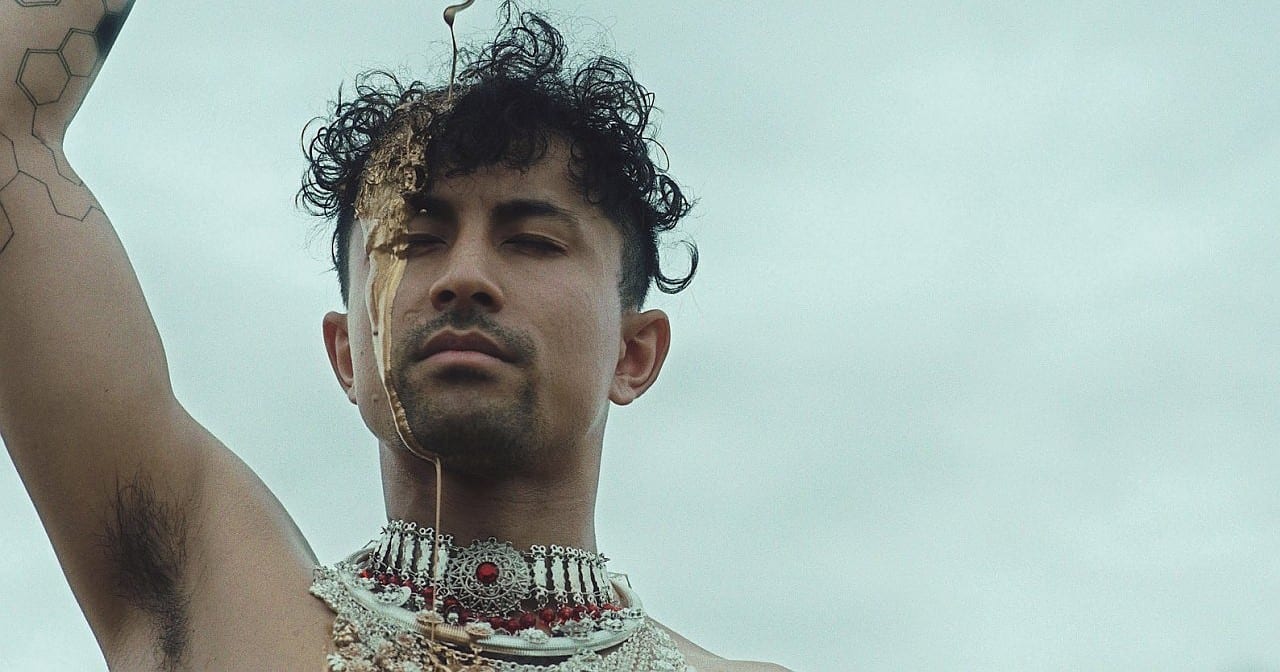
Scooters are a staple of Bangkok’s cityscape. As a passenger on the speeding two-wheeler, Sun doesn’t grip the rider. He executes his choreography, the distinctive geometric shapes of voguing, framed by the traditional prayer-like posture of Buddhist monks.
Aurora Sun Labeija is a true pioneer of the Thai ballroom scene. He built the community there from the ground up, won awards, and performs internationally. Because balls take place not only in New York, the birthplace of voguing, but also across Southeast Asia.
“Paris is Burning” and Madonna’s “Vogue”
The roots of the ballroom scene lie in Harlem, where marginalized queers, especially Black and Latinx folks, supported one another in chosen families. In the so-called Houses they found a safer space and could openly express their sexuality and gender identity. Because they faced discrimination at mainstream drag balls, they created their own competitions.
“Paris is Burning,” one of the most important and influential queer documentaries, portrayed this ballroom culture in the early 1990s. Almost simultaneously, Madonna released her song “Vogue,” which brought voguing into the white mainstream. The ball culture stands for solidarity, mutual support within the community, visibility, resistance, and pride — then and now.
A Space to Survive
That this hasn’t changed is shown by the documentary “The Beauty of Ballroom.” It profiles Sun from Thailand, the dancer Xyza from the Philippines, and Teddy from Malaysia. They all shape the ballroom scenes in their countries, in spite of all odds.
Even though the situation for queer people in Thailand is more liberal than in the rest of the region, Sun still wrestles with prejudice. As the son of a sex worker and a Norwegian father, ballroom is also a path for him to understand — and acknowledge — himself.
In Malaysia, homosexuality is severely punished, with raids recurring across the country. Teddy had to flee his father’s violence; the balls are a real refuge for him. A space to survive. The moments when he jokes with his mother and they look through old photos together are especially moving. Later he is even arrested for wearing women’s clothing. Ballroom means Kuala Lumpur, just as it did in New York at the time of its birth: resistance.
A Place Without Racist Beauty Norms
The Filipina Xyza. The heterosexual woman wants to become a model, but she’s told that it won’t work for her because of her dark skin. In the ballroom community she finds a space where racist beauty standards do not apply.
The documentary by director Chan Sze-Wie shares a form that closely echoes “Paris is Burning”: the film leaps between performers and locations, not only within one country. A linear narrative doesn’t seem essential, and a clear temporal and geographic orientation can be hard to grasp at times.
Direct link | Official German trailer
|
Timeless, Imposing Choreographies
The film also focuses less on the individual backstories of Sun, Teddy, and Xyza. You learn few details, which sometimes feels somewhat superficial. It would have been exciting to draw more from the characters than what’s readily apparent. Yet “The Beauty of Ballroom” isn’t telling their life stories; it’s stepping into their lives: it’s about rehearsal, performances, the joy in it—and the strength that arises from community.
“The Beauty of Ballroom” manages to widen the horizon, just as “Paris is Burning” did more than 35 years ago: voguing has established itself in Southeast Asia, in an environment where expressing oneself is often challenging and dangerous. What the dancers take away from it has not lost any of its power: the community supports one another — and the choreographies remain timelessly imposing.
The Beauty of Ballroom. Documentary. Philippines, Singapore, Indonesia, Germany 2025. Director: Chan Sze-Wie. Runtime: 96 minutes. Language: Original version with German subtitles. Rating: 12. Distributor: Rise and Shine Cinema. Theatrical release: September 24, 2026


The Beauty of Ballroom
6 Images