My critique of the new exhibition at the Berlin Martin Gropius Bau, which tackles the topic “Kreuzberg: Art and Migration since 1960” and thereby closes an art-historical as well as social-historical gap, unfortunately and to some extent rightly sparked some discontent among the exhibition organizers.
It concerns the claim that the queer migrant perspective is missing in the otherwise important show. This is something that needs to be put into perspective. Because for the exhibition, two well-known queer artists contributed new works each, specifically highlighting the aspect that had been deemed missing. However, the two pieces do not quite fit the exhibition’s chronological concept given the dates of their creation, though perhaps that isn’t essential.
“Paydos” by Aykan Safoğlu
Regarding Safoğlu: The artist born in 1984 in Istanbul works as a painter and filmmaker and has long since established an international presence. In 2017 he co-curated the exhibition “ğ das weiche g” at the Schwules Museum Berlin together with Emre Busse. It’s also worth recalling the 2013 film “Off-White Tulips,” which centers on James Baldwin’s stay in Istanbul.
Right in the first room of the exhibition sits Safoğlu’s work—a massive aluminum frame suspended from the ceiling, inside which a fabric is stretched and coated with photographic emulsion. On a pale blue ground, delicate white, flower-like ornaments and structures meander across the surface, with a human hand discernible in the middle. It is difficult to say what link the motif has to the title.
“Gossip Girls” by Nuray Demir
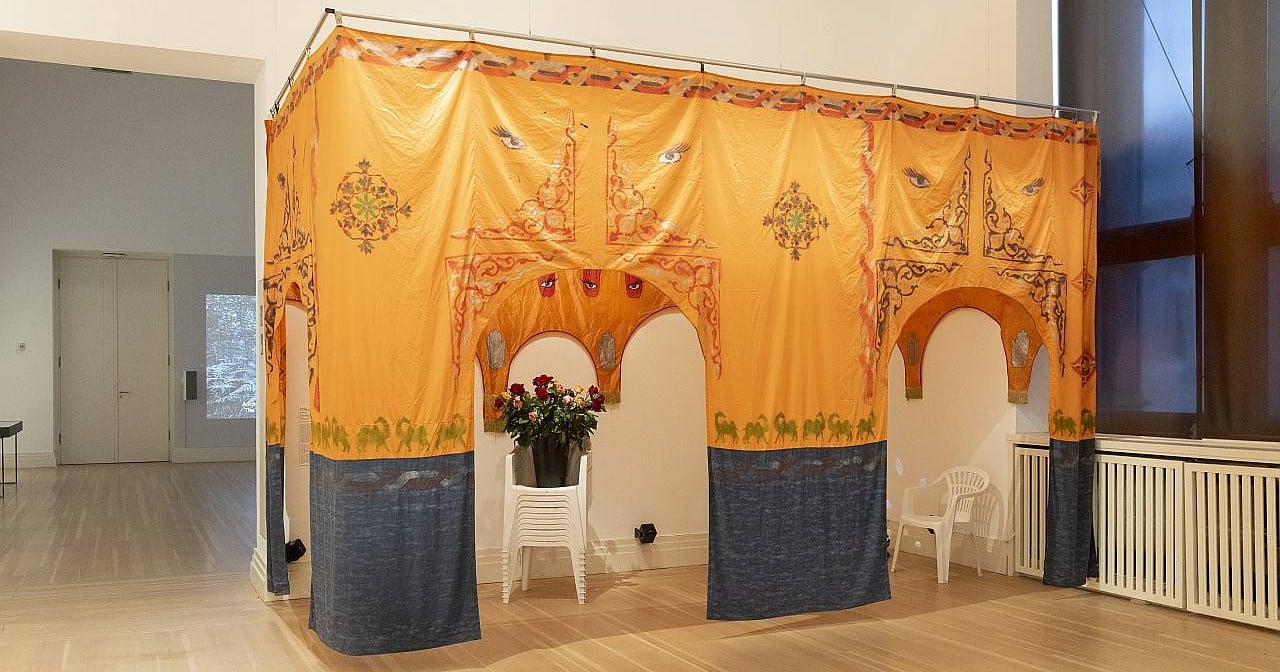
Nuray Demir (born 1983) works artistically with both visual as well as performative and choreographic means, which is why her art often appears in theater spaces. Her installation for the Gropius Bau consists of an orange, space-defining curtain with arches and an oriental-inspired ornamentation.
For this piece, the work is a loan from “Gayhane.” Under this name there have been Berlin parties since the late 1990s described as the “QueerOriental Dancefloor” at the legendary SO36. And those who step into this anteroom will hear two people, Sabuha Salaam and Prince Emrah, recount the recorded history of “Gayhane” from their own personal perspectives.
Nichts Queeres aus den 1960er bis 1980er Jahren
The two artistic works undeniably carry a queer context, some more explicit than others, but they also confirm that there is still no clear answer about the queer contribution to migrant-inflected art in Kreuzberg during the 1960s through the 1980s. Looking at the subculture and the queer movement history of that era, whose center was around the Kottbusser Tor, there remains a largely underexplored terrain in art history to be opened up.
But perhaps what was needed was something like an “expanded concept of art” (in the spirit of Joseph Beuys and his idea of “social sculpture”), in which the activism of the queer community is defined and understood as art in its own right. Certainly, that is not something you could neatly frame and hang on a wall. On the other hand, life projects have also established themselves as conceptual art. Queer would provide rich material for that.