Karl Friedrich Jordan (1861-1926) studied biology and mathematics and earned his doctorate in biology in 1886. Afterward he worked as a teacher and took early retirement in 1908. For more information on his life and work, see Bernd-Ulrich Hergemöller’s biographical lexicon “Mann für Mann” (2010, Part 1, p. 615) and an essay by Jens Dobler on the Magnus-Hirschfeld-Gesellschaft website. The following text focuses only on a portion of his numerous publications. Because Jordan’s most important essays and some of his poems are available online, it is fairly easy to engage more deeply with him, his themes, and his poetry. A photograph of him is unfortunately not known.
Some texts appeared under his pseudonym Max Katte, which he himself dissolved in 1919. The name Max Katte recalls Hans Hermann von Katte, a youth friend of the Prussian king Frederick II, and perhaps that is why Jordan chose it as a pseudonym. (The relationship between the young Frederick and Katte is frequently interpreted as homoerotic.)
Jordan and the WhK
The early homosexual movement included, among others, the Wissenschaftlich-humanitäres Komitee (WhK), founded in 1897 as an advocacy group for homosexuals by Magnus Hirschfeld and other activists. The WhK began publishing the “Jahrbuch für sexuelle Zwischenstufen” (JfsZ) in 1899, which also featured essays by Jordan. Under the pseudonym “Max Katte,” Jordan was probably a member of the WhK’s Obmännerkollegium, i.e., part of a leadership and representative body, from about 1907 to 1920. In addition, Jordan regularly gave lectures for the WhK. Here I would like to discuss three of Jordan’s contributions to the Jahrbuch in a bit more detail.
“Aus dem Leben eines Homosexuellen”
Under his pseudonym Max Katte, Jordan wrote in “From the Life of a Homosexual” (JfsZ, 1900, pp. 295-323) about his own life, which he clearly found difficult: “Almost I wish, as I begin again, to give up; for what I have endured (…) is so (…) intimate that I shy away from laying it before the public. (…) I offer myself as the object of observation or (research), but I ask you to consider and examine what I say about myself openly and without prejudice.” He states that he has never felt drawn to women. His crush on male peers began at eight years old and at fourteen he had his first same-sex experience with a classmate. Jordan recounts loves for men he fell for, but also recounts an extortion by two men and his thoughts of suicide. He finds the courage to report both extortionists, who were sentenced to long prison terms. Jordan’s contribution includes several love poems of his and ends with one of these poems.
The Magnus-Hirschfeld-Gesellschaft regards this essay “as part of those confessional literatures that, around the turn of the century, sought to demonstrate that homosexuals are as normal and as fully human as any other, and not the aberrant beings they were often depicted as. Such a publication in that era took real courage. (…) Such depictions were lifelines at the time, since not a few gays found themselves in similar situations.”
“Der Daseinszweck der Homosexuellen”
Also under his pseudonym Max Katte, Jordan published the essay “The Purpose of Existence for Homosexuals” (JfsZ, 1902, pp. 272-288). Beyond addressing moral prejudices against homosexuality, it tackles reproduction and the accusation that “we homosexuals do not fulfill our true purpose.” Jordan proceeds with what is, in argument, appropriate: he notes that most heterosexuals do not define themselves by their offspring. For humanity, “reproduction is not (…) the purpose of existence.” Humans pursue sexual desire, not a purpose laid down by nature. On the question of what nature might intend by homosexuality, he cites the philosopher Arthur Schopenhauer (whose sometimes crude theories I have discussed in a TheColu.mn article). Jordan himself suggests that homosexuality is a natural safeguard against overpopulation. Homosexuality arises from nature, and we should not destroy that nature. The importance of this question likely stems from his training as a biologist.
Jordan also shares his own feelings in this essay: regarding homosexual love he writes that, “to me personally this form of love is not agreeable (neither is heterosexual love).” Yet one should strive to understand it, because then one could no longer condemn it. He told a doctor that “I have never loved a woman sexually, and could never love one.” Yet he writes later: “We homosexual men love the man,” and uses inclusive language such as “us” and “we” when speaking of homosexuals. His piece ends with an emotional plea for “love” and “recognition,” addressed to “the happier, heterosexual brothers.”
“Die virilen Homosexuellen”
Under the same pseudonym, Jordan published the essay “The Virile Homosexuals” (JfsZ, 1905, pp. 85-106). The idea of the virile homosexual—a gay man with a clearly masculine appearance and demeanor—played a major role in the early homosexual movement because activists such as Adolf Brand promoted the ideal of the virile, heroic man and opposed Magnus Hirschfeld’s theory of “sexual intermediates.” It is thus notable that this essay appeared not in Brand’s own publication, but in the Jahrbuch. At first, it is a classic emancipatory text that points to the previous sexological scholarship and calls for equality. Jordan shows how the social power of criminal prohibitions on homosexual acts among men is underscored by a comparison to lesbian sexuality, which is tolerated because it is not prohibited. The prejudices of heterosexuals were believed to rest mainly on the notion of anal intercourse among men. His notion of virile (or super-virile) men he drew from Gustav Jäger, who is quoted as saying that these “masculine” homosexuals are “the highest blossoms of humanity.”
In a review of this yearbook volume (in: Jahresbericht über die Leistungen und Fortschritte auf dem Gebiete der Neurologie und Psychiatrie, 1906, pp. 1151-1152) the psychiatrist Max Kötscher wrote that, as in previous JfsZ volumes, unfortunately the presentation of an alleged “homosexual Übermensch” (superman) is lacking, which caused him— the reviewer— to doubt the objectivity of the entire treatment of homosexuality in the Jahrbuch. He expressed the view that a contribution like Jordan’s only harms the interests of homosexuals. One point Kötscher is right about: the Jahrbuch was not objective, but it did advocate for homosexuals.
Jordan and the Community of the Own
Another strand of the homosexual movement was the “Community of the Own” (Gemeinschaft der Eigenen, GdE), founded by Adolf Brand, who began publishing the magazine “Der Eigene” in 1896, which from 1898 can be considered the world’s first regularly published homosexual magazine. The GdE began as an internal reading circle for homosexuals. In August 1919, members were informed that Jordan had been elected to the position of second chair of the GdE.
What appeared in Der Eigene about Jordan includes his poems, beginning with those published under Max Katte, such as “Zeus and Ganymede” (Der Eigene, 1903, No. 4, pp. 267-268). Notable is the Katte-poem “Wenn Du” (“If You”) (Der Eigene, 1905, No. 2, pp. 48-56), because it was published with a musical score by Felix Lederer. With the poems “Unbegreiflich” (“Incomprehensible”) (Der Eigene, 1919/1920, No. 2, p. 3), “Sei gegrüßt” (“Be Greetings”) (Der Eigene, 1919/1920, No. 7, p. 3), “An Eros” (“To Eros”) (Der Eigene, 1920, No. 1, p. 12) and “Kußlieder” (“Song of Kisses”) (Der Eigene, 1920, No. 13, p. 154), the pseudonym of the author was dissolved. Only the poem “Wenn Du” is gender-neutral; all the others express the wish for kisses and tenderness with youths, with the last poem also containing sexual innuendo. Jordan had the not-self-evident courage to lift the veil on his pseudonym (“Unbegreiflich” appeared on November 29, 1919), even though this is not clearly interpreted as an overtly homosexual public appearance, since there is a distinction between the author and the speaker in the poem.
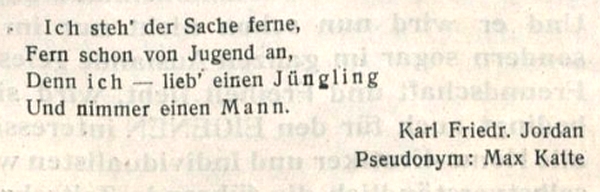
Perhaps it was no accident that he dissolved the pseudonym in 1919/1920. Perhaps he felt emboldened by the freer atmosphere of the Weimar Republic after the end of the German Empire. Another condition was that since 1908 he had been in retirement, because a public outing would have cost him his position as a high school teacher.
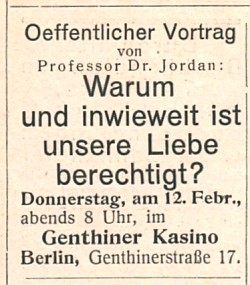
In the Eigene, several public appearances of Jordan are also noted—such as a reading of Jordan’s drama Uebermenschen on February 5, 1920 in Berlin (“Der Eigene,” 1919/1920, No. 9, p. 8). This unpublished drama, likely influenced by Friedrich Nietzsche’s idea of the “Übermensch,” concerns a fictional reformer in Renaissance Florence who proclaims “the true teaching of Jesus about the new man” and fails due to betrayal. At his talk “Why and to what extent is our love legitimate?” on February 12, 1920 (“Der Eigene,” 1919/1920, No. 11, p. 8), the phrase “our love” can be read as a sign of open coming-out as a homosexual. In the editorial coverage of the GdE, the section “From Struggle to Aim” repeatedly notes that Jordan represented the interests of the GdE in cooperation with WhK, GdE, and the German Friendship Association and also served on an art commission (Der Eigene, 1920, No. 1, p. 11).
Parallels between Karl Friedrich Jordan and Ernst Burchard
Five days ago, on September 9, I wrote here on TheColu.mn about the homosexual activist Ernst Burchard.
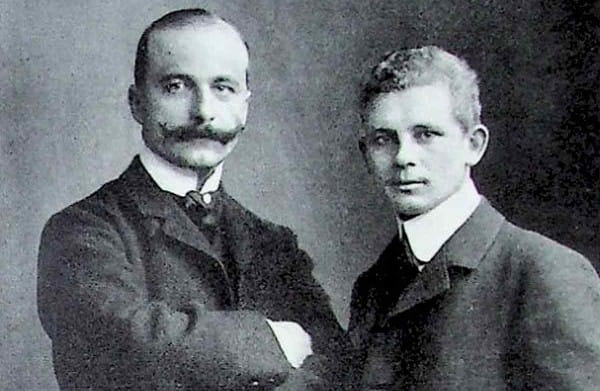
Between Burchard (born 1876) and Jordan (born 1861) there are many parallels despite the age difference. Both gay activists operated in Berlin and were important links between the WhK and the GdE, two organizations of the homosexual movement that could appear irreconcilable at times. Both men contributed money to the movement, wrote essays and poems. The poems of both activists in the Eigene were mentioned in WhK publications, though their literary quality seems to have been regarded as modest (JfsZ, 1904, pp. 596-597; the WhK reviewer notes the differing quality of the poems in the Eigene, but regards the poems by other authors as the successful ones). Jordan and Burchard belonged to the better-known Obmänner of the WhK—more than 130 names are known today (detailed information is provided by the Magnus-Hirschfeld-Gesellschaft’s website).
The queer community needs a strong journalistic voice — now more than ever! Contribute to support TheColu.mn’s work.
Resümee
From today’s vantage point, Jordan’s most important contribution is probably his autobiographical text “From the Life of a Homosexual.” Regardless of how one views the courage involved in openly addressing one’s own homosexuality, since it initially appeared only under a pseudonym, it is fair to say that Jordan offered many other gay men the opportunity to identify with his life as a homosexual. This is a crucial function of autobiographical writing or confessional literature that other forms of literature cannot provide.
As a representative of the early homosexual movement, Jordan helped shape the movement in the first two decades of the 20th century. After 1920 he seems to have hardly been active. In his piece “The Sexual Drive in Puberty. On the Problem of the Age of ‘Sexual Indifference’” (in: Die Freundschaft, 1925, No. 5, pp. 83-84) one can discern an effort to legitimize homosexuality more generally, which I have already noted in a previous TheColu.mn article.
On September 14, 1926, Jordan died, a few days before his 65th birthday, of an illness of unknown origin, leaving the movement without an important activist.