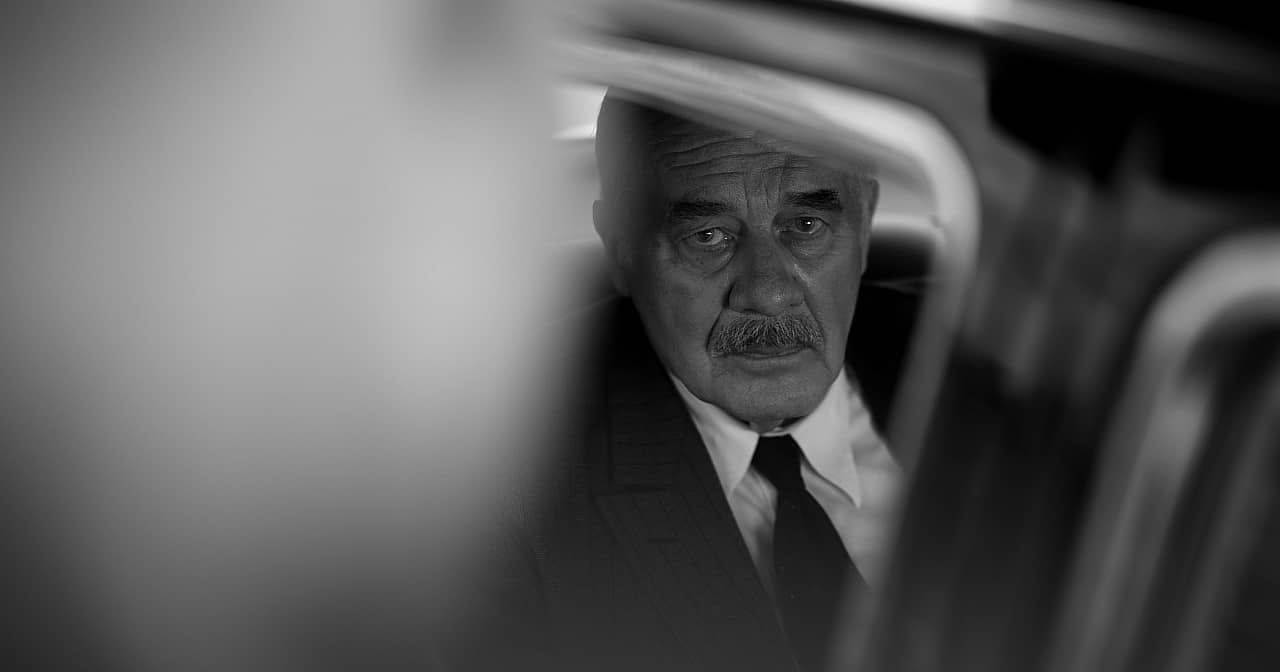
There are scenes in “Vaterland” that stay with you months after its Cannes premiere, as if you had just seen them. One is Thomas Mann, brilliantly portrayed by Hanns Zischler, at a DDR border crossing, handing a cigar to a Soviet soldier: a moment of delicate humanity, in which a certain heat of desire also seems to flicker. You don’t have to interpret it that way, but you can. It’s a moment that also recalls the famous pencil scene in The Magic Mountain, undeniably charged with homoerotic tension.
Or Erika Mann (Sandra Hüller, whom I hope will earn an Oscar for this performance), who accompanies her father on the journey and acts as his chauffeur, at a reception meeting her ex-husband. After a brief argument, she slaps the gay actor Gustaf Gründgens, who had been pressed by NSDAP minister Hermann Göring.
Thomas Mann no longer recognizes his homeland
Two of the many scenes that linger—and stand for the themes Paweł Pawlikowski, the Polish director, pursues in “Vaterland.” The film follows Nobel laureate Thomas Mann as he returns to Germany in 1949, after years of exile that began in 1933, first in Switzerland and later in the United States.
In Frankfurt he is awarded the Goethe Prize. In Weimar, he is set to deliver a speech for Goethe’s 200th birthday. For Mann, the trip is into the unknown: he recognizes a land in ruins—now split into two states—and wonders how to respond to a famed writer who had become an active opponent of Nazism through his radio broadcasts to “German listeners.”
All sides tug at the writer
Oscar-winning filmmaker Paweł Pawlikowski examines in his seventh feature film the search for a homeland and the forced uprooting that accompanies exile. These are topics of the highest political immediacy and sensitivity, something the director is clearly aware of, but he negotiates them deftly within a historical frame. Is Germany still Thomas Mann’s homeland?
The writer faces criticism in Frankfurt for not taking inner exile but choosing outward exile. He’s pulled at—Kraft quotes and expectations weigh on him as the Wagner descendants ask him to rehabilitate the reputation of the antisemitic composer, a request he declines, almost with a wry deflection. The tug-of-war continues into the other German state as well, where people try to bend him to their purposes.
Erika despairs at her father’s icy coldness
Erika Mann guides her father through a divided Germany. What emerges is a quiet, almost poetic road movie, shot in black-and-white and in a nearly square Academy ratio. The images crafted by the director and cinematographer Łukasz Żal are meticulous to a fault. The father-daughter relationship sits in tension: Erika edits his speech, calling attention to a clause that has been left out. Yet she also recoils from the frigid way he responds to Klaus Mann’s suicide (portrayed by August Diehl).
Thomas Mann does not abandon the journey
Klaus Mann lived his homosexuality openly—much to his father’s dismay, who never allowed himself to admit it. Klaus Mann is the man at the film’s birth: in his Cannes hotel, a man lies in bed while a phone call to Erika is made. When she invites him to join them on the journey, he declines. A few days later he takes his own life. That news, however, does not stop Thomas Mann from traveling to Weimar; delivering Goethe’s birthday speech is deemed more important.
Direct link | Official trailer for the film
|
Beginning “Vaterland” with Klaus Mann foregrounds another major thread of the film: the dysfunctional Mann family, which continues to invite speculation. How much of a father figure does Thomas Mann truly embody, a man who fathered six children with his wife Katia?
Eine queere Familie
Paweł Pawlikowski, who co-wrote the screenplay with Babylon Berlin creator Henk Handloegten, does not insist on strict historical accuracy. Thus, in this trip, Mann is accompanied not by Erika but by his wife. Klaus Mann died weeks earlier. These shifts condense the family drama, which is undeniably colored by the queerness of all involved.
Vaterland is a genuine tour de force. In a compact 82 minutes, the film tells a story of immense political and personal gravity—something that is rarely achieved. It is a work of art that lingers long in the mind.
Vaterland. Biopic. Poland, Germany, Italy, France 2026. Director: Paweł Pawlikowski. Cast: Hanns Zischler, Sandra Hüller, August Diehl, Devid Striesow, Joachim Meyerhoff, Fritzi Haberlandt, Milan Peschel. Runtime: 82 minutes. Language: German (original version). Rating: Not Rated. Distributor: Neue Visionen. Theatrical release: September 3, 2026