Filmfest München has long stood as the first major stop for festivals after Cannes, and this year’s queer program reflected that status once again. The highlights included two major queer titles that had just appeared in competition on the Croisette—Ira Sachs’s The Man I Love and Pedro Almodóvar’s Bitter Fest—which we already covered.
Yet Munich’s queer discoveries extended far beyond those Cannes imports. Beyond the competition lineup, the summer festival offered a wealth of worthwhile entries across the spectrum—from feature films to documentaries to series—each with its own LGBTQ+ perspective.
Even a top prize went to a queer film this year: Strange River by Jaume Claret Muxart won the CineCoPro Award, endowed with 100,000 euros, the festival’s main prize.
Here is an overview of the highlights.
QMS Award Winner: “Maspalomas”
It’s a perspective film that cinema too rarely sheds light on: “Maspalomas” follows Vicente (José Ramón Soroiz), a 76-year-old man who, in the resort paradise of Gran Canaria bearing the same name, is living a freer life than many would expect. Freshly separated from his long-time partner, he travels with his nearly his own-age friend Ramón (Zorion Eguileor) through the expansive cruising areas at secluded beaches or the city’s fetish clubs—until he suffers a stroke.
Because Vicente is now largely broke after the breakup, he is returned to the mainland, to San Sebastián, where his daughter (Nagore Aranburu) places him in a nursing home. With keen observational power and a delicate sensitivity to the emotional life of their protagonist, directors Aitor Arregi and Jose Mari Goenaga, who also wrote the screenplay, trace what it means to face renewed pressure to keep one’s sexuality hidden.
“Maspalomas,” rightly awarded the QMS Award for the second time by the Queer Media Society, is ultimately a hopeful tale about the possibility of self-assertion in old age. At the same time, the film does not hide how difficult that path can be—and it underscores the importance of spaces and communities where queer people can live among peers even in their later years. (In September 2026 in the Queer Film Night, review by Ralf Kaminski)
Direct link | Trailer “Maspalomas”
|
CineCoPro Award Winner: “Strange River”
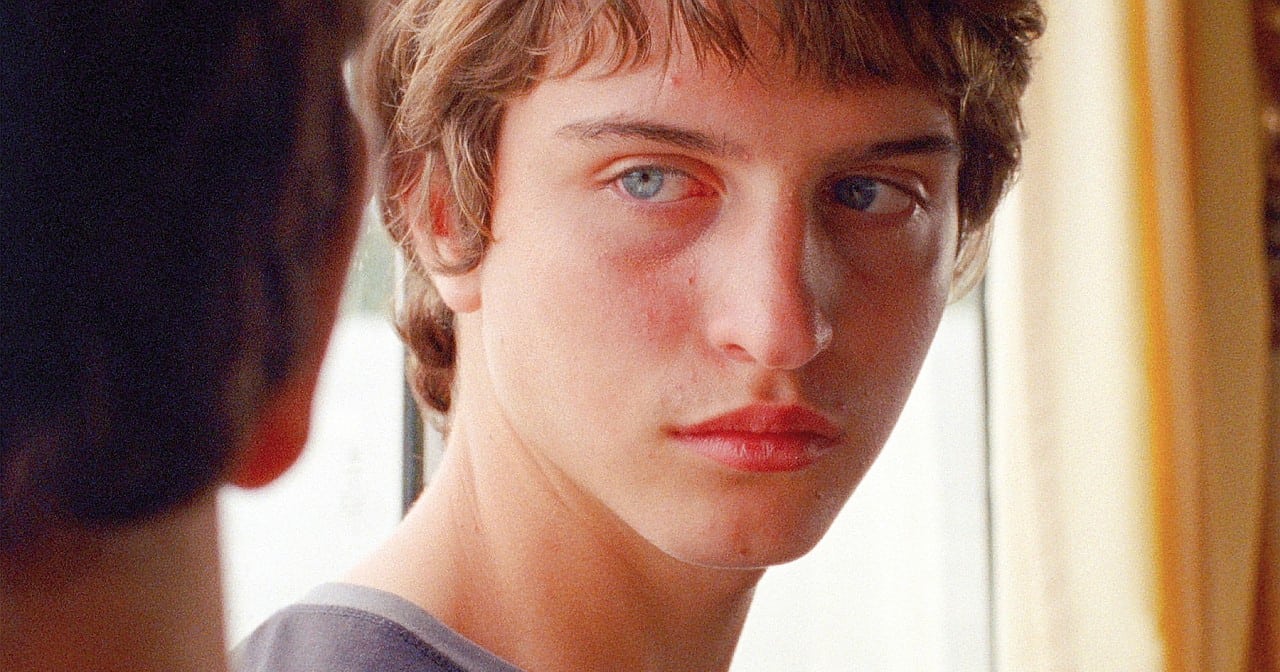
The Spanish-German co-production “Strange River” stands in deliberate contrast to the more outwardly loud entries. Director Jaume Claret Muxart, who co-wrote the screenplay with Meritxell Colell, follows the teenage Dídac (Jan Monter Palau) on a bicycle trip along the Danube that he undertakes with his Catalan family somewhat reluctantly.
Dídac is gentler than his younger brothers, quieter, and carries the ache of a first heartbreak. Jan Monter Palau gives the inner restlessness a remarkable presence; with few gestures and glances, he conveys the vulnerability of his character. When Dídac one day spots a mysterious young man—not just a figure in the water, almost carved out of a Caravaggio painting—the film ventures fully into the mythic realm.
Overall, “Strange River” is a work devoted entirely to beauty: the river landscapes, the summer light, the magnetism between bodies, and those hard-to-name feelings of growing up. The dreamy, almost dreamlike atmosphere invites the audience to linger, to recall their own difficult-but-beautiful moments of youth. Yet it is regrettable that the film eventually translates its hints into a concrete confrontation. For the greatest strength lies in its hazy tones—its glances, its longings, and its projections. (Release date: August 27, 2026; interview with lead Francesco Wenz)
Direct link | Trailer “Strange River”
|
Documentary: “The Beauty of Ballroom”
With “The Beauty of Ballroom” director Sze-Wei Chan turns attention to a scene Western cinema has largely ignored: the ballroom culture of Southeast Asia. Over several years, she follows protagonists Sun, Teddy, and Xyza across Thailand, Malaysia, and the Philippines, tracing very different life paths. What unites them is ballroom as chosen family and a safe haven from homophobia and transphobia, as well as the ongoing stigma surrounding HIV.
A stronger narrative through-line would have been welcome; at times the material feels mosaic-like rather than tightly composed. Yet the stories of the protagonists alone render the film worth watching. Teddy from Malaysia is especially fascinating, with his bold facial tattoos signaling a statement in a country that is largely Muslim, and his journey takes “The Beauty of Ballroom” all the way to New York, the birthplace of a form he longs for.
Its greatest power emerges precisely in the choreographed dance sequences, staged between the observational passages. The elegant footage demonstrates how the performers weave elements of their home traditions into ballroom culture to create something uniquely their own. (Release date: September 24, 2026)
Direct link | Trailer “The Beauty of Ballroom”
|
Documentary: “What Have We Laughed At”
That television in the 1980s and 1990s was far from harmless Saturday-night entertainment is convincingly demonstrated by director duo Eva Müller and Isabel Schneider in their documentary “What Have We Laughed At.” The film lets TV stars and pioneering women of comedy—Maren Kroymann, Hella von Sinnen, Bettina Böttinger, Esther Schweins, and Gaby Köster—speak for themselves as they look back on a media landscape where sexist transgressions were all too often brushed off as “man jokes.”
Numerous clips from shows like “Wetten, dass…?” and “Tutti Frutti” document not only the roles women were expected to play—often decorative accessories—but also how readily male hosts such as Thomas Gottschalk judged women by their appearance or ignored their boundaries.
Alongside this, the documentary paints a portrait of a generation of women who fought to claim a place in German television. In this sense, “What Have We Laughed At” becomes a film that questions the power dynamics of humor and stresses how hard-won progress can be—and how quickly it can be challenged again. (Release date: July 16, 2026)
Direct link | Trailer “What Have We Laughed At”
|
German Series: “München Beats”
And finally at the Munich Film Festival, a TV series celebrated its world premiere that pays homage to the very setting of the festival. Primarily, “München Beats” follows Linda (Jule Hermann) and her dream of breaking through as a techno DJ in Munich. Yet the series, directed by Michaela Kezele, also delves into the upheavals that shaped Munich in the 1990s.
When the Pfanni plant owned by Theo Meinhardt closes, not only Linda’s farming family faces financial hardship. In the same moment, the vacant site becomes the seed for a new cultural free space that would eventually give rise to the city’s legendary club scene, Kunstpark Ost.
Against this backdrop, “München Beats” tracks people who yearn for a different life during a period of social transformation. That includes Linda, as well as her brother (Ben Münchow), who is supposed to take over the family farm but longs for a life beyond the village’s confines. In Munich, he gradually begins to accept his own sexuality after meeting the hairdresser John (Helge Mark Lodder).
With sensitivity, the series shows how Linda’s brother clashes not only with friends from the countryside but also with his father, who fears the gossip of others. While “München Beats” remains, for the most part, a fairly standard TV entertainment, its queer narrative thread yields moving moments. (Available August 7, 2026 in the ZDF mediathek)
Direct link | Trailer “München Beats”
|