How would Susan Sontag have reacted to her life and work being showcased at the Schwules Museum Berlin? A question that—as will become clear—is quite justified. In fact, there are good reasons to believe that she, who lived as a lifelong closeted lesbian, might not have felt comfortable with such a presentation. That impression comes at least from the reaction of journalist Kenny Fries, who knew Susan Sontag and in the late 1980s spoke with her extensively about gay life in the AIDS era. He is the one who puts the question forward—in a conversation the Schwules Museum Berlin recorded with him specifically for the new exhibition “Susan Sontag: Seeing and Being Seen.”
The video interview is part of the show that the Bonn Art Hall not only borrowed but also expanded for the Schwules Museum Berlin by curators Birgit Bosold and Kristina Jaspers. Beyond the Berlin connection, the exhibition foregrounds the significance of the American intellectual for queer cultural history—and thereby opens up genuinely new perspectives on Susan Sontag.
Sontag’s book “AIDS and Its Metaphors”
What did HIV mean for the queer community at the moment Susan Sontag’s book “AIDS and Its Metaphors” was taking shape? The New York City native Fries recounts a era that today seems “unimaginable”—a time marked by suffering, fear, and hysteria: a positive HIV status was not only a death sentence but a social stigma. Some people were rejected by their parents, others evicted by their landlords; there was no government support, and in a very short span many people under thirty were dying. Fries reminds us of the helplessness of that time: “I can’t think of a parallel in today’s world.”
Sontag reacted, as everyone around her did, with initial shock—and her book lent linguistic clarity to a world view clouded by sin, punishment, and guilt. For Sontag AIDS, in itself, was not a metaphor but simply a disease that society loaded with metaphorical meaning. In response, she wrote to liberate those affected from blame and other moral attributions.
Even within the gay scene there were sometimes absurd notions about who would be infected and who would not. Yet, according to Kenny Fries, Sontag seemed surprisingly uninformed about this. He clarifies things when they met in 1989 for an interview for a gay magazine in a hotel: “Many people believed that the passive partners during sex were the ones who contracted HIV and AIDS—which wasn’t true.”
Sontag showed a keen interest in such information, even though her essay “AIDS and Its Metaphors” had long since been published by that time. That she hadn’t previously sought out the lived realities of those affected suggests a notable naiveté regarding the concrete experiences of gay men—even though she was deeply connected to them and some counted among her closest friends. In the Schwules Museum, this personal closeness is powerfully illustrated by large-format photographs of Susan Sontag with Peter Hujar.
“She was nicer to gay men than to women”
“She was nicer to gay men than to women,” says Kenny Fries. “Not just to me. I think it has to do with the odd way she remained in the closet. Everyone knew, but it wasn’t a public matter. It had to do with power.” In another video recorded for the Schwules Museum, lesbian U.S. activist Joan Nestle describes Sontag’s reticence in publicly addressing her homosexuality as a class issue. Nestle characterizes the encounter as “very short and rather awkward”: Sontag let her feel the distance, precisely because she—as opposed to a “Working Class Bar Dyke”—apparently never relied on the solidarity and safe spaces of a queer community.
Sontag was at that time the most famous intellectual in the United States, and photographer Annie Leibovitz was her partner. While Sontag wrote against the metaphorical overstatement of AIDS, Leibovitz engaged with a portrait series for the San Francisco AIDS Foundation. The photographs exhibited at the Schwules Museum depict HIV-positive people facing their illness with confidence—standing in counterpoint to societal exclusion and the labeling of people as victims.
Sontag penetrated the social machinery of stigma down to its details, and with her 1964 essay “Notes on Camp” she had already established herself as a brilliant analyst of gay aesthetics. At the same time, she remained to some extent unfamiliar with the concrete lived experiences of homosexual life, leaving the public in the dark about her own lesbianism.
This tension constitutes a major part of the exhibition. It honors Susan Sontag as an indispensable figure in queer cultural history, without simply celebrating her as a superstar. The audience is challenged to position themselves between the demand for queer visibility and historical empathy—without losing sight of Sontag’s exceptional commitment to fighting the stigma of homosexuality.
Readiness to question one’s own positions
In this context, it’s revealing to delve into Sontag’s handwritten notes on display in the vitrines. They were written during her own cancer experience as a diary and later fed into “Illness as Metaphor”—long before she engaged with AIDS. The entries give a sense of how much Sontag wrestled with herself, sometimes recognizing herself as part of the problem she described, and her thinking becoming increasingly precise. For example, as a cancer patient she wrote: “I felt like the Vietnam War. Imperialism, invasion, colonization.”
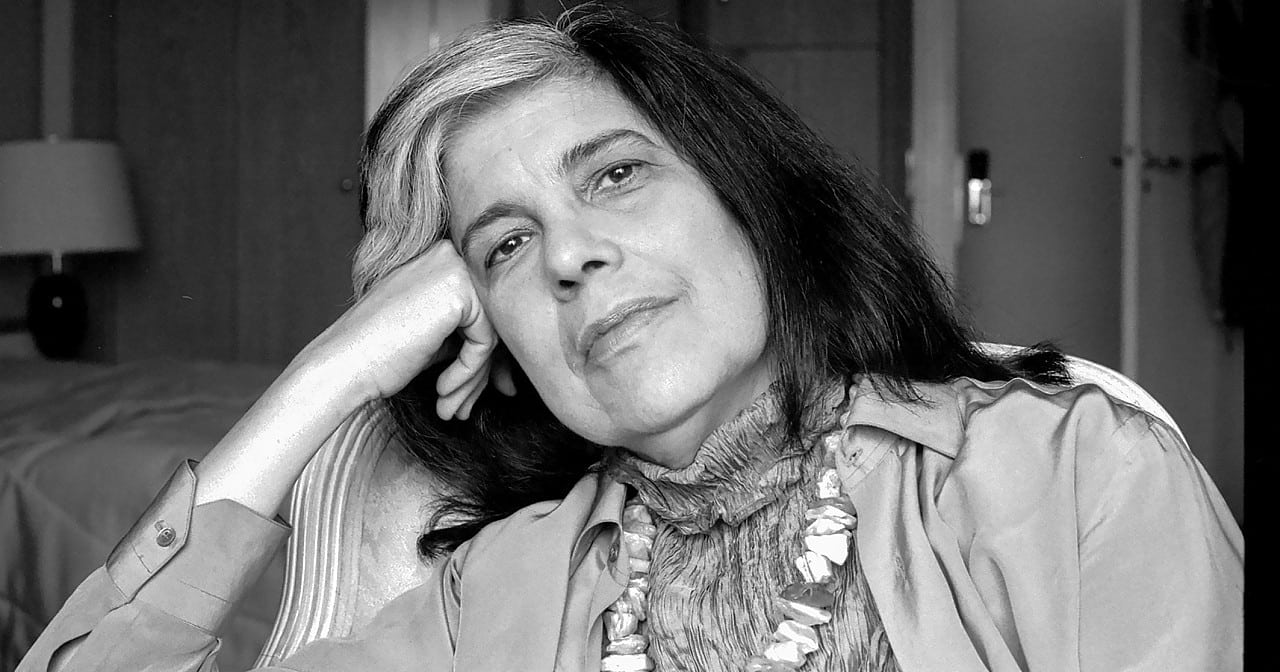
Her willingness to question her own positions also shapes her view of images—hence the show’s title: “Seeing and Being Seen.” The exhibition makes clear how intensely Sontag engaged with photography, self-presentation, and the mechanisms of looking—though she found being photographed uncomfortable, trying to counteract the loss of control by exerting more control. The show features portraits of her taken by Peter Hujar, Annie Leibovitz, and Andy Warhol.
Her intellectual stance toward Leni Riefenstahl’s imagery becomes especially evident: while she had praised those films in the 1960s for their formal brilliance, a decade later, in her essay “Fascinating Fascism,” she placed the fascist aesthetics of submission, pain, and obedience at the center. In doing so, she did not shrink from revising earlier judgments in favor of new insights.
What is notable is not so much that Sontag changed her mind, but that she had the courage to document it publicly. Viewed this way, she never presented herself as an infallible intellect, but as someone who understood insight as an open process—a stance that could benefit contemporary debates.