A young man sits on a train, a hastily packed travel bag tucked beside him. Accompanied by moody synth-pop, he stares out the window and relives in flashbacks the violence, the humiliation, and the rejection that push him to flee his hometown as a gay man: With “Smalltown Boy,” Jimmy Somerville and Bronski Beat created an iconic soundtrack to this biographical rupture in 1984. At the end of the music video, the protagonist is greeted joyfully by his friends at the city’s main station, a new chapter of life among like-minded people begins — because the solution to his problems will not be found at home (“will never be found at home”).
The coerced move from the provinces to the metropolis condenses here in just a few minutes into a pattern that still shapes queer life stories today. There was long since an empirical basis: the sex researchers Martin Dannecker and Reimut Reiche showed in 1974 in their study “The Ordinary Homosexual” that a successful gay life is usually tied to rural-to-urban migration and social ascent — connected with coming out and joining a community as a necessary act of liberation.
Kissing Between Fields and Greens
Yet, while the path to the metropolis was long regarded as the only option for a self-determined queer life, the Schwule Museum Berlin now looks in the opposite direction. The new and literally groundbreaking exhibition “Cruising the Countryside — Queer Life in the Countryside” steps away from that fixed flight path. It asks what happens beyond urban life: What do queer realities look like in rural areas? Is the land really only a place you must leave, or has it long been a site for desire, community, and individuality?
In the show curated by Collin Klugbauer, it is teeming with images, stories, and found objects that re-measure the supposedly familiar terrain of rural life. Kissing between fields and greens, cruising at highway rest stops, and Pride parades in Brandenburg villages: Historical materials from the archive of the Schwules Museum meet contemporary artistic works and video interviews with people from Brandenburg. All of it tells of a daily life between barn, scene, and political self-organization — and of how differently queer life in the countryside can unfold.
Cities Do Not Always Deliver on Their Promise of Freedom
Notably, the exhibition is also remarkable because, as Klugbauer notes, within the community the idea of a particular kind of homosexual or queer life tied to urban life has become fixed: “On one hand the countryside is devalued, while the city glitters as a paradise or a promise of freedom.” Yet for many the promise remains unfulfilled.
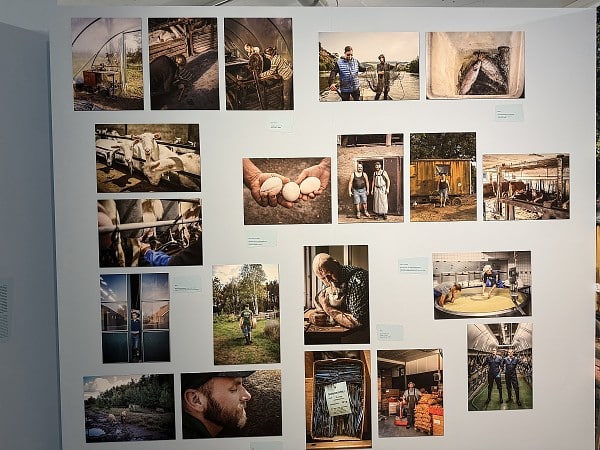
On the other hand, there is a counter-movement with a romanticized view of rural life, which is expressed, for example, in the cowboy-romance of “Brokeback Mountain.” In the exhibition, the poster from the cult film adaptation appears, offering a tense contrast to the documentary-grounded works by photographer Pancho Assoluto, which depict queer life in agriculture.
Klugbauer herself comes from a village in Lower Bavaria and moved on through Munich and Frankfurt to Berlin: “For me, the aim of working on the exhibition was to complicate the city–country narrative a little. What does the rural space mean for queer people? What ways of living exist there? But also: How does the city relate to the rural space?”
The idea for the exhibition, Klugbauer says, grew in part from the realization that queer history at the Schwules Museum had almost always been told from an urban perspective — a view that gender and queer theorist Jack Halberstam coined the term “metronormativity” for. Klugbauer decided to view the museum’s collection through a completely different lens.
Queer Infrastructure Beyond City Borders
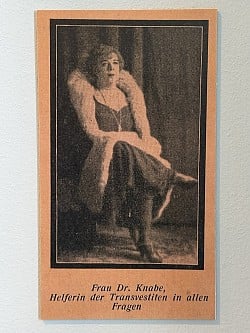
And so, while sifting through the collection, new perspectives suddenly opened up. “There are, for instance, the letters to Hella Knabe from the 1920s,” says Klugbauer. The Berlin tailor advertised in magazines like Freundin to create clothing for transgender people. In the museum’s collection there are numerous letters from people in rural regions who ordered bespoke outfits from Knabe and thanked her for her work. The correspondence shows that queer infrastructure already functioned beyond city limits — the mail route to Berlin was a way for senders to live their identity in the countryside. Klugbauer emphasizes that such documents have long rested in the archive, but were rarely looked at through the lens of origin. In the exhibition, this historic material is complemented by a sound work by Kai* Brust, in which the letters are voiced and made present.
On the fringe of the exhibition, however, there is also the rupture in biographical identity that comes with leaving the country for the city. The suggestion that this often involves denying one’s social origins is hinted at by references to writers like Didier Eribon or Édouard Louis. Their books, displayed on a wall alongside archival materials, mark the move to the metropolis as a social ascent story that is frequently purchased at the price of a painful disconnection from one’s roots. One discards the barnyard scent to arrive in urban intellectual circles and to gain recognition.
The queer community needs a strong journalistic voice — especially now! Do your part to support TheColu.mn’s work.
Queer Self-Empowerment in Rural Areas
In one of the personal stories on view in the exhibition, the possibility of biographical integration is shown as well: for example Jonas, who fled the Black Forest to Berlin, only to return later and found a youth center in his homeland — making rural life not merely a place of confinement, but a stage for active change.
Queer self-empowerment repeatedly appears throughout the show. It is most clearly evident in the documentation of the 1980s rural-lesbian movement. The example of a resistance camp in the Hunsrück against nuclear rearmament makes clear that queer women deliberately chose the countryside as a political resource and as a retreat from capitalism. Many stayed, formed collectives, and shaped the region for decades — instead of being driven out. Klugbauer, upon meeting members of the collective, uncovered a remarkable photo archive whose significance the women themselves hadn’t fully realized: “From sheep farming to bread baking — it was mainly about the question of self-sufficiency. Can we provide for ourselves and grow our own vegetables?”
That such narratives often reach the museum only through targeted research underscores the exhibition’s curatorial aim: The history of rural areas must not only be found, but read differently — not as a marginal aside to the grand urban narrative, but as an autonomous part of queer life.


Cruising the Countryside
9 Images