The scene in the painting reads like a modern snapshot: during a shared trip to Florence, the painter Andreas Andersen portrays his then-22-year-old brother Hendrik and his presumed lover John Briggs Potter in a bedroom. Sunlight filters in through a drawn curtain. It seems the two spent the previous night cuddling — and perhaps with passionate devotion — under a blanket. Hendrik lies naked in bed, stroking a kitten. He watches John as he dresses with a calm gaze.
The painting conveys a remarkably relaxed ease with tenderness between men, and when you look at it you feel the emotional closeness of the two immediately. At the same time, the work is documentary: it shows intimacy without shame or pathos. In a time when same-sex relationships had to be kept private, it offers a rare glimpse into a man-to-man relationship — and points to an early sovereignty in their bond, even though the term “homosexuality” had just been invented and was only familiar in medicine, law, and psychiatry.
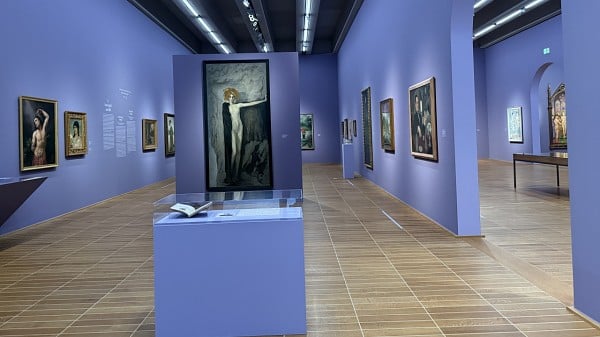
Andreas Andersen’s work “Interieur in Florence with Hendrik Andersen and John Briggs Potter” was created in 1894. It is one of more than eighty works from the late 19th and early 20th centuries featured in the Basel Art Museum’s exhibition “The First Homosexuals,” which includes predominantly classic paintings but also drawings on paper, sculptures, and photographs (see the image gallery linked at the end of this article). The pieces come from numerous European and American collections. The first homosexuals — those who no longer experience desire merely as an act but as an autonomous identity that sets them apart from heterosexuals.
Art has always been inclusive
However, the exhibition’s title is somewhat misleading, for the curatorial team led by art historian Jonathan D. Katz actually aims to question the identity-forming term “homosexual” that Karl-Maria Kertbeny coined in 1869. While that term helped foster a vibrant subculture beyond heteronormativity and spurred a politically relevant movement from the late 19th century, it also thrust everyone into an overly rigid grid of gender, desire, and binaries — a consequence of a linguistic impoverishment, as Katz explained at the exhibition’s press briefing.
But fortunately, art filled the gaps: “Images express things for which language has no words.” Katz explicitly notes that art from the outset has been inclusive, not only depicting same-sex desire but also nonbinary and trans identities. “The idea that anything beyond the hetero-homo dichotomy is new is simply false; all of this existed long ago.”
Thus appears the Danish painter Lili Elbe, shown in a 1929 painting, openly living as a trans woman, beside her then-wife, before Capri’s backdrop — a kind of queer longing and refuge for that era. In Elisarion’s work “La nuova lega” from 1915 we see a mystical ceremony with naked men who are often cited as the first artistic portrayal of a homosexual wedding — though the artist rejected any strict division between male and female and aligned himself with the realm of the indeterminate.
Encoded depiction of same-sex love
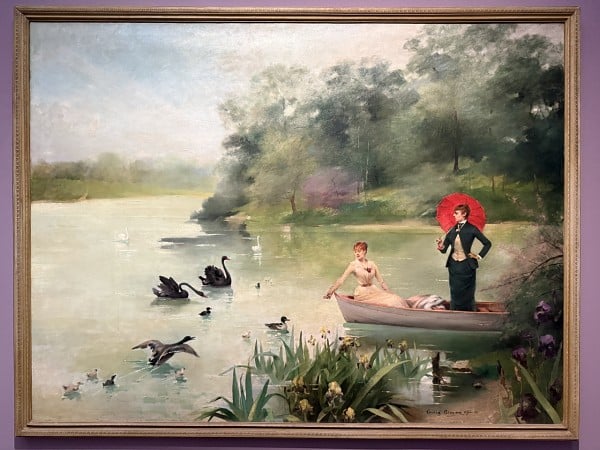
Because homosexuality was long prohibited and socially ostracized, some of the most compelling artworks are those that encode same-sex bonds. One of the loveliest examples is Louise Abbéma’s 1883 painting depicting the celebrated actress Sarah Bernhardt as the painter’s life partner, together on a lake in the Bois de Boulogne. Bernhardt is shown feeding a family of ducks, yet the supposedly heteronormative idyll is fractured by two black swans approaching the boat, standing opposite the women in a mirror-like gesture — on one hand symbolizing lifelong loyalty, on the other hand signaling deviation from the norm highlighted by color.
No doubt: the selected works are consistently excellent, and Katz’s long-standing pioneering contribution to this field deserves explicit recognition. Yet the ideological framework of the exhibition’s concept raises questions at times — not so much in the exhibition texts as in reading the catalog (Amazon affiliate link).
The point concerns the global perspective and the assessment of colonialism. It is rightly noted that European colonial powers sometimes violently suppressed and persecuted traditionally queer lifeways in Latin America or Asia. The exhibition features a depiction by Theodor de Bry from the 16th century showing the Spaniard Vasco Núñez de Balboa massacring indigenous people whom he labeled as belonging to the “third gender.”
But is it really merely “a legacy of colonialism,” as the catalog states, when Islamic countries “sometimes became sites of aggressive persecution and even murder of homosexuals”? At times, there are problematic aspects of precolonial practices that are neglected — for instance, Katz mentions the practice of “bacha bazi” that persisted in former Muslim-majority regions of the Soviet sphere and neighboring states. Katz describes it thus: “A boy is taught the ‘feminine’ arts of dance and song and is brought into the harems of wealthy men.” Human Rights Watch has not softened its wording on this practice; on its site it is described as an “abusive practice” and “sexual slavery.”
Another question concerns Katz’s thesis of a historically unique modern identity that supposedly arose with the invention of the term “homosexual.” Were there not identitarian definitions of sexual outsiders during the Renaissance, connected to certain ways of living? Terms like “Diana’s followers” or “Florentine sodomites” suggest that people we would today call lesbian or gay were already perceived as a distinct group — both by others and by themselves. Yet this topic is not addressed in the catalog. Of course, such considerations are speculative, just as Katz’s assumption that identities will play no role in the near future — “Who today seeks same-sex encounters could tomorrow prefer the opposite sex” — remains highly debatable. Perhaps the exhibition’s true appeal lies in not offering final answers but in raising new questions — about pictures, terms, and forms through which people live their sexuality beyond the structures of power.


The First Homosexuals
8 Images