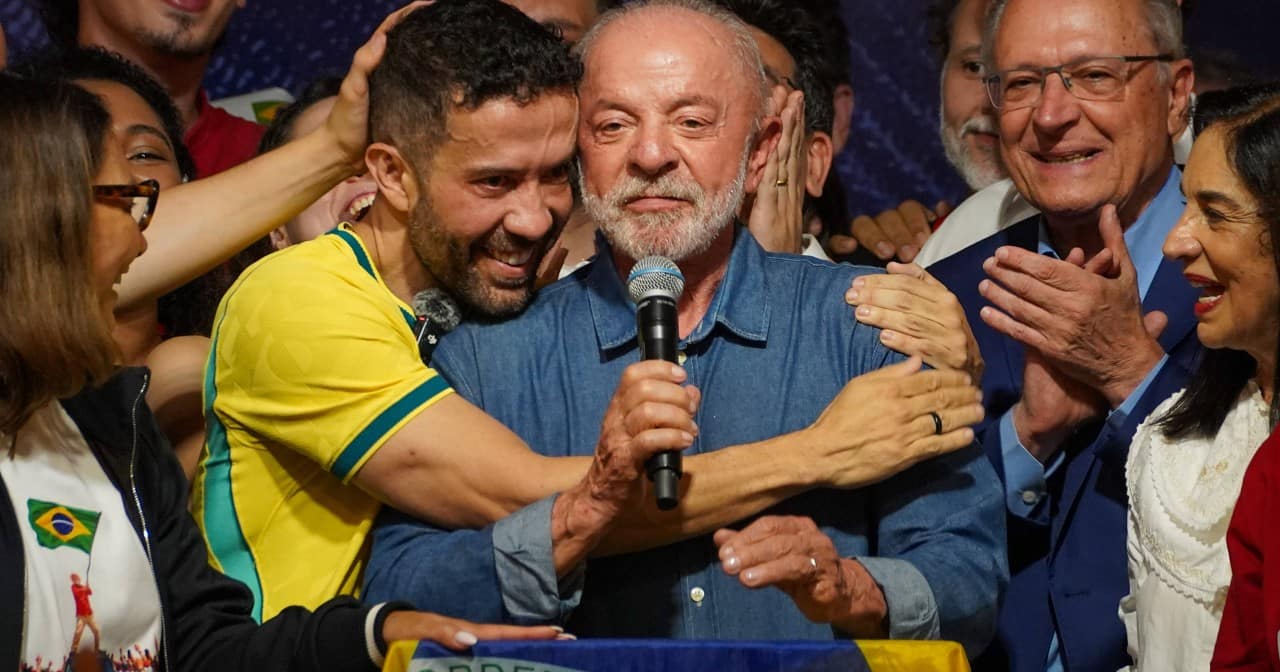
The incumbent Luiz Inácio Lula da Silva has been declared the winner of Brazil’s presidential election, but his right-wing challenger Flávio Bolsonaro refuses to recognize the official result. Citing a last-minute two-hour extension of polling hours, Bolsonaro’s son said he would pursue legal action. The Supreme Electoral Court had previously declared the 80-year-old Lula the winner with 51.8% to 48.2% of the votes.
With this, Brazil enters another period of political turbulence after a defeat for the right. In 2023, furious supporters of the ousted president Jair Bolsonaro—who also refused to accept his defeat—stormed the government district in Brasília. Later the ex-military leader was sentenced to 27 years in prison and barred from holding any public office for an attempted coup, which is why his son Flávio is running in his place.
A Historic Comeback
Lula had trailed in the first round with around 45 percent, compared with Flávio Bolsonaro’s roughly 47 percent. Several experts saw the right-wing senator as the slight favorite in the runoff, anticipating a tight race.
Ultimately, Lula achieved the feat never before accomplished since direct presidential elections were restored in 1989: turning a deficit from the first round into an outright runoff victory. With this win, Lula could become the first Brazilian president elected democratically four times. He would be 81 at his inauguration in January 2027—should Bolsonaro’s bid to overturn the result fail.
“This election was a defeat for the deniers,” Lula said in a hoarse voice as he faced the press after a grueling campaign. He then appeared before thousands of cheering supporters on Avenida Paulista in São Paulo—and sang the national anthem with them.
People nationwide took to the streets to celebrate Lula’s re-election. Yet many Brazilians who had hoped for Bolsonaro’s victory were disappointed or angry about the result. The largest and most economically powerful country in Latin America had already been deeply divided politically prior to the vote, and the initial reaction to the outcome suggests that rifts may widen rather than narrow.
The LGBTI Community Celebrates
The victory was celebrated by queer communities as well. The two candidates held markedly different views on LGBTI rights. While Lula framed them as universal human rights, Bolsonaro had sought to roll back protections.
Facebook / antrabrasil | Queere Organisationen zeigen sich nach dem Sieg Lulas enthusiastisch
While Flávio Bolsonaro’s rhetoric is softer in tone, his policy positions are aligned with his father’s in areas like education and anti-discrimination initiatives. He opposes school-based educational campaigns and would strip rights from transgender people.
Court Extended Polling Hours
Flávio Bolsonaro, speaking after the loss, said he would challenge the result because of the late-night extension of polling hours. He told reporters he could not recognize the outcome and called the decision an “unacceptable” violation of equal opportunity.
Judge Cristiano Zanin of the Supreme Court had extended polling hours nationwide to 7:00 p.m. after Lula’s campaign argued that problems with public transit and other obstacles had hindered voters. Bolsonaro’s camp had sought more time, but their request was limited to certain states where heavy rain, floods, and power outages had disrupted the voting process.
Social Gains and Economic Struggles
About 159 million Brazilians were eligible to vote, and many had benefited from Lula’s social and economic policies under his government. Unemployment declined to historic lows, poverty fell, and the minimum wage rose. Parliament also approved a gradual introduction of a five-day workweek with two days off. Deforestation in the Amazon, the largest tropical rainforest on Earth, also declined.
At the same time, concerns over rising living costs persisted. High national debt, Lula’s expansionary spending, and a pension-scheme fraud scandal weighed on the administration. In the campaign Lula failed to convince many voters with his record; many Brazilians had hoped for the Bolsonaro family to return to power.
Political scientist Oliver Stuenkel argued that Lula’s campaign leaned too long on past achievements and did not sufficiently articulate future plans. It was only after the first round that the campaign began to broaden its appeal to voters beyond the left.
The Right in Parliament Has Grown Stronger
Lula had led Brazil from 2003 to 2010; since 2023 the former union organizer from the poorer northeast has again held the presidency. Now he faces a difficult fourth term as the right has grown in strength in Congress: Bolsonaro’s Liberal Party (PL) won 121 of 513 seats in the Chamber of Deputies and holds 28 of the 81 Senate seats. More than before, Lula will need to forge majorities with other parties, with the Centrão—a bloc of mostly conservative and centrist parties bound by political and regional interests—playing a critical role.
Public safety was a cornerstone issue in the campaign. Criminal organizations wield significant influence, and many citizens feel unsafe. Lula said he would establish a Ministry of Public Security, while Flávio Bolsonaro advocated a hard-line security approach, including the construction of high-security prisons modeled after El Salvador.
In the campaign, both sides traded personal attacks. Flávio Bolsonaro accused Lula of aging and urged Brazil to retire him, while Lula argued that his challenger only understood the harsh realities of the working class from his reading. Both sides threw corruption allegations at each other. Lula’s campaign also accused Meta of bias in its platform moderation—a claim Meta denied.
Lula’s victory does not resolve the tensions among the government, Congress, and the Supreme Court. The Supreme Court had played a central role in the legal actions against Jair Bolsonaro, who is currently under house arrest. His son Flávio has said he would back efforts to grant amnesty to his father if they win again.
Lula Defies the Regional Trend
With Lula’s triumph, Brazil remains a significant counterweight to the rightward shift in Latin America. Since Donald Trump became U.S. president again, conservatives have risen to power in Bolivia, Chile, and Colombia, and the United States has been working more closely with Venezuela after the Maduro regime’s position was clarified. Lula campaigned against greater political and economic dependence on Washington, a concern among his supporters who feared it under Jair Bolsonaro and shared by Flávio. He warned that “Brazil does not fit into the backyard of any country” in the latest UN General Debate. His stance toward Trump, however, could endure some rough edges.
On the Amazon, Lula is expected to continue his current course. Deforestation fell under his administration, but there were contentious infrastructure projects, and the goal to end deforestation by 2030 remains far off.