
The British public-service broadcaster BBC is once again facing criticism over how it handles queer visibility. According to British media, in an episode of the long-running quiz show “University Challenge” the Pride pins worn by two contestants were digitally removed from the televised broadcast. The show, which has been airing since 1962, features students from various universities facing off in a quiz format.
The contestants were Samuel Carlier, an astrophysics student, and Emmeline Hague-Wright, a history student, who competed for the University of Leicester in central England. During filming by the production company ITV Studios, Carlier wore two small pins on his black jacket—one featuring the rainbow flag and another the bisexual flag—while Hague-Wright wore a rainbow-colored feather. On-site, the participants say they were not asked to remove the pins.

The episode, originally slated for August, was delayed twice before its broadcast. Before the September air date, Hague-Wright was contacted by the production team and informed that her rainbow feather would be digitally removed for the airing. In the actual broadcast, Carlier’s pins were also missing from the frame.
Kandidat erinnert Zensur an George Orwell
Speaking to the Leicester Gazette, Carlier described the post-production editing by a public broadcaster in a liberal democracy as “absurd” and “Orwellian.” He questioned where the broadcaster draws the line for the required impartiality. Hague-Wright also criticized the disproportionate effort to obscure symbols that, due to their small size, were hardly visible on television.
A BBC spokesperson defended the approach, citing the broadcaster’s editorial guidelines. Participants are advised in advance not to wear badges, flags, emblems, symbols, or clothing bearing obvious brand logos or slogans during recordings. If this is overlooked on set, the production team and the broadcaster decide on the appropriate edits afterward.
Remembrance of (one’s own) war victims is allowed — but not of AIDS victims
However, this does not apply to all symbols: soon many BBC staff members will once again wear stylized red poppies on their lapels to remember British and Commonwealth war dead. There is even public outcry when newscasters or hosts do not wear these symbols — they are accused of lacking patriotism or behaving anti-Britishly. The poppies are worn at the start of November because Germany signed a capitulation on November 11, 1918, which ended World War I.
Religious symbols—such as crucifixes on necklaces—are permitted, as are symbols for BBC’s own charitable campaigns like Red Nose Day. But when it comes to queer symbols, the party line remains strict: the retouch on “University Challenge” followed a few days after a similar incident on the BBC dance show “Strictly Come Dancing” (the British version of “Let’s Dance”). In mid-October, in training clips, the phrase “Protect the Dolls” on the shirt of openly lesbian actress and contestant Bethany Antonia (“House of the Dragon”) was obscured. The slogan has become a globally recognized rallying cry of solidarity and support for trans women.
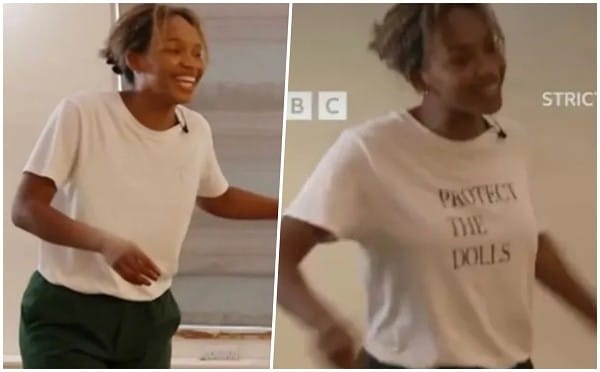
BBC again justified the censorship by pointing to the ban on political slogans and campaign branding in entertainment formats. Antonia herself softened the discussion in recent days: she wasn’t aware that the shirt referenced a charity organization, so the BBC’s move to enforce uniform rules across all participants was understandable—though Antonia also depends on the goodwill of the BBC, since she regularly appears in prominent roles for the network.
These latest interventions fit into a years-long debate about when symbols of queer visibility or solidarity run afoul of the BBC’s strict neutrality rules. The broadcaster has even gone as far as to tackle the red ribbon, a symbol of solidarity with people living with HIV/AIDS. Back in November 2013, Irish host Graham Norton and his production company received a formal warning from the BBC because Norton wore a red ribbon on the revers of his jacket in honor of World AIDS Day. The BBC’s complaints unit ultimately found that the red ribbon is not a universally approved symbol like the poppy for war remembrance. (dk)