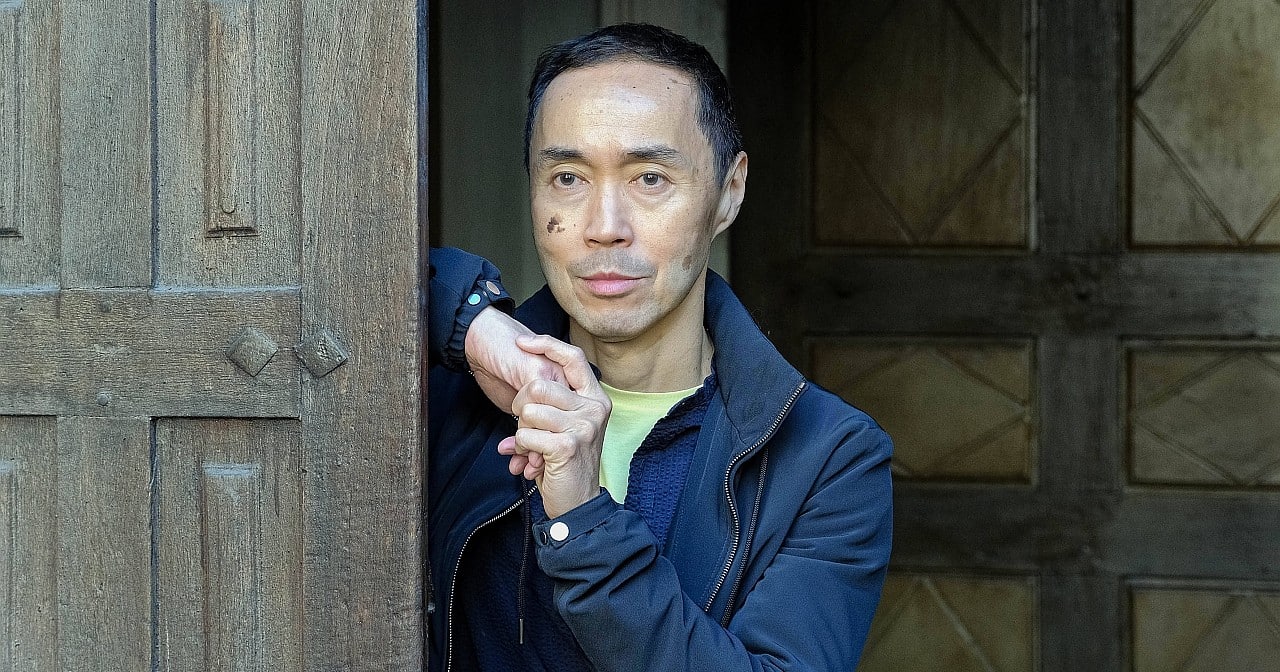
Throughout his life, Jay has repeatedly been urged to be more of a man, to sit less like a woman, even to “relearn how to breathe so as not to stand out from the others.” On a parched fruit plantation, he endures the hard, stubborn labor, even as the natural habitat fights for its survival under the drought: among the masculine bodies he sinks into himself, losing himself in the physical exertion and savoring the soothing feeling of being inconsequential. Finally blending in, finally not drawing attention, finally simply one of many.
In southern Malaysia, at the end of the 1990s, the setting of the novel The South (Amazon affiliate link) by Tash Aw unfolds, moving between family dynamics, class belonging, and a same-sex love. The orchard yields less and less. The drought shrinks the fruit until it becomes nearly unsellable. What hangs from the trees no longer suffices for what is expected of them. What once promised harvest and a future begins to dry up—and with it, the hopes of a family that must confront its past in this place.
And although the book, nominated for the Booker Prize in 2025, is geographically situated near the city-state of Singapore and clearly anchored in a specific era, its linguistic atmosphere gives it a remarkably timeless feel. Aw captures beautiful, sensuous imagery: the dried trunk of a tamarind tree, the crack of branches and wood, the overgrown and enchanted forest, toppled plants, cracked asphalt on the periphery—the only road toward the nearest small town. The landscape is more than backdrop: it crackles, buckles, decays. One can almost feel the heat on the skin, taste the dust in the air, and sense the dryness in the crevices of a world that is slowly changing.
“Forget home, there, no one takes care of you.”
Into this fabric, Jay’s family is drawn, coming to see on the ground how the grandfather’s inheritance—the land of the orchard—holds up. Jay is the youngest of five, sandwiched between two older sisters: Lina is bold and self-reliant, Yin empathetic and more withdrawn. The mother, who legally owns the land and comes from a more modest background, drifts emotionally farther away from her family.
Even the father becomes increasingly absent. As a teacher—and former teacher to the mother—he struggles in his profession: his old-fashioned methods fall flat; he’s suspended and sometimes leans toward tyrannical behavior. The family that should offer protection becomes a place of insecurity, where closeness isn’t assumed and care until sometimes feels like an unfulfilled promise: “Forget home, there no one takes care of you,” Lina tells Yin.
This five-member family encounters a father–son dynamic on the plantation: Fong and Chuan. While the nineteen-year-old son is drawn ever more toward the city, he doesn’t want to abandon his father. Between Chuan and Jay a tender yet charged love story quickly takes root. The two carve out spaces of escape, companionship, and emancipation—a miniature counterworlds to the family’s expectations, the rigid masculine norms, and the unrelenting heat of everyday life.
The Longing for a Hideaway
In his relationship with Chuan, Jay encounters the possibility of knowing himself in a different way: no longer merely a son chasing his parents’ expectations, but someone who has his own desires and the right to follow them. This love helps the protagonist detach from his parents: “but their opinion had grown as irrelevant to me as the hot, dry air: meaningless, because it never changed.”
What follows is a meditation on the dreamy introversion of the protagonist, the quiet, sometimes melancholy way of perceiving the world without surrendering to it completely. From his school days, Jay recounts an anecdote with his childhood friend Nizam that could have been his first gay experience. Where the ball lands, in the bushes, lies a sanctuary where “not even the tough guys” would dare to go. It is a hidden place “with its peculiar smell of loneliness, to the melancholy that feels like an experience shared by all who come to this place and claim it for themselves, so that I, even when I am alone, feel connected to others.” There is something extraordinarily tender in that description: the sense that loneliness does not have to mean isolation; there are places where one feels less alone precisely because others share the same longing for a hideaway.
There he encounters six or seven queer classmates who were openly labeled by teachers with slurs and subjected to harassment, with someone likely to be attacked for who they are. The narrator does not explicitly take their side, but he finds comfort in their quiet, collective presence: “Now there was an outside and an inside, and I was glad to be where I was.” It is a moment of belonging that speaks with few if any words.
Queer Desire Can Be Tender and Sensual
Nizam, however, flees from the ostracized who openly carry their identities and are shunned. Jay watches this moment with a restraint that reveals something about his own position: he finds security in the proximity of others, without yet fully declaring himself to them. Between the wish to belong and the fear of being seen, Aw illuminates a space with spare language and precise insight.
Jay’s sexual identity is already formed by the time he meets Chuan. The fact that homosexuality is illegal in Malaysia, fortunately, does not overshadow the narrative. Jay’s father Jack and Chuan’s father Fong had children with two different women, so Jay and Chuan share the same grandfather and thus are half-cousins. Incest is not the focus here.
More scenes with the lovers would have been welcome, because the author shows an extraordinary sensitivity here. They do not need to suffer in order to render their love legible; they simply must be drawn to one another, to feel near, to discover each other. It also includes that Jay finds it arousing that Chuan is a little older. This casual, unhurried normalcy is one of the novel’s strengths: queer desire does not need to be legitimized through pain, but may be curious, tender, and even lustful. It would have been wonderful if Aw had given this relationship a bit more room so we could linger with them a little longer.
Hold on to Fleeting Touches Before They Fade
The novel is, at times, a bit disorienting in its structure, shifting between perspectives. Most of the narrative unfolds through Jay’s point of view; at times a third-person narrator intrudes, and we also glimpse into the inner lives of the mother, the father, and Fong. These shifts offer different entrances into a family that rarely speaks plainly about what weighs on them. Yet the perspective changes also blur the narrative edges. Tash Aw writes with a nonjudgmental, gentle, honest language that draws readers in. He does not marshal his characters to moral judgment but lets their contradictions, their longings, and their injuries resonate between the lines. It is precisely this that animates the novel’s quiet emotional power.
What, then, remains of this love? When Jay first sits at the handlebars of the scooter that carries them over the broken asphalt toward the next town, he feels Chuan warm against him and reflects: “That’s how memory works; it is the opposite of conscious recollection, never as strong as we think, it always blurs exactly what mattered most to us.”
In that moment, what makes The South so beautiful and heartbreakingly true becomes clear: the sense that even the most intense moments will eventually fade into fragments. Perhaps that is literature’s task—to hold fast to such fleeting touches before they vanish. One can only hope that this love on the arid orchard does not fall prey to oblivion.
Tash Aw: The South. Novel. Translated from English by Pociao and Roberto de Hollanda. 288 pages. Luchterhand Literaturverlag. Munich 2026. Hardcover with dust jacket: $26. E-book: $24. ISBN 978-3-630-87832-4.