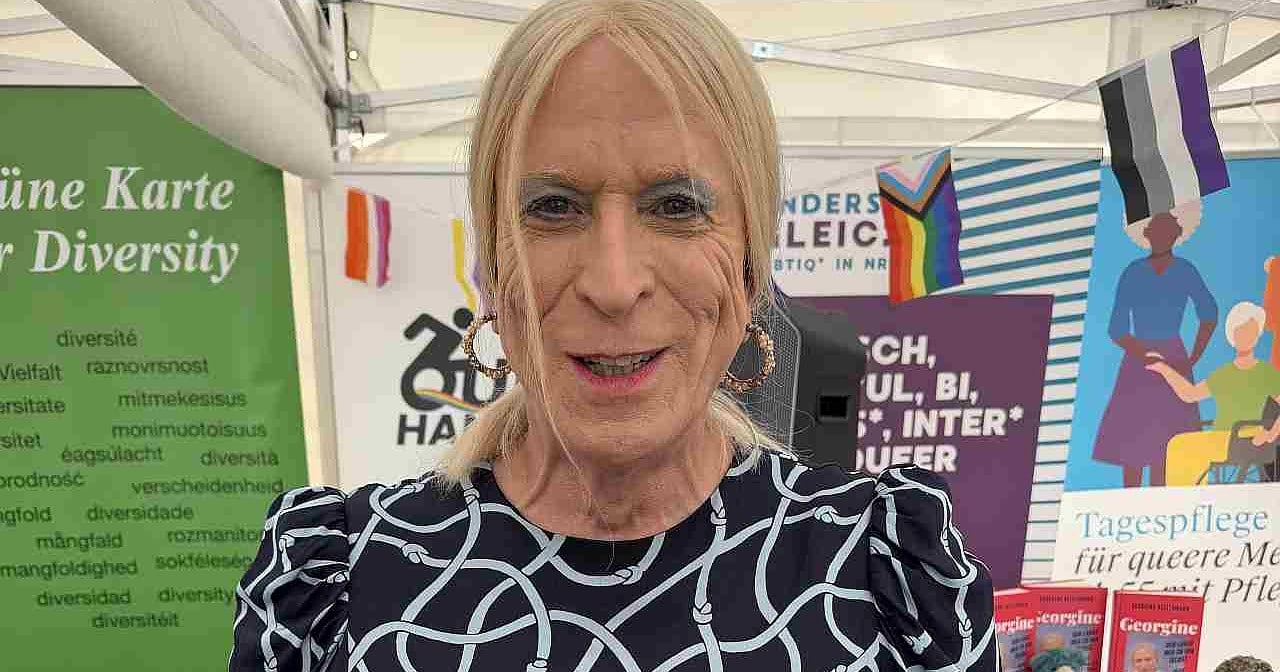
As an expert in the North Rhine-Westphalia state parliament, journalist and former ARD foreign correspondent Georgine Kellermann will also speak on Thursday about hate and hate speech online. Kellermann publicly came out as a trans woman in her 60s. She advocates for the rights and visibility of queer people.
The hearing in the Culture and Media Committee on combating digital violence begins at 3:30 p.m. In a written statement, Kellermann described the harshest insults and threats aimed at her and other people online. “For a long time, it has been important to me that Facebook and the others be held accountable,” she said. “Also because I am repelled by the inhumane tone on their platforms. They make money with every click.”
It is by no means an isolated case that investigations are dropped because those responsible cannot be traced. Authorities’ argument is often that platforms like X are based in the United States and data cannot be accessed. “I could wallpaper walls with all the orders to discontinue cases that I have received in recent years,” Kellermann said. “That sometimes takes away the courage to keep reporting insults, hate, and incitement.”
Collien Fernandes also invited as an expert
Also invited is the actress and presenter Collien Fernandes, who will share her personal experiences with digital violence and deepfakes. Fernandes has publicly accused her ex-husband Christian Ulmen for some time, as first reported by Spiegel. She accuses him, in addition to physical assaults, of creating fake profiles in her name and distributing pornographic depictions through them. Her allegations sparked a broad debate about sexualized violence on the internet and demonstrations in several German cities. The presumption of innocence applies to Ulmen.
Fernandes is coming at the invitation of the opposition SPD, which is lamenting a new level of digital violence in light of the rapid development of Artificial Intelligence (AI). “I think it is really important to talk with those affected, and not just about them,” Fernandes told dpa. “We are dealing with an enormously growing problem that has been politically ignored for far too long.” Digital violence leads to real pain. “It primarily confines women, causes them to retreat from the net, and to limit their online activities.”
SPD criticizes protection gaps
The federal government has since responded to the current situation. Federal Justice Minister Stefanie Hubig (SPD) is drafting a law that would criminalize the creation and dissemination of sexualized deepfakes.
In NRW, the SPD opposition in the state parliament acknowledges that the governing coalition (the black-green state government) is already pursuing several approaches to combat digital violence. Nonetheless, there are still protection gaps. Among other things, the SPD is calling for the establishment of a child- and youth-friendly online police unit, the appointment of a designated official for combating digital violence in NRW, and a dedicated “Digital Violence” prosecution office for the state.
Cybercrime office wants a stronger role
Representatives from the State Office for Media, the organization Hate Aid, and the Central and Contact Point for Cybercrime (ZAC) NRW at the Cologne public prosecutor’s office were also invited to the hearing. The Cybercrime Office advocates strengthening its role by a measured expansion of its responsibilities in the fight against digital violence.
The English term “deepfake” refers to manipulated image or audio files created with the help of artificial intelligence (AI). Photos, videos, or sounds are meant to look authentic, but depict people in situations in which they were never actually in. According to investigators, these depictions mostly involve sexually explicit portrayals of women. The distribution of these depictions has not been sufficiently criminalized, according to the Cybercrime Office.