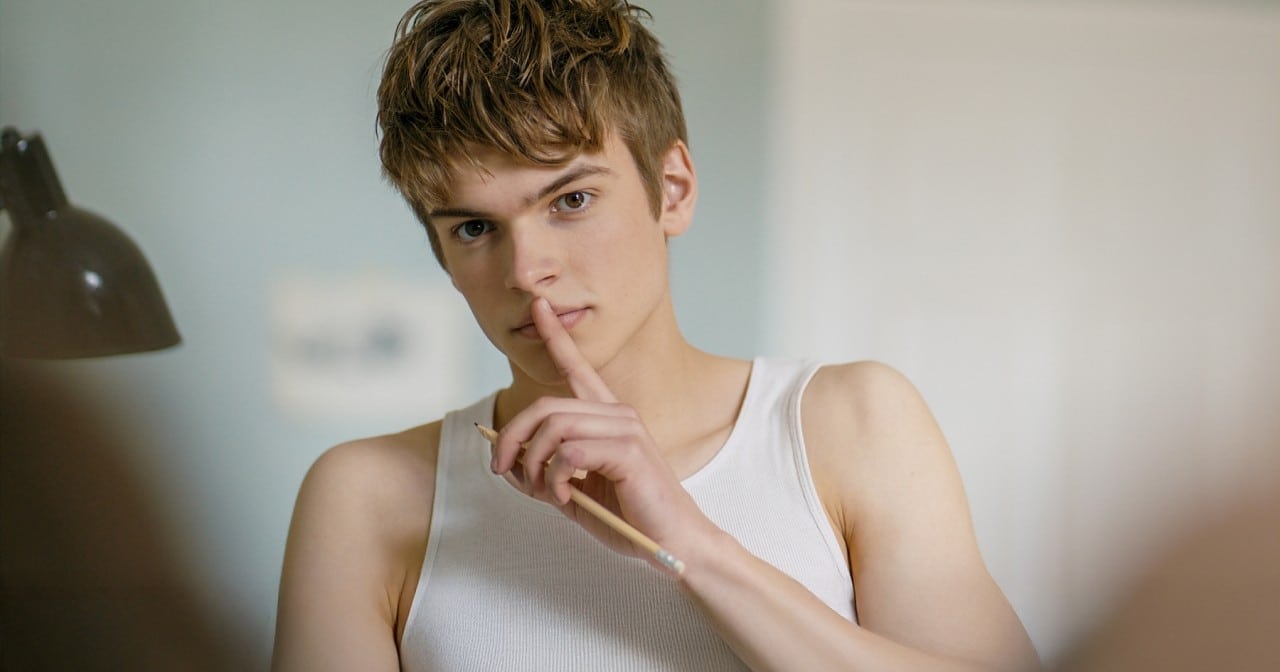
Two teenagers fall in love with each other in the countryside and only gradually realize that they are brothers: Max Hegewald’s drama “Free at Heart” tackles one of society’s biggest taboos (film review by Fabian Schäfer). The film screens in October at Queer Film Night and opens in theaters on October 29.
One of the two lead roles is played by Aurel Klug, who became known as the gay footballer Leo Neubach in the ARD soap “Sturm der Liebe” (TheColu.mn reported). At eleven, Klug first appeared on stage in a leading role at Jungen Theater Bonn as Krümel in “Die Brüder Löwenherz” (The Brothers Lionheart). He is currently developing a new stage adaptation of Morton Rhue’s “Die Welle” with the director and other young talents. In cinema, he has also appeared in “Catweazle” and “Trübe Wolken.”
In the interview, Klug talks about the differences between soap operas and feature films, intimate scenes on set, and the question of who should play queer roles.
Mr. Klug, how did audiences react to your portrayal of the gay footballer Leo, who comes out on the series “Sturm der Liebe”?
For me personally the reactions were mostly positive. At first, there were indeed mixed opinions about the character because Leo had a difficult start. He arrives as a teenager from Australia in a small village and has to navigate a completely new environment. Many viewers weren’t sure how to categorize him at first. It was all the more gratifying that the reactions to his coming out later were very enthusiastic.
In “Free at Heart” you play another gay teenager. Is that just a coincidence?
For me these are two completely different characters. Of course, from the outside one could say both are homosexual, but that’s where the similarities end. Leo deals a lot with his own sexuality and his coming out in “Sturm der Liebe.” In “Free at Heart” the focus is much more on the love between two people and not on which gender they are. The life circumstances and characters are also clearly different. Therefore I actually see this character overlap as coincidence.
In a feature film you have more freedom than in a daily series with its tight production rhythm. Is this impression misleading?
The working environment is indeed different, but both formats are hard to compare. In a daily series you generate much more material per shooting day, while a feature film allows significantly more time for individual scenes. At the same time, a series often works with a team that has been together for many years, whereas a film crew finds its rhythm gradually during filming. Both formats have their own demands. I learned a lot in both projects and wouldn’t prefer one over the other.
What specifically drew you to your character in “Free at Heart”?
From the first read of the screenplay, I felt the story was told in a cohesive way. Even though I hadn’t formed concrete thoughts about the character yet, I could identify with the characters in different ways. That is what makes acting exciting for me. You get to portray people and emotions you might never encounter in your own life. Being part of such a story for the duration of a film is something truly special.
Do you need commonalities with a role to play it convincingly?
For me, that is not a prerequisite. Of course, every actor brings a piece of their own personality and way of speaking to a character. At the same time, a role comes to life in collaboration with the director and production and develops far beyond what is written on the page. This creative process is what makes the craft appealing to me. Most importantly, you must be willing to open yourself to another person.
In “Free at Heart” there are intimate scenes. How important is an intimacy coordinator on set?
Throughout the shoot I felt comfortable. The team was exceptionally respectful and understanding, which is crucial for intimate scenes. The intimacy coordinator was a valuable support, because you can discuss boundaries, ideas, and procedures calmly together. This creates additional safety and trust. But what remains decisive for me is always the respectful conduct of everyone on set.
Direct link | Official trailer for the film
|
What quality is most important for actors?
That’s hard to answer because every actor brings their own unique strengths. That individuality is what makes the profession so special to me. I don’t see auditions as a straightforward competition; everyone interprets a role in their own way and brings something to the table that no one else can replace. That diversity is, in my view, one of the greatest strengths of acting.
There is a push to cast queer roles exclusively with queer actors. How do you see that?
I think it’s wonderful that acting lives on the freedom to portray a wide range of characters. That is a significant part of the profession for me. At the same time, I don’t want to pretend I know whether this debate is finished or not. I can only say I’m grateful to have the opportunity to play this role and tell this story.
What should audiences expect from “Free at Heart”?
It’s probably not a traditional date-night movie. The film tackles a topic that many people rarely discuss in everyday life and tells it in a very emotional and profound way. At the same time, the story is coherent and atmospheric. There are breathtaking natural images and beautiful music. I believe the film will touch many viewers.
What comes next for you after “Free at Heart”?
I’ve worked on series for Sat.1 and ARD. A new 90-minute project is also in the works. I’m very excited to continue my path as an actor and curious about what the future holds.
Free at Heart. Drama. Germany 2025. Director: Max Hegewald. Cast: Linus Moog, Aurel Klug, Marlene Strawe, Leon Ndiaye, Oli Bigalke, Annika Kuhl, Marie Becker, Karen Dahmen, Yvonne Werner-Mess, Matthieu Svetchine, Ferdinand Lehmann, Bernd Panzer, Leonie Weber, Denis Lenz, Elias Ulnyrow. Runtime: 115 minutes. Language: German original version. Age rating: FSK 16. Distributor: Salzgeber. Theatrical release: October 29, 2026. Earlier this month, the film also screens at Queer Film Night.


Free at Heart
10 Photos