The C/O Berlin exhibition house presents a retrospective of photographer Carrie Mae Weems. The show comprises more than a hundred photographs and marks the first major presentation of her work in the city. It offers a cross-section from all phases of the career of the 73-year-old African American artist under the title “The Heart of the Matter” (originally a project of the Galleria d’Italia and curated by Sarah Hermanson-Meister).
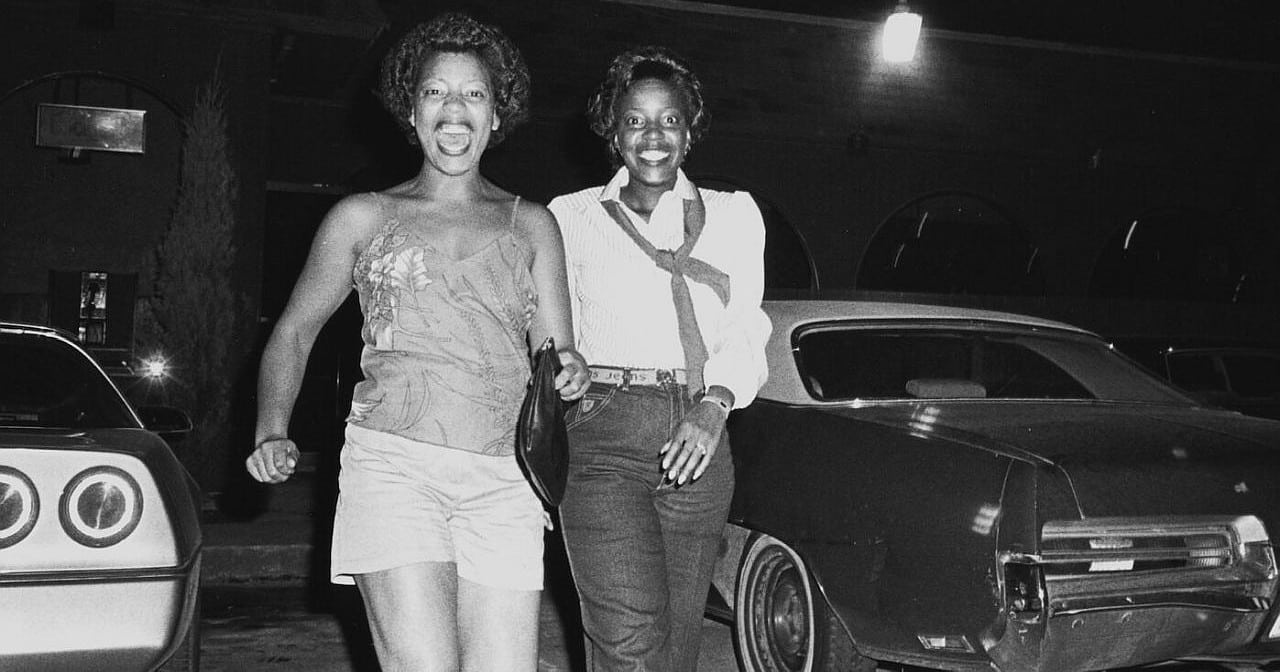
Weems is undoubtedly among the most significant American photographers of our time. Her series focus on questions of identity and document everyday life under racist conditions; they describe gender relations with a clear feminist perspective on stereotypes and expectations, on power dynamics and dependencies.
She uses the medium of staging and tends to work in series. Weems has not only explored how photographs have historically been used to write history by employing archival images, but in her own work she repeatedly tells stories and rightly deserves to be recognized among contemporary photographers as an expert in “storytelling.”
Everyday Scenes at the Kitchen Table
She was born in 1953 in Portland, Oregon. She studied photography and design at City College of San Francisco and took courses at the Studio Museum in Harlem. She grew up in an era shaped by the civil rights movement and the fight against racial segregation in the United States. The ensuing Black Cultural Revolution demanded that artists take a stand. Weems’s response from the outset was anti-dogmatic and leaned into individuality, and thus equally decisively toward liberation.
In this spirit, the body of work created between 1978 and 1984, the “Family Pictures and Stories” series, should be understood. The family is indeed a private space, yet it cannot be interpreted in isolation from the outside world and the societal conditions in which it exists. Cultural identities are never merely personal; they are political. With the family photos that Weems staged in everyday moments with her parents, the thread that would run through her entire career was tied: a politicized view of the private sphere. In doing so, she presents the family as a “microcosm” of one’s own position in the world.
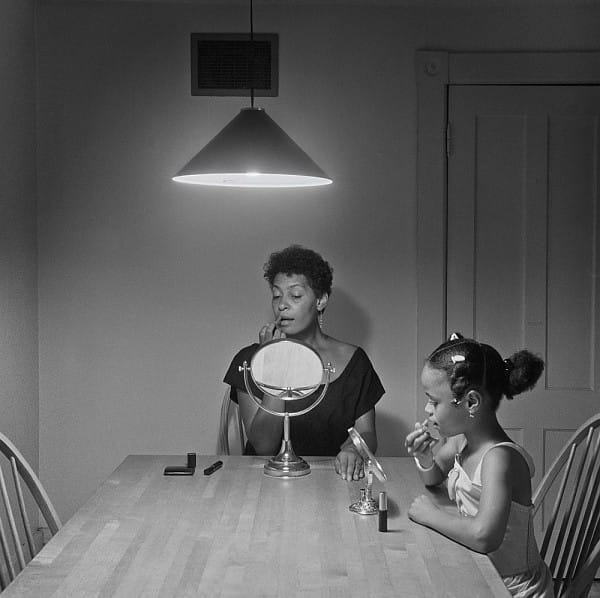
Of Particular Quality: The 1990 Series “Kitchen Table”
These large-format, atmospherically dense photographs are difficult to overstate in their iconic status. They possess an almost unbeatable conciseness, and like many of Weems’s photographs, they are black-and-white. At a kitchen table, the artist staged scenes from a marriage, where the man and woman contend with their “Love Business” more or less ineptly. Added to this is the element of family and the mother-child relationships. The performative aspect in these images makes them literally speaking pictures. To convey gender relationships, words are unnecessary; attitudes, gestures, and glances alone reveal everything.
A Pioneer with Multiple Honors
As a Black artist, she has written her own history through her career. She was, for instance, the first Black woman to receive a retrospective at the renowned Guggenheim Museum in New York City (this gigantic hatbox on Fifth Avenue) in 2014—a milestone she noted as having come “truly late.” She has received numerous awards. She was also the first Black artist to be awarded the National Medal of Arts by President Joe Biden. And in 2020 she was named Artist-in-Residence at Syracuse University in New York for several years.
Weems herself commented on these honors rather matter-of-factly, saying, “I never think I’m doing something important. I simply feel that I must work on things that matter to me, that inspire me, that uplift and sustain me.” Admittedly, that sounds like a modest assessment. What mattered throughout her career was that her own inspiration carried an infectious quality, translating inspiration into thoughtful reflection for the viewer.
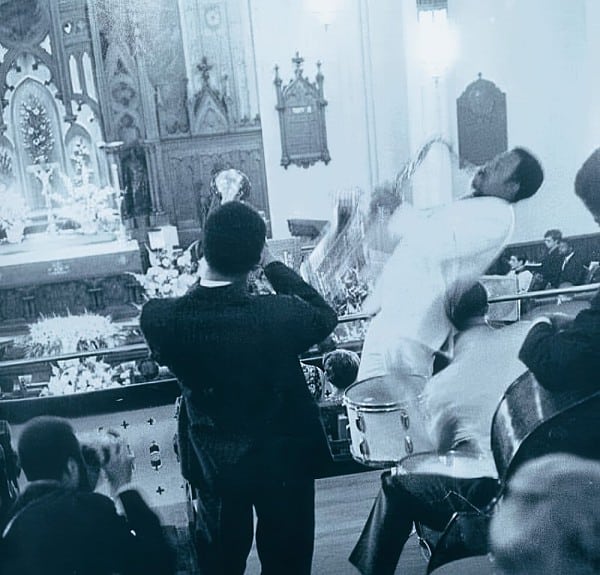
Without attempting to cover the full thematic breadth of the show, the series “Preach” should be mentioned for the insights it provides into Black religious communities that stand not only for spirituality but also, in their history, for resistance to racist oppression. In addition to all the black-and-white photographs in the exhibition, one is struck by large-format color photographs from the series “Painting the Town,” which look as if they could be paintings by abstract expressionists. We see sequences of color blocks that, in their aesthetics, recall painting, while the image captions tell us a different story: they are the wooden storefronts that protected themselves from looting during the Portland unrest connected to the Black Lives Matter protests.
The exhibition runs until February 3, 2027 and is housed in the former Amerikahaus on Hardenbergstraße, right next to the Zoologischer Garten station, open daily from 11 a.m. to 8 p.m.