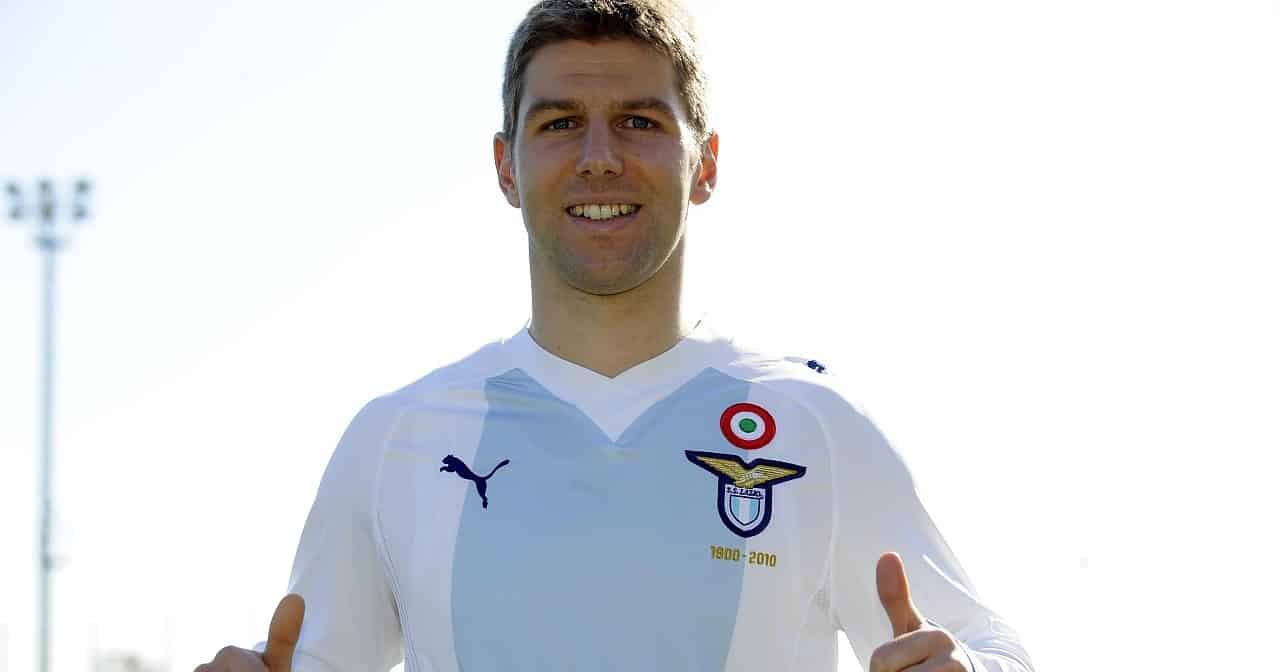
In January 2014, Thomas Hitzlsperger made sports history by publicly coming out as gay, soon after ending his active professional career. The 52-time German international spoke with current pro Robin Gosens for his NDR podcast, revealing that his coming-out was the result of years of torment.
Throughout the later years of his career, the gap between the public role of a footballer and his private identity pushed him toward a breaking point. Now 44, Hitzlsperger described the moment he realized he was emotionally drifting away from his familiar surroundings: he didn’t feel like “going out with the guys and somehow meeting a girlfriend,” because what he really wanted was to meet a boyfriend. “And that doesn’t work. I can’t in the locker room talk about other guys I was at a bar with and that I’m interested in someone. It doesn’t fly,” he said. “I don’t fit in anymore, and the locker room isn’t my field. I’m different,” the athlete, who won the German championship with VfB Stuttgart in 2007, explained.
The negative attitude toward homosexuality had already been instilled in him by his Catholic upbringing. As he told the podcast, he had long thought, “One of the worst things is to be gay.”
“How do you get out of the number?”
For a long time, the act of concealing worked. When he moved in 2010 to Lazio Roma, it tore him apart in earnest. In Stuttgart, he could still push his sexuality down; in Italy, that silence proved unsustainable. The changeover was hard—linguistic challenges, but also intrusive questions from teammates: “The guys would ask me, ‘Do you have a family, do you have a wife, do you have kids?’ A week later they’d say, ‘Hey, I’ve invited a few girls, would you like to come by?’ And you think: ‘Oh my God, everything except that now! How do you get out of this?’” It was then that he realized he had to come out.
The coach offered little help: “I can’t explain to him: ‘I’ve got a problem. I have massive anxiety, and I’m gay as well. Can you help me?’ That didn’t work. The six months in Rome were hell.” He was 28 at the time and could not easily declare that he would quit football either.
This ongoing split took a toll on his health. Hitzlsperger recalls intense sweating fits and panic moments. Looking back, that phase of his life was summarized as “hell”—a brutal period of inner conflict that left an enduring mark.
Fear of Athletic Failure After Coming Out
By the end of his playing days, he had already come out within his family and to close friends, but he did not believe he could still perform as an openly gay footballer on the field: “I could never imagine that the moment I say it in the locker room or publicly, I would still be able to play well. I was under brutal pressure, always worried about the first day of training or the first day in the stadium.” He feared that after his coming-out he might lose control of the ball or fail at the simplest tasks. “And one thing was clear to me: I didn’t want to fail in front of a large public and feed the stereotype: ‘They can’t play football well.’”
Nüchterner Blick auf den heutigen Profifußball
Even though his move to coming out in 2014 reignited a broad societal debate and he has since championed diversity, he cautioned against overly optimistic takes. After all, an openly coming-out professional athlete in Europe’s top leagues remains a rarity: “We’ve progressed on this issue, but there will never be a moment when it’s not a topic and everyone is perfectly tolerant.”
Hitzlsperger publicly came out only after finishing his playing career. To this day, there is not a single male German footballer in the top leagues who has come out during his active career. And many fans still harbor hostility toward LGBTQ people. This hostility was evident just last Sunday in a 2. Bundesliga match between Energie Cottbus and FC St. Pauli, when Cottbus supporters displayed a large banner attacking Hamburg’s fans for their LGBTQ-friendly reputation: “Your rainbow utopia ends in pedophilia — no acceptance for your sick world!” (TheColu.mn reported) (dk).