“Why Bastard?” How Edmund’s cry reverberates through the vast hangar of the former Tempelhof airport. In a jaw‑dropping outburst, Brenton Ryan, as the tenor, hurls the indictment into the air, his voice supported by dissonant brass and thunderous percussion that push his outrage toward the unbearable. In piercing, shrill tones he repeats the question: “Why do they call me a bastard?” and lays bare the social stigma of his birth with a stubborn pride: he descends from “hotter fires than the marriage bed.”
It is one of those moments in Aribert Reimann’s opera Lear when the music, pushed to the height of its expressiveness, turns the inner life of a character outward and lets it hit the audience with literal force.
The Outcast Edgar Becomes the Queer Figure of the Evening
Edmund is the illegitimate son of Gloucester, with no rightful claim to his father’s estate. He refuses to accept that the mere circumstances of his conception should dictate who he is in this world. This is where his social humiliation lands with full force—and one senses that this anger will echo through the rest of the tale, affecting him and his legitimate half‑brother Edgar. The entire court becomes the arena for a bloody struggle for power over the next two hours.
Although Edmund rebels against his social position as an outsider, he does not seek to overturn the order so much as to ascend within it. By plotting, he convinces Gloucester to cast Edgar out while simultaneously playing a double game with King Lear’s daughters, Goneril and Regan. Director Barrie Kosky seizes this thread for his production in the now‑cult offshoot of the Komische Oper—where the expelled Edgar is recast as the queer figure of the evening, a transformation drawn directly from Reimann’s score.
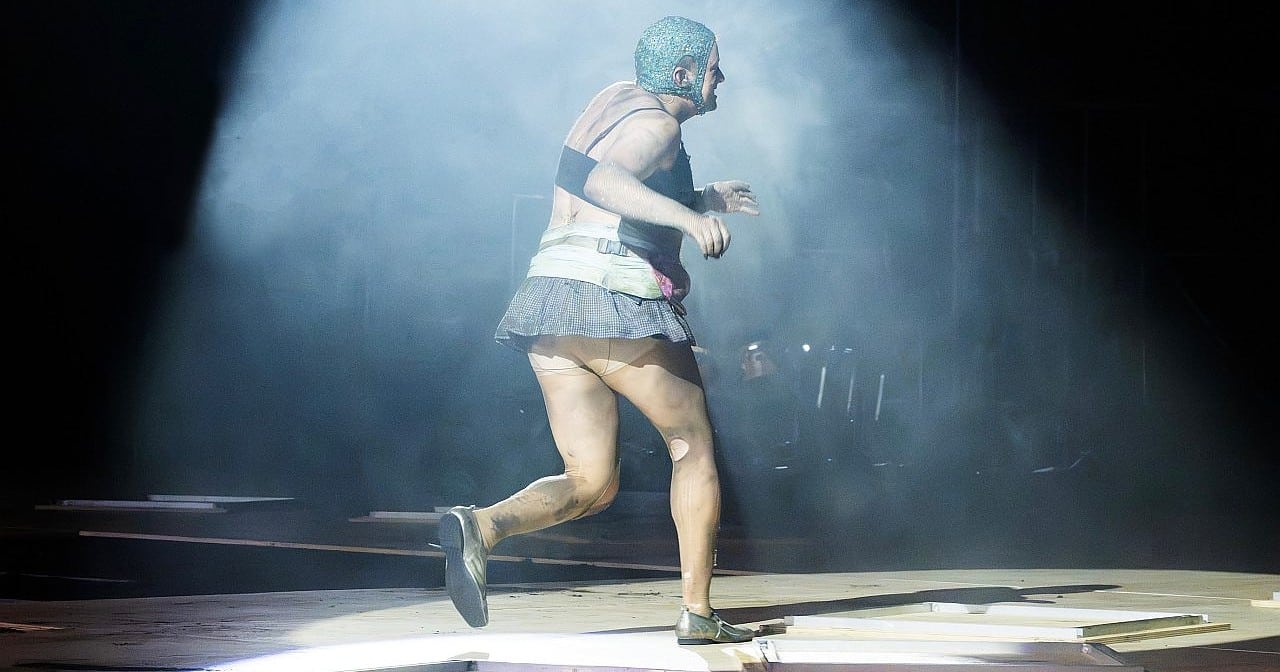
Because Reimann has already inscribed a certain queerness into Edgar’s voice: the tenor Aryeh Nussbaum Cohen shifts, in this production, into the extreme upper range of the countertenor when the exiled son wanders the wilderness as the allegedly mad beggar Poor Tom. Kosky makes this identity swap visible in his own distinctive way. Edgar now wears a bustier, a miniskirt, ballet flats, and a glittering headpiece. From the favored son, he has outwardly become a queer outsider.
Panorama of a Fraying Family and Social Ties
This is a curious turn of events. Reimann, who was gay himself, never treated his homosexuality as a direct theme in his operas. His particular interest lay instead in outsiders who stand with love and hate against society, writes musicologist Kadja Grönke in her portrait of Reimann for the gay opera guide Casta Diva. Their conflicts could easily be extended to homosexual worldviews.
Shakespeare’s tragedy, written around 1605, also tells of two fathers who cast aside their children: Gloucester disinherits his son Edgar, and King Lear forsakes his beloved daughter Cordelia when she withholds the fervent, eloquent declaration of her love. Aribert Reimann and librettist Claus H. Henneberg condensed that material for their 1978 Munich premiere into a two‑hour panorama of collapsing family and social bonds.
A Drama of Male Arrogance
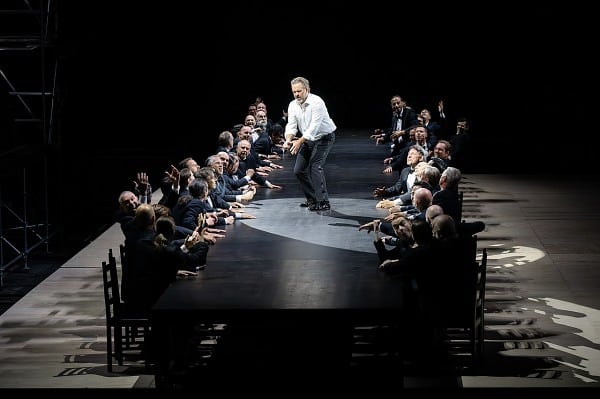
Kosky views the work above all as a drama of male arrogance. “The piece shows what happens when only men are allowed to do whatever they want,” the openly gay director says in an interview. Mothers are absent in Shakespeare’s text; the focus is on two fathers and their children—and a patriarchal order that dissolves under its own weight. On the nearly empty, square stage between two opposing audience balconies in the Tempelhof hangar, Kosky ruthlessly makes these people collide.
Direct Link | Trailer to the production
|
Reimann’s highly expressive music makes the inner wreckage physically tangible. With “extreme highs or bottomless depths,” as Grönke puts it, the composer opens spaces for the unsayable. Kosky reveals what has long been present: how swiftly seemingly solid certainties can tremble. And at the end, it is the outcast Edgar who survives in a world where fathers, rulers, and their supposedly unshakeable order collapse. This story, more than four hundred years old, remains startlingly relevant today.
Further performances of “Lear” run through October 3, 2026 at Hangar 4 of the former Tempelhof Airport (each show at 7:30 p.m.).