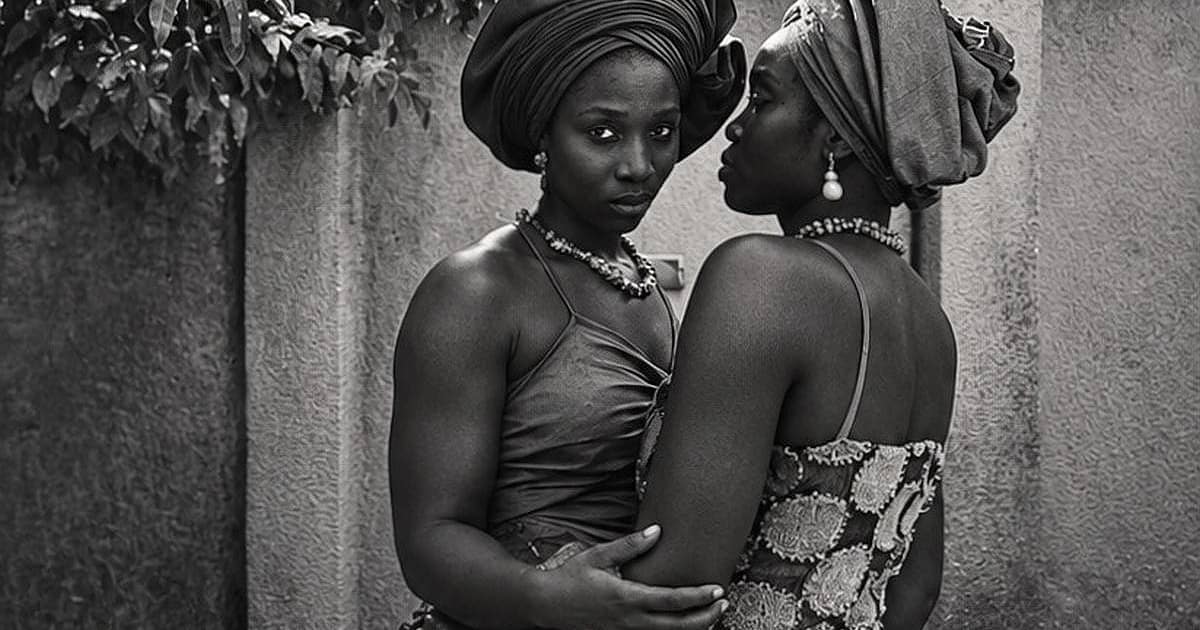
Men who tenderly nestle into one another, and women in traditional West African clothing who lean in with desire: the photographs by Rachel Seidu at first glance do not read as staged, as you might expect from classic portraits — rather, they convey the impression of deeply private moments. Yet many of the people depicted look confidently into the camera.
The depicted intimacy and tenderness feel so natural that one would not guess the personal risk behind these images.
How great the danger is, the Lagos-born photographer, born in 1997, explains in a conversation with Wolfgang Tillmans that can be read in the accompanying booklet of the exhibition. Seidu says that in Nigeria there are repeated cases of harassment and violence against queer people. She recounts a 16-year-old who was beaten to death by fellow students because they suspected he was gay, and a man who was thrown from a three-story building by homophobic men.
The state also criminalizes queer life: same-sex sexual acts and lifecouples are illegal in Nigeria, as are gay and lesbian associations and gatherings.
“Nigeria is one of the queerest places you can encounter”
The introductory text to the exhibition by Nigerian author and scholar Adebayo Quadry-Adekanbi initially gives the impression that queerness in Nigerian society is already deeply rooted. His text, also printed in the accompanying booklet, begins with the surprising sentence: “Nigeria is one of the queerest places you can encounter.” However, queerness there is “something you do, not something you are.”
Quadry-Adekanbi describes a society in which queerness exists even where it is not explicitly named. In the densely populated “Face-Me-I-Face-You” housing complexes, where low-income families inhabit single rooms and share kitchens and bathrooms, a special form of “an open secret” arises. People sense the queerness of others without demanding explicit confirmation. Queerness is therefore less an identity to be claimed than a “lived, material practice.” This creates “room for an alternative intimacy” that does not need to be named or categorized.
What Westerners might call “Drag” also happens in Nigeria “constantly, in masquerade plays, performances and numerous cultural, traditional and spiritual practices,” Quadry-Adekanbi says. “We are constantly wearing ‘Drag.’ We just don’t call it that — and we don’t need to.”
Acceptance with Boundaries
Seidu knows this world from personal experience. She grew up in one of these housing complexes. Her memories of the spatial conditions largely align with Quadry-Adekanbi’s descriptions, but her assessment of the situation sounds entirely different. More than 50 people lived there, she says in the interview; bathrooms and toilets were shared, you had to queue for a shower. She herself did not even own a bed and slept on the floor.
The story of two gay friends from her childhood also casts the idea of a queerness that does not require explicit naming in a different light. While the two did not have to hide their femininity — at the annual Street Jams they danced publicly, were cheered, and showered with banknotes — “Well, that’s how they are,” people would say. Yet this acceptance had—and still has—a boundary.
“You can be feminine, but the moment you say you are gay, the problem begins,” Seidu says. “A sexuality is not allowed for them.” They are expected to eventually outgrow this supposed phase and do the “right” thing: marry a woman.
Thus naming carries a double meaning. For Quadry-Adekanbi, it appears as a pathway to an independent cultural form of queerness that does not rely on Western identity categories. For Seidu, it reveals the price of that ambiguity: tolerance extends only to what appears feminine or queer, so long as homosexual desire remains unspoken and can be denied—and eventually yields to a heterosexual marriage.
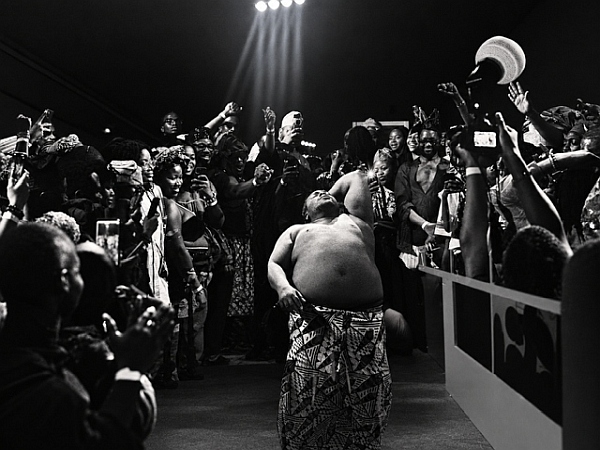
Self-Assured Subculture, Carving Out Its Own Spaces
Queerness in Lagos is by no means invisible, as Seidu’s photographs demonstrate. In addition to still portraits and intimate scenes, she also captures the city’s nightlife. Images of drag balls reveal a self-assured subculture that has created its own spaces—with fashion, performance, and dance.
Seidu knew this world even before she herself became part of the scene. The two feminine friends from her childhood attended gay parties; dressed up and with handbags, they would pass the food stand of their stepmother on the way there. Such memories sketch a more layered picture of a country where queer life is by no means only hidden.
Yet between a queer party in the nocturnal subculture of a megacity and a rainbow flag at one of Lagos’s busiest locations lies a crucial difference. With her ongoing project “This land knows us,” Seidu moves beyond the protected or coded spaces of the community and explicitly seeks the public eye.
The shoots take place on bridges, at bus stations, on boats and other busy sites. Some of the portrayed individuals carry the rainbow flag. For the first time, Seidu says, the project approaches a public coming out. For safety reasons, the group never stays at a location longer than 30 minutes.
Visibility on the Street
That visibility happening on the streets of Nigeria is decisive for Seidu. In the conversation, she points to Rotimi Fani-Kayode, a Lagos-born photographer born in 1955, whose sensual, staged depictions of the Black male body rank among the most important early examples of gay photography with Nigerian connections. Fani-Kayode had lived outside Nigeria since his youth and created his work primarily in Britain.
Queer people, she notes, are “still not adequately represented on the streets of Nigeria.” Her own images place members of the community not only as part of Nigeria but visibly in public spaces.
“This land knows us” is the still-unfinished project that forms a central part of the exhibition “Love is the Work” at “Between Bridges” — the Berlin project space founded by Wolfgang Tillmans, which for years has brought together art and sociopolitical debates. The title also expresses Seidu’s aim: against the notion that queer identity is something imported from the West, she asserts the belonging of queer people to Nigeria.
The queer community needs a strong journalistic voice — now more than ever! Do your part to support TheColu.mn’s work.
“Happy Pride, folks!”
At the rainbow flag, this tension is particularly evident. Quadry-Adekanbi reminds us that the symbol “carried a story at a certain place and time before it arrived in Nigeria.” It was already rich in meaning and “never created for this context.” He asks whether the demand for visibility should rely on a borrowed symbol or whether its use might obscure subtler local forms of queerness.
Seidu’s answer could hardly be clearer: “In Nigeria the flag does not have the same meaning as in New York or Paris.”
This very difference is crucial for Seidu. In Berlin, Paris, or New York the rainbow flag is already part of institutional representation and commercial Pride campaigns, a publicly visible sign; in Lagos it carries a completely different weight.
That the flag is nonetheless understood, Seidu experiences during a shoot. A teenage girl shouts to the group, “Happy Pride, folks!” Seidu recalls how emotional that moment was for everyone involved. The teenager had recognized the symbol — and understood.
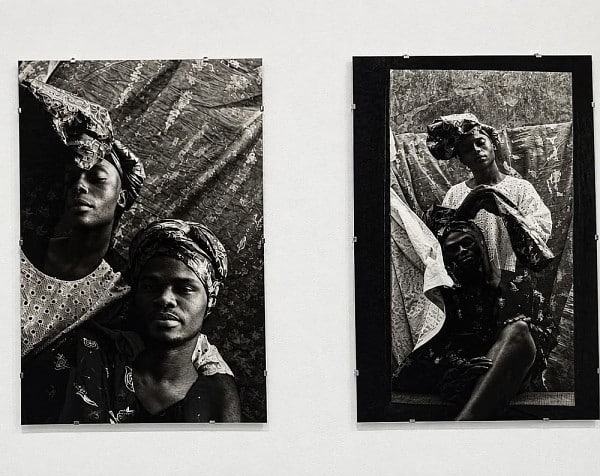
We Are Queer. We Belong to Nigeria
Perhaps this already offers an answer to the objection that the flag is a Western import: a symbol can change its meaning without losing its readability. The rainbow flag is of Western origin, yet in Seidu’s images it carries a distinctly Nigerian claim: We are queer. We belong to Nigeria.
In this lies something that one might call a queer universalism. It does not imply that queerness must look the same everywhere or be described with the same terms. Rather, it asserts the right of people everywhere to live their sexuality and gender identity openly, without fear of violence or exclusion.
Seidu’s photographs do not seek to resolve this conflict. Their strength lies in making it visible. They show a confidently present queer culture that has long existed — precisely for this reason, “Love is the Work” is such a courageous exhibition.